Best AI Tools for Ad Audience Research
Want to know what your audience really wants? Explore the best AI tools for ad audience research to uncover customer insights, spot trends, study competitors, and create smarter ad campaigns.

AI tools for ad audience research help marketers turn scattered data into clear buyer insights. They study search trends, social media posts, customer reviews, website activity, and past campaign results.
This helps teams understand what people want, what concerns them, and what matters most when they buy. Marketers can find high-intent audiences, build better customer profiles, and use language that feels natural to buyers.
These insights also make it easier to create stronger ads, test new ideas, and avoid wasting money on the wrong audience. Instead of relying on guesswork, brands can use real data.
Best AI Tools for Ad Audience Research Comparison
The following AI tools help marketers research audiences, understand customer behavior, analyze competitors, identify trends, and turn audience insights into better advertising strategies.
| AI Tool | Best For | Key Features | Drawbacks |
|---|---|---|---|
| Brandwatch Consumer Research | Social listening and audience research | Online conversation analysis, audience groups, sentiment analysis, trend discovery, Social Panels, dashboards and alerts | Requires strong queries, filters, and human review; data coverage varies by market and platform |
| Semrush Advertising Research | Competitor PPC and search demand research | Paid keywords, ad copy, ad positions, traffic estimates, spending signals, landing pages, historical ads | Works best when competitors have visible paid activity; PPC metrics can be confusing for new users |
| AdSpyder | Multi-platform ad intelligence | Ad research, competitor tracking, audience grouping, creative analysis, funnels, keyword research, ad generation | Ad data and spend signals are estimates; advanced features require higher plans |
| Ryze AI | Paid-ad research and campaign management | Competitor ad research, audience insights, campaign analysis, creative optimization, budget and ad-set recommendations | Requires connected ad accounts and good conversion tracking; automated changes need review |
| Perplexity AI | Fast audience and market research | Live web search, research mode, source links, buyer research, competitor research, file analysis | Does not replace surveys, interviews, CRM data, or platform-level ad data |
| Hootsuite Insights | Social listening and audience insights | Social listening, demographics, interests, sentiment, emotions, topics, competitor monitoring, AI summaries | Does not replace first-party or ad-platform audience data; advanced functions may be excessive for small teams |
| Anyword | Audience-focused ad copy and messaging | Audience profiles, predictive performance scores, campaign data, content creation, brand voice, benchmarking | Performance scores are predictions; strong insights require enough clean historical data |
| Brand24 | Social listening and audience sentiment | Brand monitoring, sentiment analysis, trends, audience interests, demographics, location and creator insights | AI can miss sarcasm and context; demographic data is inferred |
| ChatGPT (GPT-4o) | Audience analysis and customer persona research | Customer research, persona creation, data analysis, image analysis, audience segmentation, ad hooks and creative briefs | May miss local context or recent market shifts; sensitive data requires careful handling |
| Meta Advantage+ | AI-powered audience targeting for Meta ads | Audience expansion, conversion signals, customer lists, targeting optimization, placement and budget optimization | Weak conversion data can reduce optimization quality; expansion may not suit narrow audiences |
Brandwatch Consumer Research
Best for: Social listening and audience research
Brandwatch Consumer Research is an enterprise AI tool that helps businesses understand their audiences through public online conversations. It shows who people are, what they care about, what they need, and how they feel.
Teams can use it to build audience groups, identify trends, test advertising ideas, and monitor competitors. The platform collects data from more than 100 million online sources and uses AI to identify topics, sentiment, brands, people, and emerging trends.
Its Social Panels feature also allows businesses to study specific audience groups and niche communities. This helps marketers make better decisions based on real conversations.
Pros
- Uses a very large archive of online discussion, which helps with trend and audience discovery
- AI can tag brands, places, people, hashtags, and emojis in large result sets
- Supports flexible dashboards, alerts, segmentation, and shareable reports for media and research teams
Cons
- Strong results need good Boolean queries, careful filters, and human review of AI labels
- Access, data depth, and source coverage can vary by market, platform rules, and contract
Pricing
| Plan | Pricing |
|---|---|
| Request for Pricing (RFP) | Request for Pricing |
Semrush Advertising Research
Best for: Competitor PPC and search demand research
Semrush Advertising Research is a competitive PPC intelligence tool that helps marketers understand search demand and competitor strategies. It shows competitors’ paid keywords, ad positions, ad copy, traffic estimates, spending, and landing pages.
You can also review past ads and see how campaigns have changed over time, with data going back to 2012. The tool helps identify common keywords, competing websites, audience interests, and gaps in the market. It is useful for finding demand themes, testing message ideas, and planning campaigns.
However, it is not an audience panel and does not provide verified demographics or first-party customer data.
Pros
- Compare rivals’ keywords, ads, spend signals, and landing pages in one workflow
- Historical ads help separate short tests from lasting campaign themes
- Ad-copy analysis can inspire clearer angles, calls to action, and offers
Cons
- It works best when competitors have enough visible paid activity
- PPC metrics and keyword overlap can confuse new users
Pricing
| Plan | Pricing |
|---|---|
| Request for Pricing (RFP) | Request for Pricing |
AdSpyder
Best for: Multi-platform ad intelligence
AdSpyder is an AI-powered ad intelligence tool that helps marketers research audiences and competitors. It lets you search and track ads across platforms such as Google, Meta, LinkedIn, YouTube, Amazon, TikTok, X, and Bing.
You can study brands, keywords, landing pages, creatives, offers, and targeting signals to understand what may work for a similar audience. Its AI tools help group audiences, spot ad trends, score creatives, and generate text, images, and videos.
You can also analyse funnels and domains, monitor competitor ads, and connect ad accounts on higher plans. This makes AdSpyder useful for market research, campaign planning.
Pros
- Brings ad research, creative analysis, and generation into one tool
- Covers several paid-media channels, not just Meta ads
- Helps connect competitor ads with keywords and landing pages
Cons
- Ad data and spend signals are estimates, not direct access to a rival’s true results
- The best tools, such as unlimited search and automation, need the top plan
Pricing
| Plan | Pricing |
|---|---|
| Spy | $10/month |
| Spy + Analytics + Generation | $20/month |
| All in One | $30/month |
| All in One + Brand Protection | $99/month |
Ryze AI
Best for: Paid-ad research and campaign management
Ryze AI is an AI copilot for paid-ad research and campaign management. It connects with platforms like Google Ads, Meta, TikTok, LinkedIn, Microsoft Ads, and analytics tools.
It studies campaign data to find useful audience segments and reviews competitor ads through the Meta Ad Library, including their formats, copy, and run time. You can ask questions through ChatGPT or Claude and use the insights to improve targeting, creatives, budgets, and ad sets.
Ryze AI can also create and refine ad creatives and make campaign changes with approval. It supports unlimited ad accounts within one workspace.
Pros
- Shows competitor messaging, formats, and ad longevity through Meta Ad Library research
- Lets marketers work in familiar chat tools rather than a separate reporting interface
- Supports several major paid channels in one workflow
Cons
- It needs connected ad accounts and good conversion tracking
- Automated changes still require review and approval
Pricing
| Plan | Pricing |
|---|---|
| Paid Ads | $89/month |
| SEO AutoPilot | $129/month |
| Traffic Printer | $599/month |
| Ecom Autopilot | $1,499/month |
 Vivek Dev Jacob
Perplexity AI
Best for: Fast audience and market research
Perplexity AI helps ad teams research audiences and market trends with speed. It can explore buyer needs, customer views, competitor activity, social discussions, and industry changes.
Its live web search finds current information and shows links to the sources used. Research mode can dig deeper by running several searches and building a detailed report.
Teams can use these insights to find audience groups, create buyer profiles, test ad ideas, and improve campaign messages. It also supports file analysis and model selection on paid plans. However, important facts should still be checked before they guide major campaign decisions or spending.
Pros
- It searches the web in real time, which can help with changing trends, news hooks
- Research mode can review many sources and produce a structured report in minutes
- Low learning curve
Cons
- It cannot replace surveys, interviews, focus groups, CRM data, or platform-level ad data
- Its output is only as good as the public sources
Pricing
| Plan | Pricing |
|---|---|
| Enterprise Pro | $34/seat/month |
| Enterprise Max | $271/seat/month |
Hootsuite Insights
Best for: Social listening and audience insights
Hootsuite Insights is an AI-powered social listening tool that helps teams understand their audience and competitors. It tracks conversations across social media, reviews, forums, news, and other web sources.
The tool analyzes demographics, interests, location, language, sentiment, emotions, and key topics to show what people care about and why. Teams can monitor brands, keywords, hashtags, and competitors in real time. They can also create audience groups based on engagement, intent, or interests.
AI-powered summaries, alerts, dashboards, and reports make large amounts of data easier to understand. Insights also helps identify influencers, communities, trends, and opportunities for better campaigns.
Pros
- Helps compare brand perception with competitor perception
- Supports research from a wide mix of public channels, not only owned social accounts
- AI summaries reduce time spent sorting large listening datasets
Cons
- Listening insights do not replace first-party customer data or direct ad-platform audience data
- Advanced research functions may be excessive for small teams with simple needs
Pricing
| Plan | Pricing |
|---|---|
| Standard | $99/user/month |
| Professional | $199/user/month |
| Advanced | $399/user/month |
| Enterprise | Custom Pricing |
Anyword
Best for: Audience-focused ad copy and messaging
Anyword is an AI writing and performance platform built for marketers. It helps teams study campaign data, understand different audiences, and create copy for each group.
Users can generate content for paid social, search ads, display ads, emails, and landing pages. The platform also scores different messages to predict which ones may perform better for a specific audience, channel, or goal.
It helps marketers test different angles, pain points, and calls to action before spending money on ads. Teams can also track winning themes, create audience personas, and keep content consistent with their brand.
Pros
- Predictive performance scores help rank copy variants before launch
- Audience profiles and data insights can reveal strong themes and pain points
- It connects content creation, brand voice, and campaign benchmarking in one tool
Cons
- Scores are predictions, not proof; live testing still matters
- Best insights need enough clean historical campaign data
Pricing
| Plan | Pricing |
|---|---|
| Starter | $49/month |
| Data Driven | $99/month |
| Business | Custom Pricing |
| Enterprise | Custom Pricing |
Niku Mandal
Brand24
Best for: Social listening and audience sentiment
Brand24 is an AI-powered social listening tool that helps businesses understand what people are saying online. It tracks mentions of brands, products, competitors, and topics across social media, news sites, blogs, forums, reviews, podcasts, and videos.
Its AI can help identify sentiment, common themes, audience interests, emerging trends, and sudden changes in online conversations. You can also see where people are talking, what they care about, and which creators influence the discussion.
Brand24 monitors more than 25 million sources and offers filters for demographics, topics, sentiment, and location. For useful results, focused keywords and human review are still important.
Pros
- Demographics reveal likely age, interests, income, and more
- Filters by market, language, region, and platform
- Detects sudden mention spikes, which can flag a trend or risk
Cons
- AI sentiment can miss sarcasm, slang, or context
- Demographic data is inferred, not a substitute for first-party customer data
Pricing
| Plan | Pricing |
|---|---|
| Individual | $249/month |
| Team | $349/month |
| Pro | $499/month |
| Business | $699/month |
| Enterprise | From $1,499/month |
ChatGPT (GPT-4o)
Best for: Audience analysis and customer persona research
GPT-4o can make ad audience research faster by turning raw information into clear customer personas, themes, and test ideas. It can review survey responses, comments, customer reviews, web notes, images, and spreadsheets to find common patterns.
You can ask it to group customer pain points, needs, language, competitors, and buying triggers.
These insights can then help you build audience segments, ad hooks, exclusions, and creative briefs. GPT-4o also supports text and image inputs, file analysis, data work, and structured outputs, making it easier to move from research to practical ad plans.
Pros
- Turns audience language into ad hooks, headlines, and angle tests
- Can inspect images, such as competitor ads or product screenshots
- Supports repeatable workflows with prompts and structured outputs
Cons
- It may miss local context, niche slang, and recent market shifts
- Sensitive customer data needs careful handling and approval
Pricing
| Plan | Pricing |
|---|---|
| Paid ChatGPT Plans | Included with paid plans of ChatGPT |
Meta Advantage+
Best for: AI-powered audience targeting for Meta ads
Meta Advantage+ is Meta’s AI-powered tool for running Facebook and Instagram ads. It uses signals such as past conversions, Pixel data, ad interactions, and customer activity to find people who are more likely to respond.
You can give it audience hints, such as age, gender, interests, or customer lists, and the system can expand beyond these suggestions when it sees better opportunities.
You still have control over key settings like location, minimum age, language, and exclusions. Advantage+ also adjusts audience targeting, ad placements, and budget in real time to improve results.
Pros
- Finds demand beyond manual interest targeting
- Uses live campaign signals, not only static profiles
- Keeps key compliance and brand-safety limits intact
Cons
- Weak Pixel or conversion data can weaken optimization
- Expansion may not suit narrow retargeting or tightly defined niches
Pricing
| Plan | Pricing |
|---|---|
| Meta Ads | Included with Meta Ads Plans |
Vivek Dev Jacob
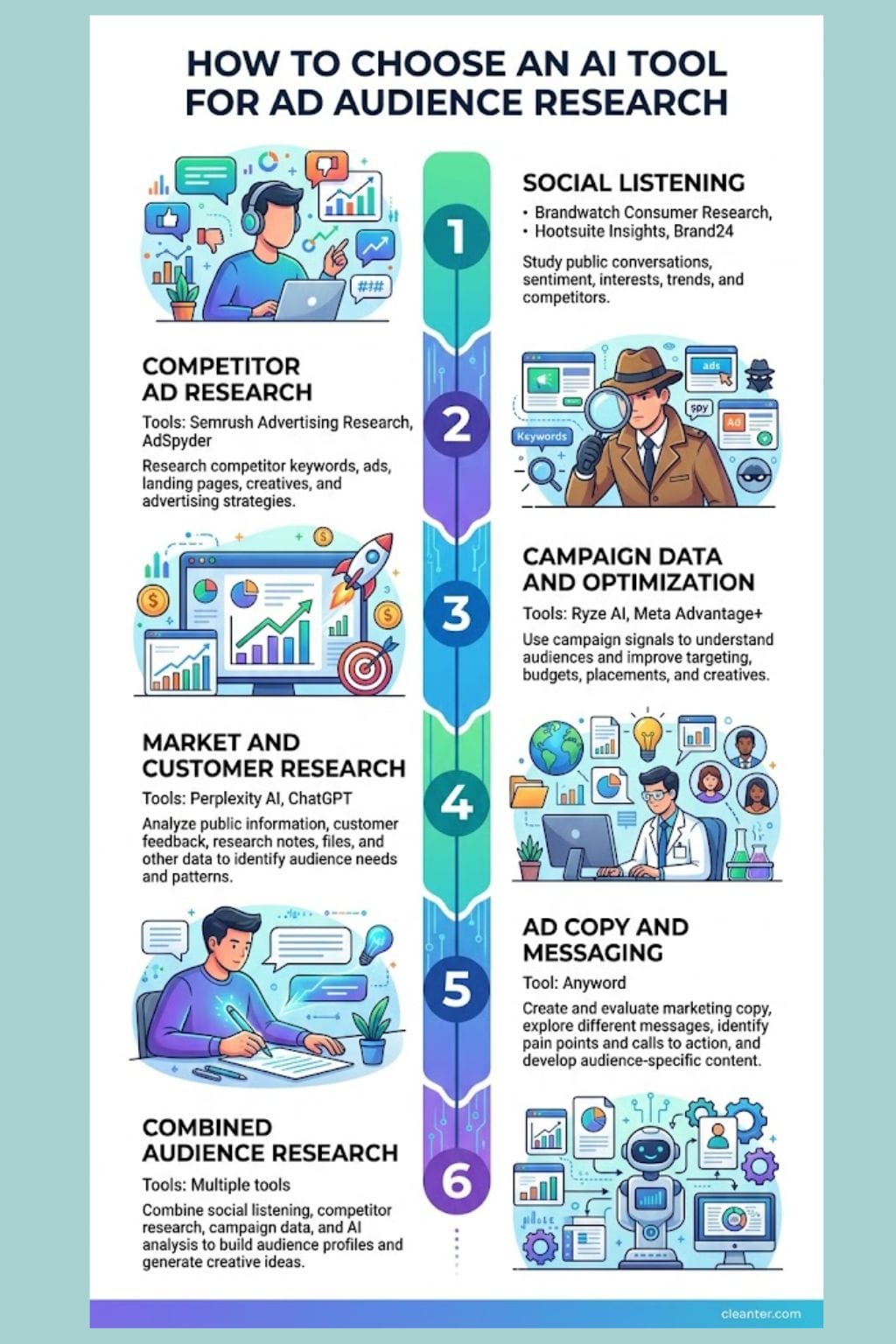
How to Choose an AI Tool for Ad Audience Research
| Research Need | Recommended AI Tools | How They Help |
|---|---|---|
| Social listening | Brandwatch Consumer Research, Hootsuite Insights, Brand24 | Study public conversations, sentiment, interests, trends, and competitors. |
| Competitor ad research | Semrush Advertising Research, AdSpyder | Research competitor keywords, ads, landing pages, creatives, and advertising strategies. |
| Campaign data and optimization | Ryze AI, Meta Advantage+ | Use campaign signals to understand audiences and improve targeting, budgets, placements, and creatives. |
| Market and customer research | Perplexity AI, ChatGPT | Analyze public information, customer feedback, research notes, files, and other data to identify audience needs and patterns. |
| Ad copy and messaging | Anyword | Create and evaluate marketing copy, explore different messages, identify pain points and calls to action, and develop audience-specific content. |
| Combined audience research | Multiple tools | Combine social listening, competitor research, campaign data, and AI analysis to build audience profiles and generate creative ideas. |
How AI Improves Ad Audience Research
Traditional audience research can involve surveys, interviews, focus groups, customer data, competitor research, and manual analysis. AI can make many of these processes faster by processing large amounts of information and finding patterns.
AI tools can help marketers:
- Identify common customer pain points.
- Find emerging audience interests and trends.
- Analyze competitor messaging.
- Group customers into audience segments.
- Discover frequently used customer language.
- Develop buyer personas.
- Find potential advertising angles.
- Create and compare ad messages.
- Identify changes in customer sentiment.
- Turn research findings into campaign ideas.
However, AI should support audience research rather than completely replace human judgment. Public conversations may not represent an entire customer base, and AI-generated insights can miss context, sarcasm, cultural differences, or niche language.
Conclusion
AI-driven audience research makes advertising smarter, faster, and more human. It turns large amounts of data into clear signals about what people want, fear, and value. Marketers can spot trends early, shape messages with care, and reach the right people at the right time.
This reduces waste and helps each campaign feel more useful. The best results still need human judgment, strong ethics, and respect for privacy. Used well, AI does not replace creative teams.
It gives them sharper insight, more time, and a better path to meaningful connections that build trust and drive lasting growth.
FAQs
What are AI tools for ad audience research?
AI tools for ad audience research help marketers analyze customer data, social conversations, search trends, competitor activity, and campaign results to understand their target audiences and create better advertising strategies.
How do AI tools help with ad audience research?
AI tools can identify customer pain points, interests, trends, buying signals, audience segments, and common customer language. These insights can help marketers create more relevant ads and improve targeting.
What are the best AI tools for ad audience research?
Some AI tools for ad audience research include Brandwatch Consumer Research, Semrush Advertising Research, AdSpyder, Ryze AI, Perplexity AI, Hootsuite Insights, Anyword, Brand24, ChatGPT, and Meta Advantage+.
Can AI replace traditional audience research?
AI can make audience research faster, but it should not completely replace surveys, interviews, focus groups, first-party customer data, or human judgment. AI-generated insights can miss context and may not represent the entire target audience.
How do I choose the right AI audience research tool?
Choose a tool based on your research needs. Social listening tools are useful for understanding public conversations, while competitor research tools can analyze ads and keywords. Other tools focus on campaign data, market research, audience personas, or ad copy.