Best AI Tools for Customer Profiling: Features, Pricing & Comparison
Discover the best AI tools for customer profiling, including their key features, benefits, drawbacks, and pricing to help businesses understand customers and improve sales and marketing.

AI tools for customer profiling help businesses turn scattered customer data into clear and useful insights. They look at buying habits, website visits, messages, feedback, and past interactions to understand what customers want.
These tools can find common patterns, group similar customers, and predict what they may do next. This helps teams create better offers, write more relevant content, and respond faster to customer needs.
Sales and marketing teams can also focus on valuable customer groups instead of sending the same message to everyone. Better customer profiles can improve service, build trust, increase retention.
Best AI Tools for Customer Profiling
The following AI customer profiling tools help businesses collect, enrich, analyze, and use customer data for sales and marketing activities.
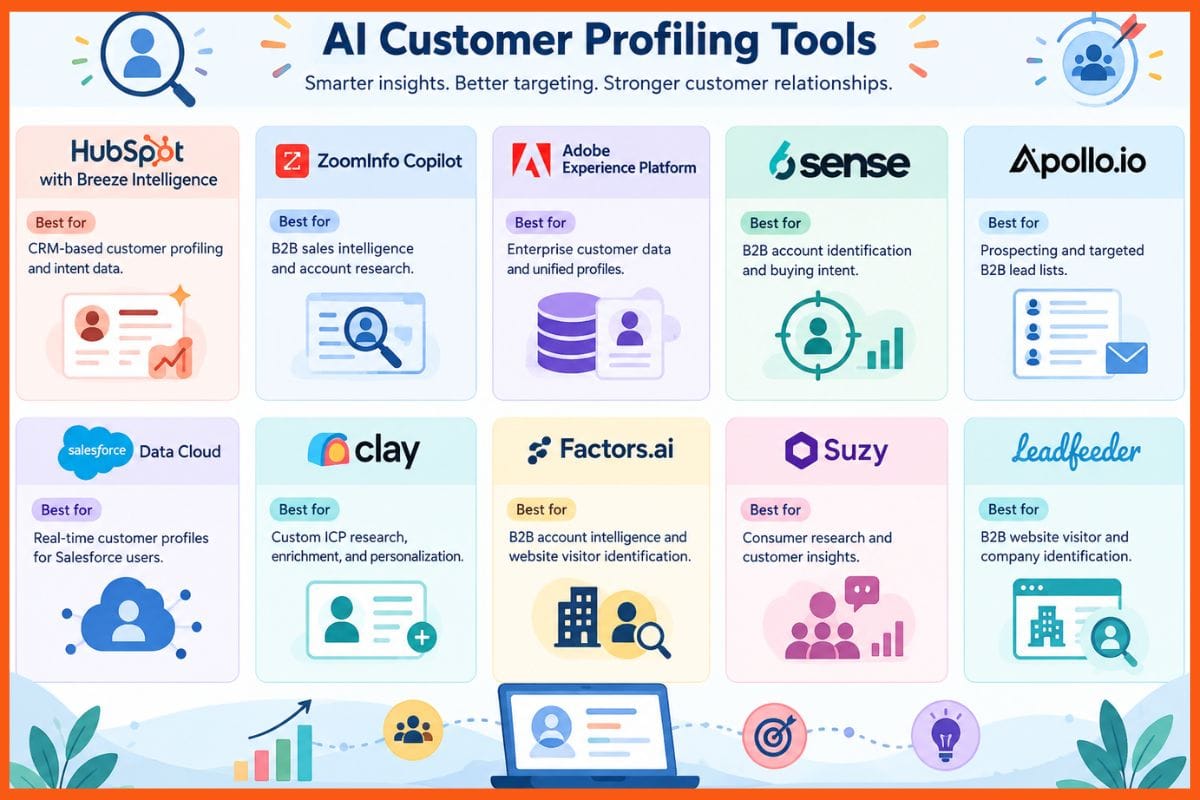
| AI Customer Profiling Tool | Best For | Key Features | Drawbacks |
|---|---|---|---|
| HubSpot with Breeze Intelligence | CRM-based customer profiling and intent data | Profile enrichment, website visitor intent, research intent, form shortening, buying-intent lists | Intent does not guarantee buying; data depth may vary by market |
| ZoomInfo Copilot | B2B sales intelligence and account research | Business data, buyer signals, AI research, decision-maker mapping, personalized outreach | Depends on CRM data quality; less useful for non-account-based sales |
| Adobe Experience Platform | Enterprise customer data and unified profiles | XDM, identity resolution, unified profiles, Customer AI, live audiences, AI Assistant | Works best within the broader Adobe ecosystem; requires cross-team data alignment |
| 6sense | B2B account identification and buying intent | Firmographic and intent data, predictive scoring, buying stages, decision-maker mapping, Sales Copilot | Scores are signals rather than buying certainty; data credits can limit access |
| Apollo.io | Prospecting and targeted B2B lead lists | Prospect filters, lead research, scoring, data enrichment, AI email creation, CRM updates | Credits can limit usage; contact details may require verification |
| Salesforce Data Cloud | Real-time customer profiles for Salesforce users | Data unification, identity resolution, consent management, Einstein AI, segmentation, activation | Poor source data affects results; advanced capabilities may add cost |
| Clay | Custom ICP research, enrichment, and personalization | 150+ data providers, waterfall enrichment, Claygent, AI prompts, buying signals, integrations | Credit use can be difficult to predict; requires users to build workflows |
| Factors.ai | B2B account intelligence and website visitor identification | Visitor identification, account enrichment, buyer journeys, intent signals, AI agents, integrations | Visitor identification is probabilistic; advanced features cost more |
| Suzy | Consumer research and customer insights | Consumer panels, surveys, AI analysis, segmentation, AI interviews, predictive heatmaps | Does not replace first-party customer records; enterprise research can be costly |
| Leadfeeder | B2B website visitor and company identification | Website behavior, firmographic data, AI enrichment, intent signals, alerts, CRM integration | Identifies companies rather than individual visitors; better contact data requires a higher tier |
HubSpot with Breeze Intelligence
HubSpot with Breeze Intelligence is an AI-powered CRM tool that helps sales and marketing teams understand their customers better. It adds useful details to contact and company records, including industry, company size, revenue, and other firmographic data.
It can also track website visits and research activity to show which companies may be ready to buy. Another useful feature is form shortening, which reduces the number of fields shown to visitors who are already known.
This can make forms easier to complete and improve conversions. Teams can also create lists based on buying intent.
Pros
- Native to HubSpot CRM, enriched profiles sit in the same customer record
- Combines profile data with website visitor intent and external research intent
- Form shortening can improve lead capture while asking fewer questions
Cons
- Intent signals show interest, not buying certainty; sales teams still need to qualify leads
- Data depth may not match specialist B2B data providers for every market
Pricing
| Plan | Pricing |
|---|---|
| Request for Pricing (RFP) | Custom pricing |
ZoomInfo Copilot
ZoomInfo Copilot is an AI-powered sales tool that helps teams understand and reach potential customers faster. It combines ZoomInfo’s business data with CRM information, buyer signals, and AI research to give sales reps a clear view of each account.
It can identify key decision-makers, map buying groups, track intent signals, and highlight accounts that may be ready to buy. Reps can also ask questions in natural language to learn more about prospects.
The tool can create personalized emails, suggest follow-ups, and recommend next steps. By connecting with CRM and other sales tools, ZoomInfo Copilot helps teams keep prospect information.
Pros
- It can help reveal more than one contact, which suits complex B2B deals
- It does not just show data; it suggests next steps and creates outreach drafts
- Reps can prepare for calls and account reviews faster
Cons
- Poor CRM data or weak account rules can reduce the value of AI recommendations
- It may be less useful for firms that do not sell through named accounts
Pricing
| Plan | Pricing |
|---|---|
| Request for Pricing (RFP) | Custom pricing |
Adobe Experience Platform
Adobe Experience Platform (AEP) is an enterprise platform that brings customer data from websites, apps, CRM systems, transactions, and offline sources into one place.
It connects this data to create a unified customer profile that can update in near real time. Identity Service helps match customers across devices and channels, while the Experience Data Model (XDM) keeps data consistent. Customer AI can predict actions such as conversion or churn.
Teams can build live audiences and send them to Adobe and other approved tools. AI Assistant makes it easier to explore data, create schemas, map fields, and build audiences.
Pros
- XDM, ingestion, identity, profiles, and destinations form a common enterprise data layer instead of isolated campaign data
- AI Assistant can help with both platform learning and data-workflow tasks, not only analytics
- Governance, security, and privacy functions are core platform capabilities
Cons
- The strongest benefit often comes when an organization also uses Adobe’s CDP, journey, analytics, or activation products
- Data engineers, analysts, marketers, and privacy teams must align on schemas, governance, and activation rules
Pricing
| Plan | Pricing |
|---|---|
| Request for Pricing (RFP) | Custom pricing |
6sense
6sense is an AI-powered B2B revenue platform that helps companies find and focus on the accounts most likely to buy. It brings together firmographic, technographic, intent, website, and CRM data to build a clear view of each account.
Its predictive models score accounts, identify their buying stage, map key decision-makers, and suggest the next best action. The platform also helps sales teams identify website visitors and discover relevant contacts.
Sales Copilot adds AI-powered account summaries, alerts, and outreach support. With CRM and sales engagement integrations, 6sense helps marketing and sales teams focus their time on high-value prospects.
Pros
- Combines many signal types into one account view
- Helps teams prioritize accounts with stronger purchase intent
- Supports both marketing and sales workflows
Cons
- Scores are useful signals, not proof that a company will buy
- Data credits can limit contact and company record acces
Pricing
| Plan | Pricing |
|---|---|
| Request for Pricing (RFP) | Custom pricing |
 Vivek Dev Jacob
Apollo.io
Apollo.io is an AI-powered B2B sales platform that helps businesses find and connect with potential customers. It allows sales teams to search for prospects based on factors such as company size, job role, location, industry, technology, and buying intent.
The platform also supports lead research, scoring, data enrichment, and personalized email creation. Teams can build targeted prospect lists, update CRM records, and track how leads interact with their outreach.
Apollo.io brings email, calling, and LinkedIn-style prospecting workflows into one platform. It is useful for sales teams that want to research prospects quickly, build accurate lead lists.
Pros
- Deep filters help define a narrow ideal customer profile
- AI research and email writing can reduce manual prospect work
- Chrome extension supports prospecting while using LinkedIn and other sites
Cons
- Credits can limit exports, phone data, and enrichment at scale
- Contact details may need verification before important outreach
Pricing
| Plan | Pricing |
|---|---|
| Basic | $65/seat/month |
| Professional | $99/seat/month |
| Organisation | $149/seat/month |
Salesforce Data Cloud
Salesforce Data Cloud brings together CRM, web, commerce, service, and external data to create a single customer profile. It also manages customer consent while connecting data from different sources.
Einstein AI uses these profiles to understand customer intent, predict churn and customer value, recommend next steps, and create targeted audience segments. Teams can then use these insights across Salesforce and other connected channels.
Its identity resolution feature connects known and anonymous customer interactions, helping reduce duplicate records and improve data quality. Data Cloud is especially useful for companies that already rely heavily on Salesforce and need real-time personalization.
Pros
- Combines Salesforce and external data into one customer view with identity resolution
- Uses profiles to power AI scoring, recommendations, segmentation, and targeted action
- Supports near-real-time activation across sales, service, marketing, and commerce workflows
Cons
- Poor source data can create weak profiles, incorrect matches, and less reliable AI outputs
- Premium capabilities, such as real-time profiles or advertising audiences, may add cost
Pricing
| Plan | Pricing |
|---|---|
| Request for Pricing (RFP) | Custom pricing |
Clay
Clay is an AI-powered go-to-market platform that helps teams find, enrich, and understand potential customers.
It brings data from more than 150 providers into one place and uses waterfall searches to find missing information from different sources. Its AI research tool, Claygent, can search the web and collect useful customer insights.
Teams can also use custom AI prompts, track signals such as buying intent and job changes, and connect Clay with CRMs and other tools. It helps sales and marketing teams build customer profiles, score leads against their ideal customer profile, and create personalized outreach at scale.
Pros
- Waterfall enrichment can improve match rates by checking many data sources
- Claygent can research public web information and turn it into usable profile fields
- Flexible tables, formulas, AI prompts, and integrations let teams design highly custom ICP scoring and personalization flows.
Cons
- Credit use can be hard to predict when profiles need many fields, repeated runs, or token-heavy AI models; some models use variable token-based pricing
- It is a powerful workflow builder, not a finished customer-data platform; teams must define fields, prompts, scoring logic, and review rules
Pricing
| Plan | Pricing |
|---|---|
| Launch | $185/month |
| Growth | $495/month |
| Enterprise | Custom |
Vivek Dev Jacob
Factors.ai
Factors.ai is an AI-powered go-to-market platform that helps B2B teams understand and reach the right customers. It identifies companies visiting a website, enriches account data, and brings together signals from websites, CRM systems, ads, products, and buyer intent.
Teams can use this data to define ideal customer profiles, score accounts, identify key buying groups, and spot accounts that are ready to engage. The platform connects with tools such as LinkedIn, Google Ads, Salesforce, HubSpot, G2, Slack, and Microsoft Teams.
Its AI agents also recommend next steps, helping sales and marketing teams focus their time on accounts.
Pros
- Identifies anonymous website visitors and enriches their company profiles, which helps reveal otherwise hidden demand
- Unifies touchpoints into account-level buyer journeys rather than treating each visit or campaign as separate
- Supports real-time activation through CRM, Slack/Teams, LinkedIn, and Google Ads integration
Cons
- Visitor identification is probabilistic
- Advanced scoring, automation, and ad activation sit in higher-priced tiers
Pricing
| Plan | Pricing |
|---|---|
| Basic | $6k/year |
| Growth | $20k/year |
| Enterprise | $30k/year |
Suzy
Suzy is an AI-powered consumer insights platform that helps brands understand their customers through fast quantitative and qualitative research. It combines consumer panels, surveys, AI analysis, market signals, and conversational interviews in one platform.
Brands can define target groups, test ideas, explore customer needs, and turn feedback into clear actions. Suzy provides access to verified audiences across 70+ panels and supports research in multiple markets.
Key features include AI-generated surveys and screeners, automated analysis, translation, customer segmentation, retargeting, and AI-led interviews through Suzy Speaks. It also offers predictive heatmaps for ads, packaging, and digital content.
Pros
- AI reduces manual work in survey setup and response analysis
- Heatmapping can reveal what customers notice first in a design or advert
- Teams may not need to source a panel from a separate vendor
Cons
- Suzy profiles panel respondents; it does not replace first-party customer records, purchase history, or customer-data-platform workflows
- Enterprise research tooling and credit use can be costly for small teams or frequent niche studies
Pricing
| Plan | Pricing |
|---|---|
| Request for Pricing (RFP) | Custom pricing |
Leadfeeder
Leadfeeder, now part of Dealfront, helps B2B teams understand which companies visit their websites. It shows the pages they view, their activity, and other useful signals that help sales teams find potential buyers.
Users can filter companies based on their ideal customer profile, firmographic data, and website behavior. The platform also uses AI to enrich data, build prospect lists, and identify accounts with buying intent.
Teams can receive real-time alerts, create account lists, and connect the data with their CRM. It also supports account-based marketing and ad audiences. Since it identifies companies rather than individual visitors.
Pros
- Blends site behavior with company data
- Makes inbound intent visible to sales teams
- Supports both prospecting and ad targeting
Cons
- It identifies firms, not each visitor
- Best contact data needs a higher-tier plan
Pricing
| Plan | Pricing |
|---|---|
| Discover | €79/month |
| Activate | €369/month |
| Scale | €599/month |
Vivek Dev Jacob
How to Choose an AI Customer Profiling Tool
The right AI customer profiling tool depends on the type of customer data a business needs and how that data will be used.
Consider the Type of Customer Data
Some tools focus on B2B account data, while others are designed for consumer research or unified customer profiles. Businesses should first identify whether they need firmographic data, website behavior, buying intent, customer feedback, or first-party customer records.
Check Data Enrichment Capabilities
Data enrichment can add useful information to existing customer or company records. Tools such as Apollo.io, Clay, HubSpot with Breeze Intelligence, and Factors.ai can help teams build richer profiles.
Look at AI and Predictive Features
AI can help identify patterns, score accounts, predict customer actions, and recommend next steps. However, AI-generated scores and intent signals are useful indicators rather than guarantees of future customer behavior.
Consider CRM and Other Integrations
Customer profiling becomes more useful when insights can move into existing sales and marketing workflows. Businesses should consider how well a tool connects with their CRM, advertising platforms, sales tools, and other customer-data systems.
Review Pricing and Usage Limits
Pricing models vary widely. Some tools offer fixed plans, while others use custom pricing, credits, or usage-based models. Businesses should consider how much data they need to process and whether credits or higher-tier features could affect overall costs.
Benefits of AI Tools for Customer Profiling
AI customer profiling can help businesses understand customers more efficiently by bringing different data points together.
Some key benefits include:
- Better customer understanding: Businesses can identify patterns across customer behavior and interactions.
- More relevant marketing: Customer groups can receive offers and content based on their interests and behavior.
- Faster sales research: Sales teams can spend less time manually researching prospects.
- Improved customer service: Teams can use customer information to respond more effectively.
- Better segmentation: AI can help identify customer groups based on common characteristics and behaviors.
- More focused outreach: Sales and marketing teams can focus on customer groups that match their ideal customer profile.
Final Thoughts on AI Tools for Customer Profiling
AI tools for customer profiling turn scattered data into clear insight. They help firms see what people want, when they want it, and how they choose.
This leads to better offers, faster service, and stronger trust. Teams can spot patterns that may be hard to find by hand. Yet success depends on care. Businesses must use data fairly, protect privacy, and keep people in control.
The best results come when smart systems support human judgment, not replace it. Used with purpose, AI makes customer understanding more personal, useful, and lasting.
FAQs
What are AI tools for customer profiling?
AI tools for customer profiling analyze customer data such as buying habits, website activity, feedback, and past interactions to identify patterns and create useful customer profiles.
What are the best AI tools for customer profiling?
Popular AI customer profiling tools include HubSpot with Breeze Intelligence, ZoomInfo Copilot, Adobe Experience Platform, 6sense, Apollo.io, Salesforce Data Cloud, Clay, Factors.ai, Suzy, and Leadfeeder.
How do AI tools help with customer profiling?
They help businesses understand customer behavior, identify customer groups, enrich profiles, predict buying intent, personalize marketing, and help sales teams focus on relevant prospects.
What should businesses consider when choosing a customer profiling tool?
Businesses should consider the type of customer data they need, data enrichment capabilities, AI features, CRM integrations, pricing, usage limits, and the tool's ability to fit their existing workflows.
Can AI customer profiling tools replace human judgment?
No. AI tools can identify patterns, generate insights, and recommend actions, but businesses still need human judgment to review the information, qualify prospects, and make decisions.