Best AI Tools for Meta Ads Analytics
Discover the best AI tools for ad performance analysis in 2026. Compare their key features, use cases, automation capabilities, and limitations to find the right tool for your advertising campaigns.

AI tools for Meta Ads analytics make campaign data easier to understand and act on. They track important signals, find ads that are not performing well, and spot wasted ad spend early.
These tools can break down results by audience, placement, creative, and campaign goal. They can also detect ad fatigue, explain changes in performance, and highlight trends that may be missed in large campaigns.
This saves marketers time on reports and gives them more time to focus on improving results. With faster insights, teams can test new ideas, adjust budgets, improve creatives, and make better decisions.
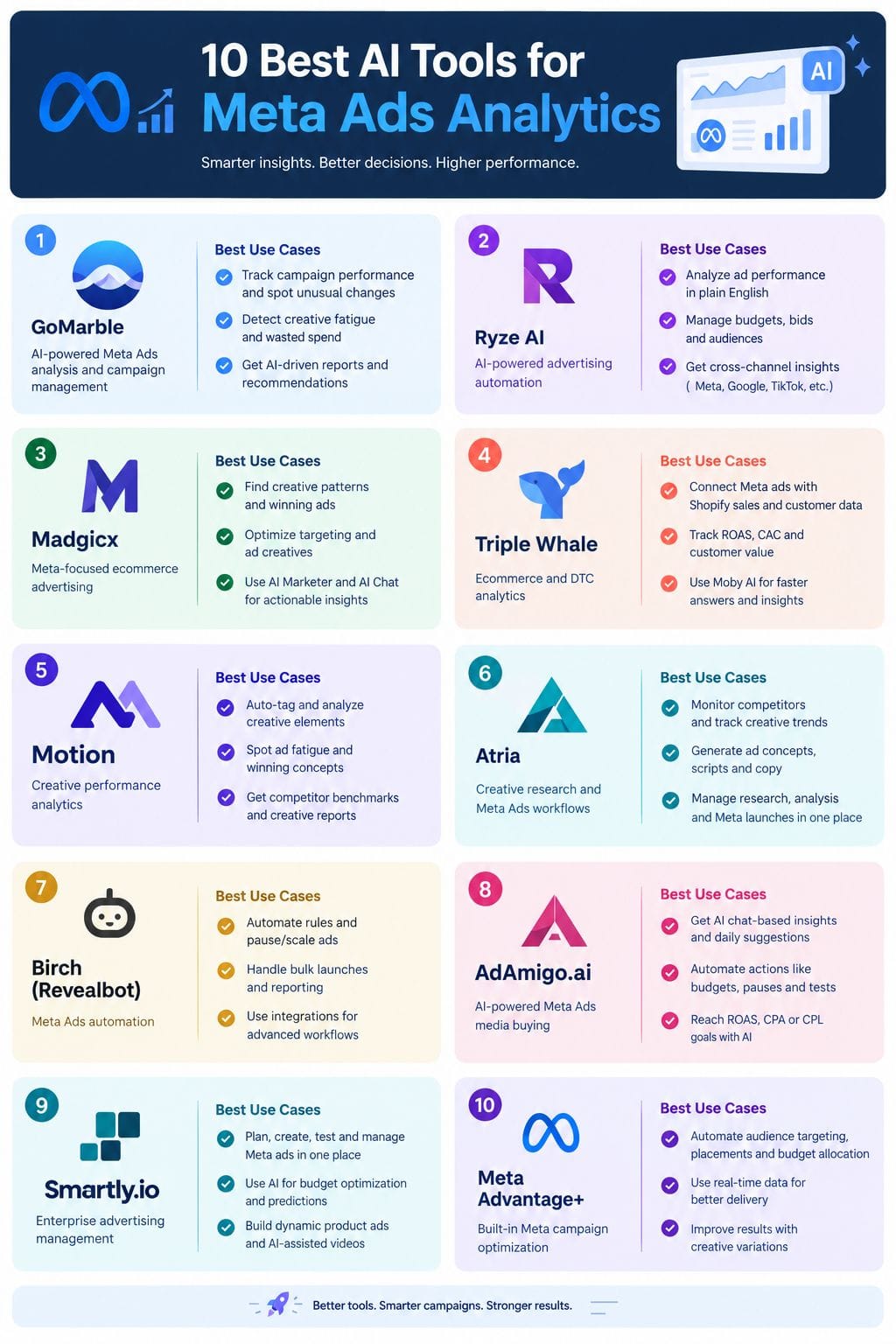
Best AI Tools for Meta Ads Analytics Comparison
| AI Tool | Best For | Key Features | Drawbacks |
|---|---|---|---|
| GoMarble | AI-powered Meta Ads analysis and campaign management | Performance analysis, AI reports, creative fatigue detection, competitor ad research, campaign actions | Monthly AI credits; findings should be verified |
| Ryze AI | AI-powered advertising automation | Plain-language analysis, creative analysis, budget and bid management, cross-channel support | More focused on automation than basic reporting |
| Madgicx | Meta-focused ecommerce advertising | AI Marketer, creative insights, targeting, automated rules, AI bidding | Strongest value is for Meta-centric advertisers |
| Triple Whale | Ecommerce and DTC analytics | Meta + Shopify analytics, Moby AI, attribution, creative analysis, cohort reports | Higher plans can become costly |
| Motion | Creative performance analytics | AI creative tagging, fatigue detection, creative leaderboards, competitor benchmarks | Less useful for attribution or media-buying control |
| Atria | Creative research and Meta Ads workflows | Competitor intelligence, creative research, AI concepts, scripts, copy and image ideas | Not a low-cost option for small advertisers |
| Birch (Revealbot) | Meta Ads automation | Rule-based automation, account analysis, bulk launches, reporting, alerts | Rules require time and maintenance |
| AdAmigo.ai | AI-powered Meta Ads media buying | AI Chat Agent, daily suggestions, goal-based automation, bulk ad launches | Automated changes need close review |
| Smartly.io | Enterprise advertising management | Creative and media management, automation, reporting, AI optimization | Setup effort and enterprise pricing |
| Meta Advantage+ | Automated Meta campaign optimization | Audience targeting, placements, budget allocation, creative variations | Broad automation may not suit strict audience exclusions |
GoMarble
Best for AI-powered ad performance analysis and optimization
GoMarble is an AI agent platform that helps teams manage and understand paid ads, with a strong focus on Meta Ads. It tracks campaign performance, spots unusual changes, finds possible causes, and suggests what to do next.
Teams can use simple language to ask questions, create reports, check competitor ads, and identify creative fatigue. GoMarble also connects creative performance with key metrics like ROAS, CPA, hook rate, and hold rate.
It works with Meta, Google, TikTok, GA4, Shopify, and Klaviyo. Paid plans can also prepare or make campaign changes, but users stay in control and approve live actions.
Pros
- It can draft or make campaign changes after approval
- It keeps the ad visual beside performance data, so teams can see what messages and formats drive results
- Write actions require approval, while higher plans add audit trails, policies, and role controls
Cons
- AI work uses monthly credits, and unused credits do not roll over
- GoMarble states that it can make mistakes, so teams should verify key findings
Pricing
| Plan | Pricing |
|---|---|
| CoPilot | $139/month |
| Operator | $399/month |
| Scale | $799/month |
| Enterprise | Custom Pricing |
Ryze AI
Best for automated ad monitoring and optimization
Ryze AI is an AI copilot that helps businesses manage and understand their digital advertising. It connects with platforms like Facebook and Instagram to track key metrics such as ad spend, ROAS, CPA, audience performance, and creative results.
You can ask questions in plain English, spot wasted ad spend, identify weak campaigns, and get ideas for better ads. Ryze can also help manage campaigns by adjusting budgets, bids, audiences, and underperforming ads based on the level of approval you set.
It also supports Google Ads, GA4, TikTok, LinkedIn, and other channels, giving teams one place to compare campaign performance.
Pros
- Users can query ad performance through ChatGPT or Claude rather than dig through Ads Manager
- It helps analyze creative results, generate new ad ideas, and spot fatigue
- It covers Meta alongside Google Ads, TikTok, LinkedIn, Microsoft Ads, and analytics tools
Cons
- Its main value is automation and action, so a basic dashboard may be enough for teams that only need reporting
- It must connect to your Meta account, so permission setup and internal governance matter
Pricing
| Plan | Pricing |
|---|---|
| Paid Ads Autopilot | $89/month |
| SEO Autopilot | $129/month |
| Traffic Printer | $599/month |
| Ecom Autopilot | $1499/month |
Madgicx
Best for AI-powered ad optimization and creative analysis
Madgicx is an AI-powered platform that helps e-commerce teams manage and improve Meta ads. It brings campaign data, creative performance, targeting, and store revenue into one workspace.
Its AI Marketer checks ad accounts daily and suggests actions, while AI Chat lets users ask questions about performance in plain language. Creative Insights compares ad formats, visuals, and copy to spot patterns behind winning ads.
The platform also offers cross-channel reporting, server-side tracking, automated rules, AI bidding, and bulk ad management. Madgicx can save time and make ad analysis easier, but it still needs clean tracking.
Pros
- Finds creative patterns, not just top and bottom ads, so teams can make better briefs and tests
- Puts analytics, creative work, targeting, and optimization in one Meta-focused system.academy
- Makes account analysis more accessible through conversational AI and action-ready suggestions
Cons
- Its strongest value is for Meta-centric advertisers, even though it includes cross-channel reporting
- Accurate advice depends on sound pixel, Shopify, and conversion-tracking setup
- nd pixel, Shopify, and conversion-tracking setup.
Pricing
| Plan | Pricing |
|---|---|
| Monthly Plan | $45/month |
 Vivek Dev Jacob
Triple Whale
Best for ecommerce ad performance tracking and attribution
Triple Whale is an AI-powered analytics platform built for ecommerce brands running Meta ads. It brings together Meta ad spend, Shopify sales, and first-party customer data to give brands a clearer view of performance.
It helps teams track key metrics such as ROAS, CAC, and customer value in one place. Its Moby AI assistant can answer data questions, spot important changes, and help teams take action faster.
The platform also offers multi-touch attribution, creative analysis, post-purchase surveys, cohort reports, custom dashboards, and budget tracking. It is mainly useful for DTC brands that want a simple view of advertising performance.
Pros
- Connects Meta ad data to Shopify revenue, products, cohorts, and repeat purchases
- Creative analytics can identify which ads, formats, and messages drive sales
- Moby AI lets users ask questions in plain language instead of building every report
Cons
- Higher plans can become costly as GMV and AI automation needs grow
- Setup, tracking checks, and data interpretation still need skilled operators
Pricing
| Plan | Pricing |
|---|---|
| Request for Pricing (RFP) | Custom Pricing |
Motion
Best for creative performance analysis and fatigue detection
Motion is an AI-powered creative analytics platform built for Meta ads. It connects to Meta ad accounts and helps teams understand which ads and creative ideas drive results. Its AI automatically tags ads by elements such as hooks, formats, messages, creators, and products, reducing manual work.
Teams can compare creatives, spot ad fatigue, identify winning concepts, and find ideas for new tests. Motion also offers creative leaderboards, concept-level reporting, AI-generated analysis and briefs, competitor benchmarks, and automated reports or alerts.
It is mainly useful for brands, media buyers, creative strategists, and agencies that want faster creative reporting.
Pros
- AI tagging cuts the slow work of naming and sorting ads
- It helps teams find a winning hook or message, then make informed variants
- Unlimited seats and ad accounts suit cross-functional teams and agencies
Cons
- It is less useful if your main problem is attribution or media-buying control
- A “winning” creative can still reflect audience, offer, placement, or timing
Pricing
| Plan | Pricing |
|---|---|
| Starter | $750/month |
| Pro | $1200/month |
| Growth | Contact Sales |
Atria
Best for AI-powered campaign analysis and optimization
Atria is an AI-powered platform built for Meta Ads teams, helping brands and agencies manage creative research, analysis, and campaign workflows in one place. It tracks ad performance, highlights trends, and uses AI to suggest what teams should scale, improve, or test next.
Atria also offers competitor intelligence, allowing users to monitor live ad strategies and spot new creative trends. Its research library helps teams explore Meta and TikTok ads for fresh ideas.
The platform can generate ad concepts, scripts, copy, and image ideas using AI. Teams can also upload approved creatives to Meta in bulk.
Pros
- Connects research, creative analysis, asset work, and Meta launching in one product.
- Radar turns raw ad data into clear creative actions, not just charts.
- Competitor tracking can reduce time spent checking the Meta Ad Library by hand
Cons
- It is not a low-cost tool for solo advertisers or very small budgets.
- AI credits, ad-spend caps, and brand-tracking limits may restrict heavy users
Pricing
| Plan | Pricing |
|---|---|
| Core | $159/month |
| Plus | $599/month |
| Business | $1199/month |
| Enterprise | Custom Quote |
Vivek Dev Jacob
Birch (Revealbot)
Best for automated ad monitoring and campaign management
Birch, formerly Revealbot, is a Meta Ads automation and analytics tool built for teams that want better control over their campaigns. It helps marketers track performance, review accounts, and automate tasks such as pausing weak ads or increasing budgets for strong ones.
Users can set rules based on metrics like CPA, ROAS, spend, and time.
Birch also offers Explorer for performance analysis, Launcher for bulk campaign creation, post boosting, audience tools, reporting, alerts, and integrations with platforms such as Slack, Google Sheets, AppsFlyer, and Hyros. Overall, Birch is a flexible automation tool, not a fully autonomous AI media buyer.
Pros
- Useful for agencies managing many accounts, campaigns, and repeated optimization tasks
- Transparent activity history helps teams see what automation changed and when
- Goes beyond basic Meta reporting with bulk launches, boosting, audience building, and custom metrics
Cons
- It can take time to design, test, and maintain safe rules for different funnel stages
- Automation may make poor choices if conversion data is delayed, incomplete, or noisy
Pricing
| Plan | Pricing |
|---|---|
| Essential | $49/month |
| Pro | $99/month |
| Enterprise | Contact Sales |
AdAmigo.ai
Best for automated ad performance monitoring and optimization
AdAmigo.ai is an AI-powered media buying tool built for Meta ads. It turns account data into clear actions that help brands and agencies improve campaign performance.
Its AI Chat Agent lets users ask simple questions, such as why ROAS has dropped or where ad spend is being wasted. The platform also provides daily suggestions, spots conversion and spending issues, and allows teams to make changes with one click.
Users can set goals for ROAS, CPA, or CPL, while the AI can adjust budgets, pause weak ads, test creatives, and create multiple ad variations.
Pros
- Chat-based analytics makes account review faster for non-analysts
- Bulk Ad Launch supports rapid creative testing across Meta placements
- Goal-based automation can act on ROAS, CPA, or CPL targets
Cons
- It is more than an analytics tool, so automated changes need close review
- The entry plan limits AI actions, which may not fit busy account
Pricing
| Plan | Pricing |
|---|---|
| <$2000+ Ad spend | $99/month/ad/account |
| Unlimited Access | $349/month/ad/account |
Smartly.io
Best for enterprise-level advertising analytics and automation
Smartly.io is an enterprise AI advertising platform that helps brands and agencies plan, create, test, manage, and measure Meta ads from one place. It brings creative and media data together, making it easier to see which ideas, formats, and ad elements drive results.
Its AI tools offer performance predictions, budget optimization, campaign automation, and real-time reporting.
Teams can also create dynamic product ads, use feed-based templates, and produce videos and Reels with AI-assisted tools. Smartly.io is built for businesses running large volumes of ads that need faster testing, better control, and less manual work.
Pros
- It connects creative choices with Meta campaign outcomes, not just spend and conversion metrics
- Templates, naming rules, and automation can reduce repetitive work across many campaigns
- One workflow for teams: Creative and media teams can work from shared data and campaign controls
Cons
- Third-party reviews report annual commitments and minimum monthly fees
- Setup effort: Templates, data connections, and team processes need careful initial setup
Pricing
| Plan | Pricing |
|---|---|
| Request for Pricing (RFP) | Custom Pricing |
Vivek Dev Jacob
Meta Advantage+
Best for AI-powered campaign optimization across Meta ads
Meta Advantage+ is Meta’s built-in AI system for improving Facebook and Instagram ad campaigns. It uses real-time data to find people who are more likely to take action, while also choosing where and how to show ads.
It can automate audience targeting, placements, budget allocation, and creative variations.
Advertisers can use it for goals such as sales, leads, or app installs. Advantage+ works best when conversion tracking is set up properly through the Meta Pixel and Conversions API, and when the campaign has enough data to learn from. It is not a separate analytics dashboard.
Pros
- Uses Meta’s first-party auction and delivery data
- Reduces manual campaign setup and daily adjustments
- Can uncover audiences beyond narrow interest targeting
Cons
- Learning periods can cause short-term performance swings
- Broad automation may not suit strict audience exclusions
Pricing
| Plan | Pricing |
|---|---|
| Meta Advantage+ | Included with Meta Ads Plans |
How to Choose an AI Tool for Meta Ads Analytics
The right AI tool depends on what your team needs from Meta Ads analytics and automation.
For campaign analysis
Tools such as GoMarble and Ryze AI can help teams understand campaign performance, identify weak areas, and ask questions about their advertising data in plain language.
For creative analysis
Motion, Madgicx, Atria, and Smartly.io focus more heavily on creative performance. They can help teams understand which hooks, formats, messages, and concepts are driving better results.
For ecommerce analytics
Triple Whale is mainly useful for DTC and ecommerce brands that want to connect Meta advertising data with Shopify sales, customer data, cohorts, and repeat purchases.
For campaign automation
Birch, AdAmigo.ai, Ryze AI, and GoMarble can help teams automate campaign actions. However, teams should still review automated changes and make sure conversion data is accurate.
For built-in Meta automation
Meta Advantage+ is useful for advertisers who want to use Meta's own AI system for audience targeting, placements, budget allocation, and creative variations.
Final Thoughts
AI can help turn Meta Ads data into simple, useful actions. It can spot trends, find weak campaigns, and show where your budget may work better.
This saves marketing teams time on reports and gives them more time to focus on ideas and creative work. AI can also help teams test new ads, improve audience targeting, and spot problems before results fall.
The goal is not to collect more data. It is to make better decisions at the right time. When used with clear goals and human judgment, AI makes ad analysis faster and easier.
FAQs
What are AI tools for ad performance analysis?
AI tools for ad performance analysis help marketers evaluate campaign data, identify performance trends, detect creative fatigue, and find opportunities to improve advertising results.
How do AI tools analyze ad performance?
These tools analyze metrics such as clicks, conversions, engagement, spending, audience behavior, and creative performance to identify patterns and provide actionable insights.
What are the best AI tools for ad performance analysis?
Popular options include GoMarble, Ryze AI, Madgicx, Triple Whale, Motion, Atria, Birch (Revealbot), AdAmigo.ai, Smartly.io, and Meta Advantage+.
Can AI tools automate ad campaign management?
Yes. Many AI advertising tools can automate tasks such as budget adjustments, bid management, campaign monitoring, alerts, creative analysis, and other optimization workflows.
Are AI ad performance tools suitable for small businesses?
Yes. Some tools are designed for smaller advertisers, while others focus on ecommerce brands, agencies, or enterprise teams. The right choice depends on the advertising platforms, campaign size, and level of automation required.