10 Best AI Tools for Writing Meta Ad Headlines in 2026
Stop staring at a blank ad box. Discover 10 AI tools that turn simple product ideas into catchy Meta headlines, fresh hooks, and scroll-stopping ad copy.

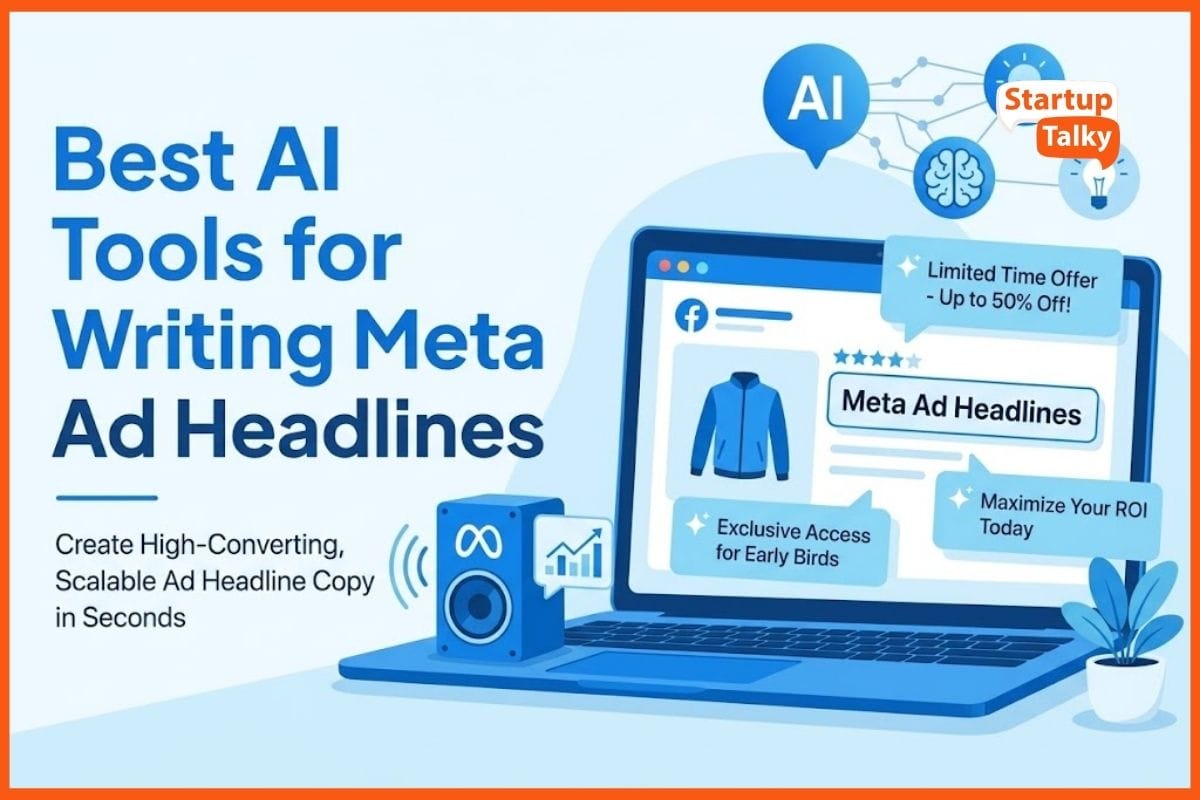
AI writing tools can help marketers create better Meta ad headlines in less time. Instead of starting from a blank page, marketers can enter basic details about the product, target audience, and campaign goal.
The tool can then suggest headline ideas with strong hooks, clear benefits, and simple calls to action. It can also offer different styles and tones to suit different audiences.
This makes it easier to explore new ideas and test several headlines before choosing the best ones. However, human review is still important. AI can speed up the writing process, but marketers should check.
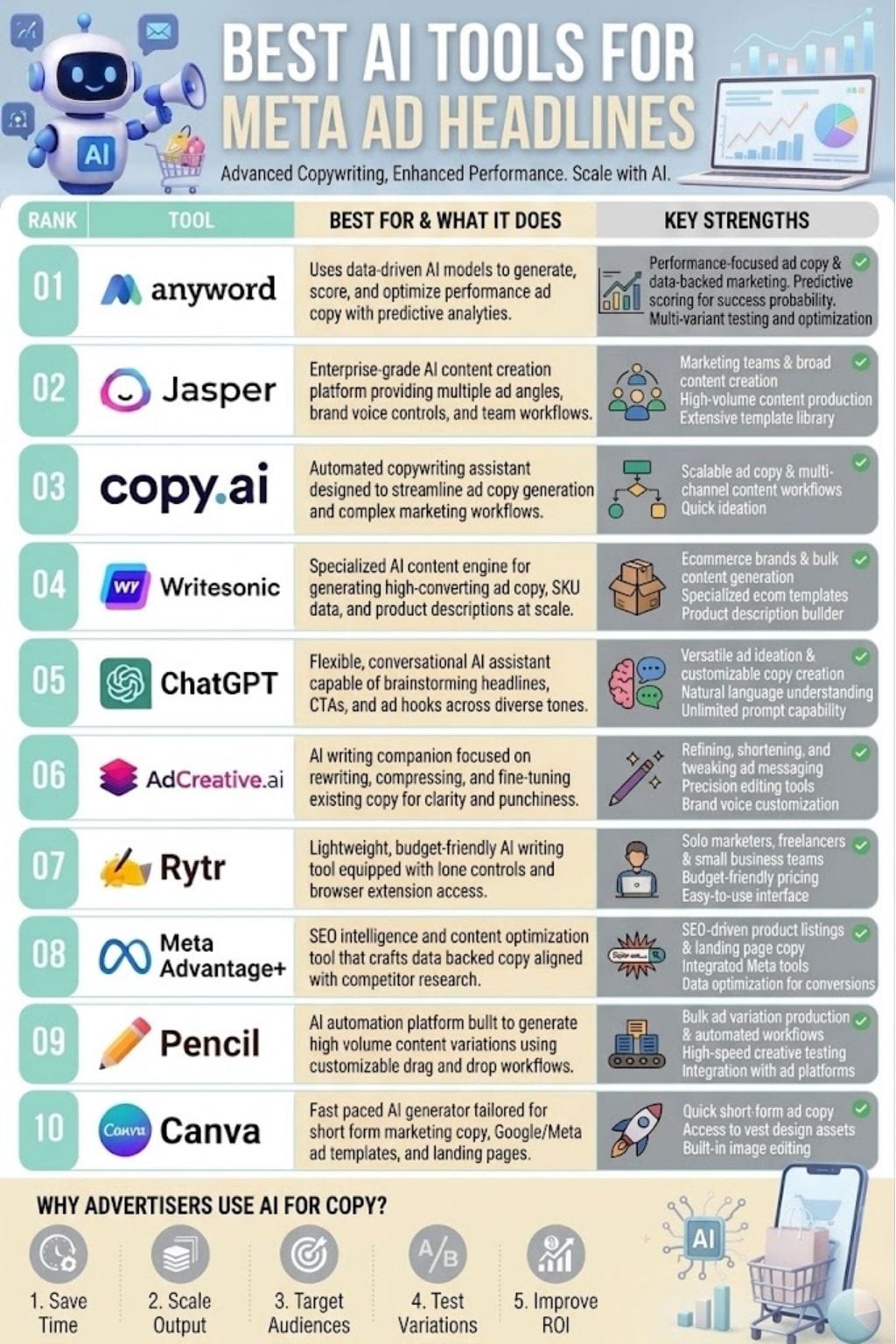
Best AI Tools for Meta Ad Headlines
| Tool | Best For | Strengths | Limitations |
|---|---|---|---|
| Anyword | Performance-focused ad copy | Predictive scoring, Brand Voice, multiple headline angles | Results depend on inputs and source data |
| Jasper | Marketing teams | Brand Voice, Knowledge Assets, campaign workflows | Can sound generic without a strong brief |
| Copy.ai | Ad copy and content workflows | Multiple AI models, Brand Voice, workflows | Advanced features are aimed at paid plans |
| Writesonic | Short-form marketing copy | Facebook Ads templates, brand voice, variations | Claims may need policy and legal review |
| ChatGPT | Flexible headline creation | Multiple hooks, tones, formats, and revisions | Requires human review and market knowledge |
| AdCreative.ai | Ad copy and creative | Copy and visual generation, creative scoring | Generic output possible with vague briefs |
| Rytr | Solo marketers and small teams | Simple workflow, tone options, Chrome extension | May miss product nuance or local context |
| Meta Advantage+ | Meta Ads workflow | Multiple variations, native Meta integration | AI output is not final copy |
| Pencil | AI ad creative | Headlines, visuals, videos, creative scoring | Results depend on briefs and assets |
| Canva | Copy and design together | Magic Write, easy editing, design integration | Headlines can sound generic without detailed inputs |
Anyword
Anyword is an AI copywriting tool that helps marketers create better ad headlines for Facebook and Instagram. It can generate several headline ideas based on the product, target audience, offer, and brand tone.
One of its main features is predictive performance scoring, which helps rank different copy options before they are used in an ad campaign. Users can also create brand voices, build audience personas, improve weak headlines, and generate copy at scale.
This makes Anyword useful for quickly testing new ideas and creating A/B test options. However, human review is still important to check the tone.
Pros
- Predictive scoring helps rank headline variants before you spend on Meta ads
- Brand Voice tools can keep new copy closer to your usual tone
- It can create many headline angles quickly, such as urgency, benefit, proof, or pain-point hooks
Cons
- Results depend heavily on the prompt, offer, audience detail, and source data
- AI can produce vague claims, repeated hooks, or language that needs a policy check before publishing
Pricing
| Plan | Pricing |
|---|---|
| Starter | $49/month |
| Data Driven | $99/month |
| Business | Custom Pricing |
| Enterprise | Custom Pricing |
Jasper
Jasper is an AI writing platform made for marketers who need quick, on-brand ad copy for Meta. It can create headline ideas, primary text, and different campaign versions using a product brief, target audience, campaign goal, and brand voice.
Marketers can use Brand Voice and Knowledge Assets to keep messaging clear and consistent. Jasper Chat also helps teams brainstorm hooks, offers, customer concerns, and new angles.
Its Canvas and collaboration tools make it easier to work on campaigns together. A browser extension lets users draft copy while they work. Jasper is best for creating and testing ideas quickly.
Pros
- Produces many headline directions quickly, which supports A/B testing
- Brand Voice can reduce off-brand copy across large campaigns
- Built for marketing workflows, rather than only general chat prompts
Cons
- Output may sound generic if the brief lacks a clear customer insight or offer
- It can invent or overstate product claims, so legal and brand review remain necessary
Pricing
| Plan | Pricing |
|---|---|
| Creator | $29/month |
| Pro | $49/month |
| Business | $149/month |
| Enterprise | Contact Sales |
Copy.ai
Copy.ai is an AI writing tool that helps marketers create multiple Meta ad headline options quickly. You can enter details such as your product, target audience, offer, and tone, then generate short and clear headline ideas.
You can also set a brand voice and save project details for future content. Its Chat tool supports unlimited words on paid plans, while templates and workflows help teams handle repeat content tasks.
You can edit content with simple prompts, such as “make this shorter” or “add urgency.” Paid users can also access models from OpenAI, Anthropic, and Gemini in one place.
Pros
- Create a wide range of angles; benefit-led, pain-led, social-proof, or offer-led
- Compare outputs from OpenAI, Anthropic, and Gemini without switching tools
- Workflow credits and larger seat counts suit teams that create ads at volume
Cons
- The best workflow and automation tools are aimed at paid, larger-team plans
- Headline quality depends heavily on your prompt, product detail, and customer insight
Pricing
| Plan | Pricing |
|---|---|
| Chat | $29/month |
| Enterprise | Contact Sales |
 Vivek Dev Jacob
Writesonic
Writesonic is an AI writing tool that helps marketers create Meta ad headlines quickly. Just add your product, target audience, offer, tone, and main benefit, and it will give you several headline ideas to test.
You can also adjust the results by adding your brand voice, keywords, or campaign goals. Beyond Meta ads, Writesonic can help with ad copy, product descriptions, social media posts, rewrites, and SEO content.
For Meta ads, it works best as a starting point for ideas. Pick the clearest and strongest options, then test them in Ads Manager.
Pros
- Includes marketing-focused templates, including Facebook Ads
- Supports brand-voice controls for more consistent copy
- Can pair headlines with primary text and other campaign assets
Cons
- It may create claims that need policy and legal review
- Strong ad results still need real audience testing
Pricing
| Plan | Pricing |
|---|---|
| Starter | $79/month |
| Basic | $199/month |
| Growth | $399/month |
| Enterprise | Custom Pricing |
ChatGPT
ChatGPT by OpenAI can help marketers create Meta ad headlines quickly. Just share your product, target audience, offer, tone, and campaign goal, then ask for several short options.
It can suggest strong hooks, benefit-focused headlines, questions, urgency-based lines, and ideas for A/B testing. You can also ask it to stay within Meta’s character limits, avoid exaggerated claims, or match your brand’s style.
Still, the final ad needs a human review. Check the facts, wording, and Meta’s advertising rules before publishing. ChatGPT helps speed up the creative process, but it cannot replace real market knowledge, customer understanding.
Pros
- Adapts to clear prompts, brand rules, customer pain points, and campaign goals
- Can revise one idea into short, bold, warm, premium, or playful versions
- Helps create related primary text, CTAs, and audience-specific message ideas
Cons
- It does not know your true ad results, audience fit, or Meta review outcome
- Some outputs may breach Meta rules on personal traits, claims, or sensitive topics
Pricing
| Plan | Pricing |
|---|---|
| ChatGPT Plus | $20/month |
| ChatGPT Business Standard Seat | $25/month |
| ChatGPT Business Premium Seat | $125/month |
AdCreative.ai
AdCreative.ai is an AI-powered ad creation platform that helps marketers develop Meta ad copy and visuals faster. Its text generator creates headline, primary text, and description options for Facebook and Instagram campaigns.
Marketers can add details such as the product, offer, target audience, and tone, then explore different copy ideas. The platform can also create matching ad visuals, making it easier to build complete creative sets.
Brand kits with logos, colors, and fonts help keep ads consistent with your brand. It also offers creative scoring and performance prediction tools. Meta Ads integration can support the wider campaign workflow.
Pros
- It creates headline ideas and related visual ads in one workspace
- You can generate several headline angles quickly, such as benefit-led, urgency-led, or problem-led variants.
- Brand-kit controls can help keep campaigns visually consistent across many ad versions
Cons
- Headline quality can feel generic if the product brief is vague
- AI may create claims that are too broad, unproven, or unsuitable for Meta ad policies
Pricing
| Plan | Pricing |
|---|---|
| Starter Plan | $20/month |
| Professional Plans | $125/month |
| Ultimate Plan | $500/month |
Vivek Dev Jacob
Rytr
Rytr is an AI writing tool that helps you create Meta ad headlines quickly. Pick a copy template, enter details about your product, target audience, tone, and main benefit, and Rytr will generate several short headline ideas.
It supports more than 40 writing use cases and offers over 20 tones, so you can try different styles for your ads. Paid plans also include brand-tone matching and plagiarism checks.
Rytr is useful when you need to test different hooks, offers, calls to action, and headline ideas without spending too much time writing them yourself.
Pros
- Fast for short copy, such as headline variants
- Many tone options help match campaign style
- Chrome extension supports writing in-browser
Cons
- Headlines can sound generic without clear inputs
- It may miss product nuance or local context
Pricing
| Plan | Pricing |
|---|---|
| Unlimited | $9/month |
| Premium | $29/month |
Meta Advantage+
Meta Advantage+ Creative helps advertisers create more copy options for Meta ads using AI. It can take an existing headline and primary text and turn them into up to five different versions.
These can also be adjusted for different audience personas, making it easier to test various hooks and messages. The tool supports single-image, video, and carousel ads and is available in Ads Manager, Meta Business Suite, and Pages.
It also helps test different copy options as ads are delivered. Since everything stays within Meta’s ad workflow, it can save time during ad creation.
Pros
- Gives several variants from one starting idea
- Helpful when teams need fresh wording fast
- Meta notes that headline space is often limited, with 40 characters recommended for many placements
Cons
- AI output is not final copy
- Text may be cut off across placements and devices
Pricing
| Plan | Pricing |
|---|---|
| Meta Advantage+ Creative | Included with Meta Ads |
Pencil
Pencil is an AI ad creation platform that helps you create Meta ads from a simple brief and your brand assets. It can generate headlines, primary text, images, videos, and full ad variations for testing.
You can explore different angles, such as benefits, urgency, offers, and social proof, without starting from scratch. Pencil also helps score creative ideas, resize ads for different placements, and track campaigns on Facebook and Instagram.
Its AI uses your brand guidelines, product images, past campaign results, and other assets to improve its suggestions. It also supports multiple languages, including English and Hindi.
Pros
- Can publish or export work for Meta campaigns from one workflow
- Predictive scores may help teams choose which concepts to test first
- Low entry price suits solo advertisers who need limited creative volume
Cons
- Weak briefs or poor product images can lead to weak ad copy and creative
- AI scores are guides, not proof that an ad will win; live testing still matters
Pricing
| Plan | Pricing |
|---|---|
| Core | $14/month |
| Growth | $55/month |
| Pro | Custom Pricing |
Vivek Dev Jacob
Canva
Canva’s Magic Write helps marketers create Meta ad copy quickly. Add your product, target audience, offer, tone, and goal, then ask for several short headline options.
It works directly in Canva Docs and designs, so you can write, edit, and add copy without changing tools. You can use it to find new hooks, improve weak headlines, shorten copy, change the tone, or create options for A/B testing.
You can also set clear rules, such as asking for five headlines under 30 characters. Magic Write can create headlines, captions, product descriptions, and first drafts.
Pros
- It is useful for producing many hook ideas from one brief
- Canva offers limited Magic Write access on its Free plan
- Non-writers can get usable starting points with plain-language instructions
Cons
- Headlines can sound generic without detailed brand and audience inputs
- It may invent or overstate product claims; human review is essential
Pricing
| Plan | Pricing |
|---|---|
| Canva Free | Available |
| Paid Canva Plans | Varies by plan |
How to Write Better Meta Ad Headlines With AI
AI can generate many headline ideas, but a good prompt can make the results much more useful. Give the tool enough information to understand what you are selling and who you want to reach.
1. Start With the Product Benefit
Tell the AI what the customer gets from the product. Focus on the main benefit rather than listing every feature.
2. Define Your Audience
Mention who the ad is targeting. A headline for first-time buyers may be different from one aimed at existing customers.
3. Add the Campaign Goal
Tell the tool whether the campaign is focused on sales, leads, awareness, app installs, or another goal.
4. Ask for Multiple Angles
Instead of asking for one headline, request several approaches. For example, ask for benefit-led, urgency-led, problem-led, question-based, and social-proof headlines.
5. Set Clear Limits
If the headline needs to fit a specific format or character limit, tell the AI before generating the copy.
6. Test Before Choosing a Winner
Do not assume the most creative headline will perform best. Test different versions with your audience and use actual campaign data to identify stronger performers.
What Makes a Good Meta Ad Headline?
A strong Meta ad headline should quickly communicate why the viewer should care. Depending on the campaign, it can focus on:
- A clear benefit: Show what the customer gains.
- A strong hook: Give users a reason to stop scrolling.
- An offer: Highlight a discount, deal, or promotion when relevant.
- A customer problem: Address a specific pain point.
- Curiosity: Encourage users to learn more without making misleading claims.
- Brand voice: Keep the language consistent with your business.
The best headline is not necessarily the most complicated one. Clear, relevant, and useful messaging can make it easier for users to understand the offer.
Final Thoughts
AI can help marketers write better Meta ad headlines in less time. It can turn rough ideas into simple, clear messages that fit the audience and campaign goal. It also makes ad testing easier by creating different headline options quickly.
This helps teams try new angles without spending hours on each version. Still, human judgment matters. A good headline should be honest, match the brand, and connect with a useful offer.
AI should be treated as a writing partner, not the final voice. With clear instructions and careful review, marketers can create ads that catch attention, build trust.
FAQs
What are AI tools for Meta ad headlines?
They use AI to create headline ideas, hooks, benefits, and ad variations for Facebook and Instagram campaigns.
Which is the best AI tool for Meta ad headlines?
ChatGPT, Anyword, Jasper, Copy.ai, and Writesonic are useful options, depending on your campaign and content needs.
Can AI create Facebook and Instagram ad headlines?
Yes. AI tools can generate headline ideas based on your product, audience, offer, tone, and campaign goal.
Can AI help with Meta ad A/B testing?
Yes. These tools can quickly create multiple headline variations with different hooks, benefits, and messaging angles.
Should I review AI-generated Meta ad headlines?
Yes. Always check AI-generated copy for accuracy, brand voice, unsupported claims, and Meta advertising policies before publishing.