Inside boAt’s Numbers: How Profitability, Cash Flow and Capital Efficiency Point to a Turnaround
For much of the past few years, the narrative around boAt has been dominated by slowing growth. After emerging as one of India’s most visible lifestyle-tech brands and building leadership in personal audio and wearables, the company entered a more challenging phase as demand moderated and competition intensified.
Imagine Marketing, boAt’s parent company, reported broadly flat revenue in FY25.
But revenue alone tells only part of the story.
Underneath the topline, the company appears to have undergone a significant financial and operational reset. Profitability has returned, cash generation has strengthened, working capital has reduced sharply and the balance sheet carries significantly less debt.
The numbers point to a possible turnaround, with improvements in profitability, cash generation and working-capital efficiency despite broadly flat revenue.
Profitability Returns
The most visible sign of the turnaround is profitability.
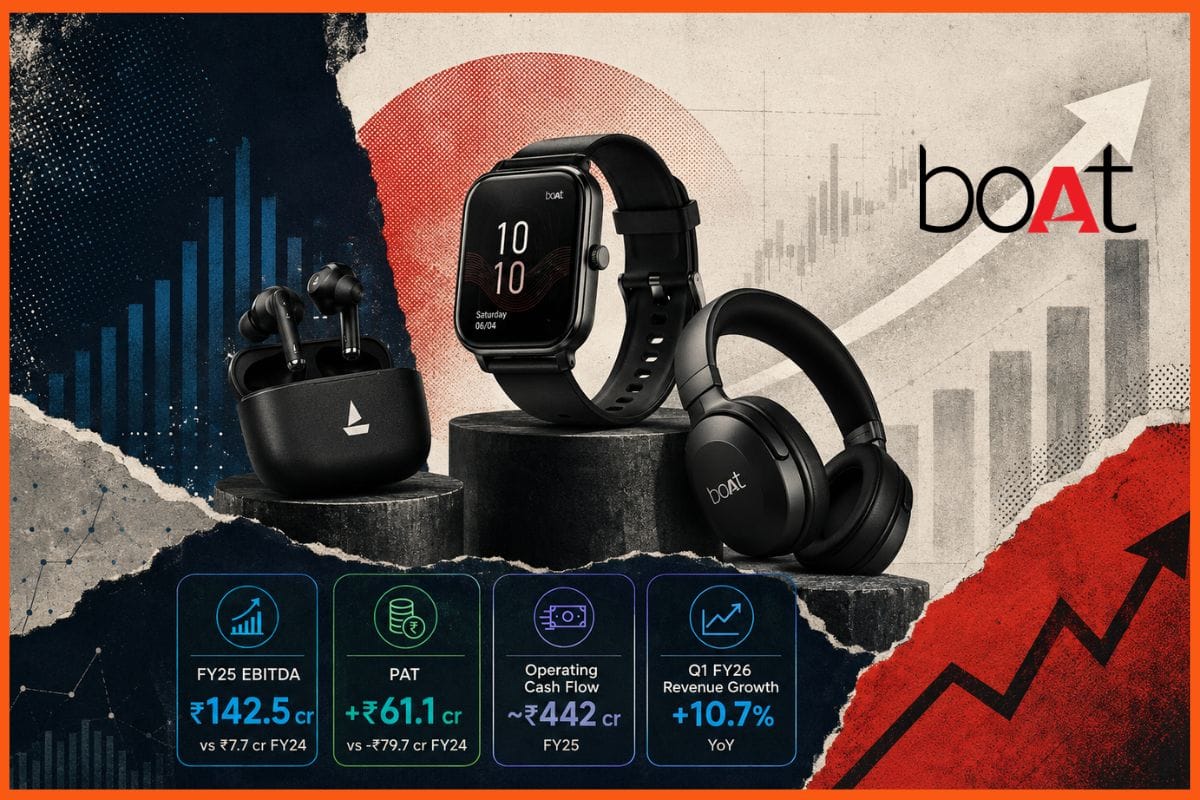
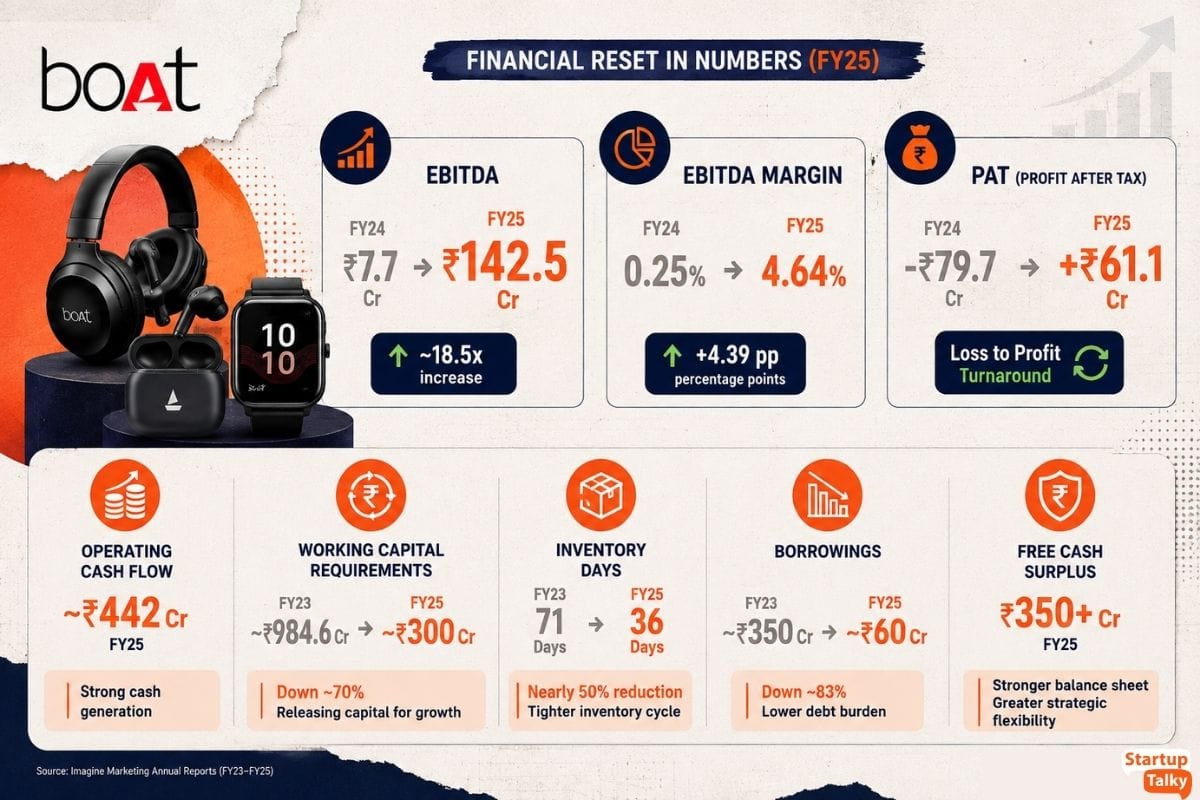
Imagine Marketing’s EBITDA increased from ₹7.7 crore to ₹142.5 crore, while EBITDA margin improved from 0.25% to 4.64%.
At the bottom line, the company moved from a loss of ₹79.7 crore to a profit of ₹61.1 crore.
For a consumer electronics company operating in a highly competitive and price-sensitive market, the shift is significant. It indicates that boAt has been able to improve the economics of the business even without a major acceleration in revenue.
More importantly, it points towards a change in operating priorities: from pursuing scale alone to balancing scale with margins, efficiency and sustainable profitability.
The Turnaround Goes Beyond the P&L
Perhaps the stronger indication of what is changing at boAt can be found outside the income statement.
Operating cash flow reached approximately ₹442 crore in FY25.
At the same time, the amount of capital required to run the business has fallen substantially.
Working-capital requirements declined from approximately ₹984.6 crore in FY23 to around ₹300 crore in FY25. Inventory holding reduced from 71 days to 36 days.
These are important improvements for any consumer electronics business.
The sector is particularly sensitive to inventory cycles. Technology changes rapidly, product refresh cycles are short, and consumer preferences can shift quickly. Excess inventory does not simply lock up capital; it can also create discounting pressure and increase the risk of obsolescence.
Reducing inventory days while releasing hundreds of crores from working capital therefore gives boAt greater financial as well as operational flexibility.
From ₹350 Crore of Borrowings to a ₹350 Crore-Plus Cash Surplus
The transformation of the balance sheet is equally noteworthy.
Borrowings have declined from approximately ₹350 crore to around ₹60 crore. At the same time, the company has built a free cash surplus of more than ₹350 crore.
That represents a significant change in financial positioning.
The ₹350 crore-plus cash surplus could provide greater capacity to invest in product development and R&D, strengthen manufacturing and supply-chain capabilities, enter adjacent consumer technology categories and explore international opportunities. It could also reduce the company’s dependence on external capital as it invests through different industry cycles.
The significance of the ₹350 crore-plus cash position, therefore, is not simply the amount of cash on the balance sheet. The more important question is what boAt chooses to do with it.
A Different Kind of Turnaround
Turnarounds are often associated with a sudden return to high growth.
But some of the more durable corporate turnarounds begin differently.
Margins improve. Inventory becomes tighter. Working capital is released. Debt comes down. Cash generation strengthens. The balance sheet gets repaired.
Only then does the business begin investing for its next growth cycle.
Viewed through that lens, boAt’s FY25 numbers tell a more interesting story than the topline alone suggests.
The company appears to have used a period of slower growth to strengthen the underlying economics of the business.
That could prove important as boAt looks beyond its traditional strongholds in audio and wearables and builds a broader consumer technology portfolio.
The company has been expanding into adjacent categories and increasing its focus on product development, technology, design and domestic manufacturing. A stronger balance sheet gives it considerably more room to pursue those ambitions.
The Next Test: Bringing Growth Back
There is still an important piece missing from the turnaround story: consistent topline growth.
boAt will ultimately need to demonstrate that its improvement in profitability and capital efficiency can coexist with renewed revenue growth.
That is likely to be the next phase of the story.
The challenge will be to sustain financial discipline while continuing to invest in innovation, new categories and capabilities that can create future growth engines.
But the starting position is considerably different today.
A company with lower borrowings, stronger cash generation, improved margins and more than ₹350 crore of surplus cash has substantially greater strategic flexibility than one trying to grow while carrying a heavy working-capital and debt burden.
That distinction matters.
For years, the easiest boAt story to tell was about its slowdown after a period of rapid growth.
The FY25 numbers suggest it may be time to look deeper.
The slowdown was visible. The turnaround underneath it may be the more important story.