Free Gmail vs Google Workspace for Indian Startups
Google Workspace Starter costs an Indian startup ₹318.60 per user per month with GST, or ₹19,116 a year for five people. But the real cost of staying on free Gmail is not storage. It is who owns the inbox.
Google Workspace Starter costs an Indian startup ₹318.60 per user per month once you add 18% GST to Google's ₹270 list price. For a five-person team that is ₹19,116 a year, or roughly ₹10.50 per person per day.
That is the entire financial question.
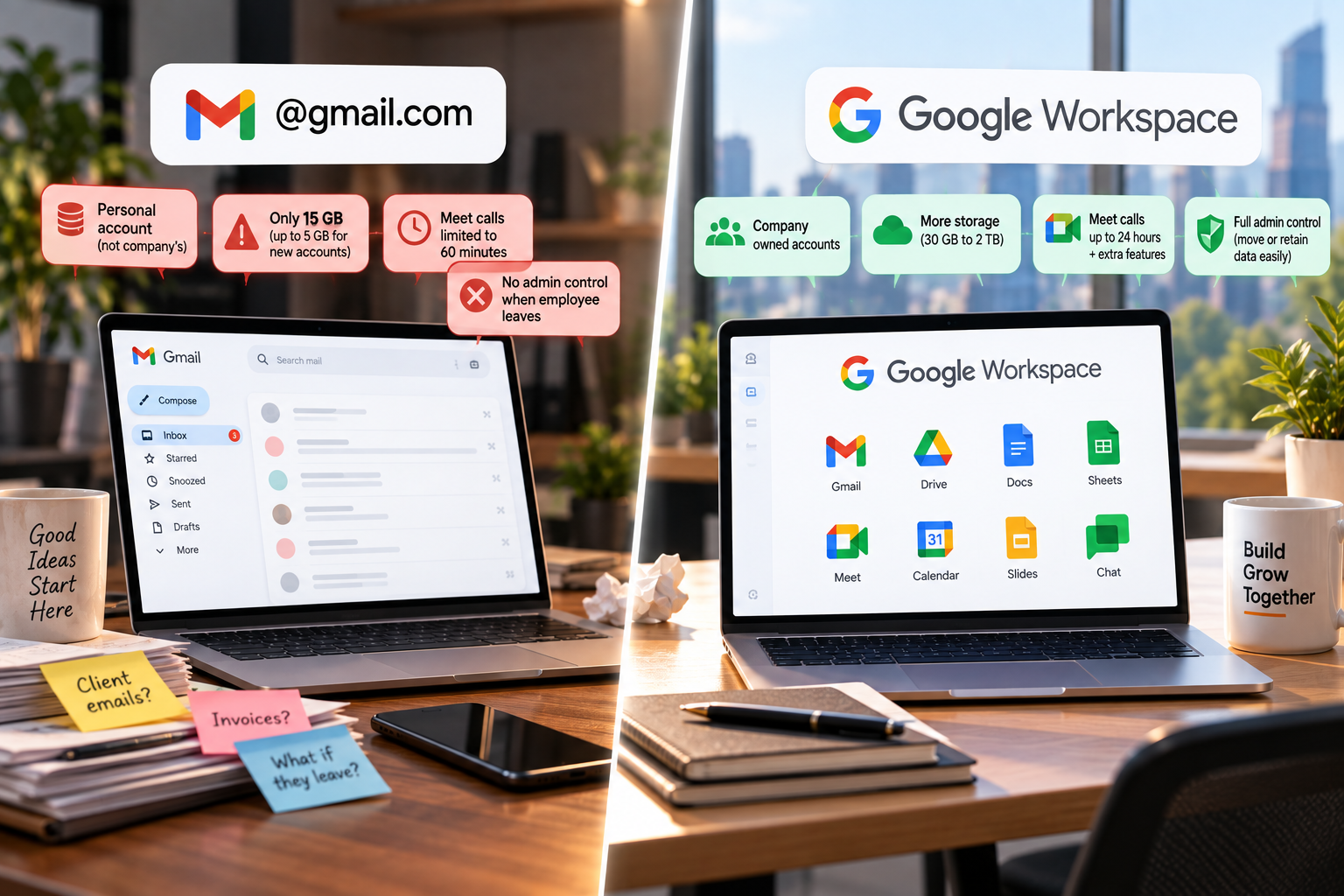
The harder question is what the free tier costs you, and the answer has little to do with storage limits. A personal @gmail.com account belongs to the person who created it, not to the company paying them. When they leave, the inbox goes with them, and Google gives you no administrative route to get it back.
Free Gmail is not a favour. Giving it away is part of how Gmail makes money, worth knowing before you build a company on it.
What Paying Actually Costs
Google publishes per-seat prices excluding tax, and Indian buyers pay 18% GST on top, so the number on your invoice is never the number on the pricing page. Starter lists at ₹270 and bills at ₹318.60. Base is cheaper at ₹99 but includes no Gemini at all. Standard is ₹1,080. For all four plans, GST-inclusive annual totals at 5, 10 and 25 seats, and the discounts currently running, see our full breakdown of Google Workspace pricing in India.
Storage is the other axis. Base gives 20 GB of pooled storage per person, Starter 30 GB, and Standard 2 TB per user with meeting recordings on top.
If you want a walkthrough of what each app in the suite actually does, we cover the Google Workspace tools separately.
Google renamed these tiers in 2025. If you are reading older guides that talk about Business Starter, Business Standard and Business Plus, they are describing the previous naming, and the plan you want is now called Base, Starter, Standard or Enterprise.
Who Owns the Inbox When an Employee Leaves
This is the part that almost never appears in pricing comparisons, and it is the reason I would switch well before cost becomes the deciding factor. On a free Gmail account, the company has no admin console, no ability to force a password reset, and no mechanism to recover mail. The account is a personal Google Account. If your salesperson spent two years building client relationships from rahul.sales@gmail.com, that entire correspondence history, along with every client who has that address saved, walks out of the building on their last day. You cannot suspend it. You cannot read it. You cannot redirect it. Your only option is to ask politely and hope.
On Google Workspace, the same departure is an admin task. You suspend the account, which Google describes as blocking "access to your organization's Google services" while leaving the data intact. You then transfer what you need. Google's own documentation is blunt about the order of operations: "If you don't transfer the content to another user, the content is deleted."
So the sequence matters. Suspend first, transfer Drive files and email data to whoever is taking over the accounts, and only then delete. Google also sells Archived User licences if you need to retain a former employee's data without paying for a full seat, which is useful if you have compliance reasons to keep records.
Free Gmail Storage Quietly Shrank in 2026
The free tier's 15 GB was always shared across Gmail, Drive and Google Photos, which means a founder's holiday photos compete with the company's invoices for the same quota.
It got tighter this year. In March 2026 Google changed its support wording from accounts coming with "15 GB of cloud storage" to "up to 15 GB", and new accounts now start at 5 GB unless the user links a phone number to unlock the rest. For a business that is an awkward dependency: your company's mail quota is now contingent on an employee's personal phone number staying attached to their personal account.
Google Meet Cuts Free Calls Off at 60 Minutes
Free Google Meet allows 100 participants but caps group calls of three or more people at 60 minutes, with a warning at the 50-minute mark. One-to-one calls get 24 hours.
Every paid tier removes that limit entirely, allowing meetings up to 24 hours, and paid accounts also get call-quality features such as Meet's AI noise cancellation. Starter keeps the 100-participant ceiling, Standard raises it to 150 and adds recording, and Enterprise goes to 1,000. If you run client calls, board updates or investor meetings, the 60-minute cutoff is the constraint you will hit first and feel most.
When I Would Actually Make the Switch
Team size is the wrong trigger. Plenty of advice says move at five or ten people, but I think the real line is different.
Switch the first time somebody who is not a founder gets access to company email. That is the moment the ownership problem becomes real, because it is the first time a mailbox containing your customer relationships sits inside an account you do not control. At ₹318.60 per user per month, insuring against that costs less than a single client lunch.
The second trigger is your first invoice. A quote sent from a @gmail.com address and a quote sent from your own domain are read differently by the person approving the payment, and that gap widens the larger the client is.
If you are a solo founder with no employees, no invoices and no client mail worth preserving, the free tier is genuinely fine. Stay on it, and lean on Gmail add-ons to close the workflow gaps. Just know which of those three things changing is your signal to move.
FAQs
How much does Google Workspace cost in India?
Google Workspace Starter lists at ₹270 per user per month, which becomes ₹318.60 after 18% GST. That works out to ₹19,116 a year for five users, ₹38,232 for ten and ₹95,580 for twenty-five. The cheaper Base plan lists at ₹99 per user per month, and Standard at ₹1,080.
What happens to a Gmail account when an employee leaves?
If it is a personal @gmail.com account, nothing you can control. The account belongs to the individual and the company has no administrative recovery options. On Google Workspace, an admin can suspend the account to block access while preserving the data, then transfer Drive files and email to another user. Google warns that if you do not transfer the content before deleting the account, the content is deleted.
Is free Gmail still 15 GB?
Not by default. Google changed its wording in March 2026 to "up to 15 GB", and new accounts start at 5 GB until the user links a phone number. The quota is also shared across Gmail, Drive and Google Photos rather than reserved for email.
What is the Google Meet time limit on free versus paid plans?
Free accounts are limited to 60 minutes for group calls with three or more participants, with a warning at 50 minutes, and 24 hours for one-to-one calls. All paid Google Workspace plans allow meetings of up to 24 hours.