India's EV Logistics Industry Enters a High-Growth Phase: Green Drive Mobility's Hari Krishna on Fleet Electrification, Uptime, and the Future of Last-Mile Mobility
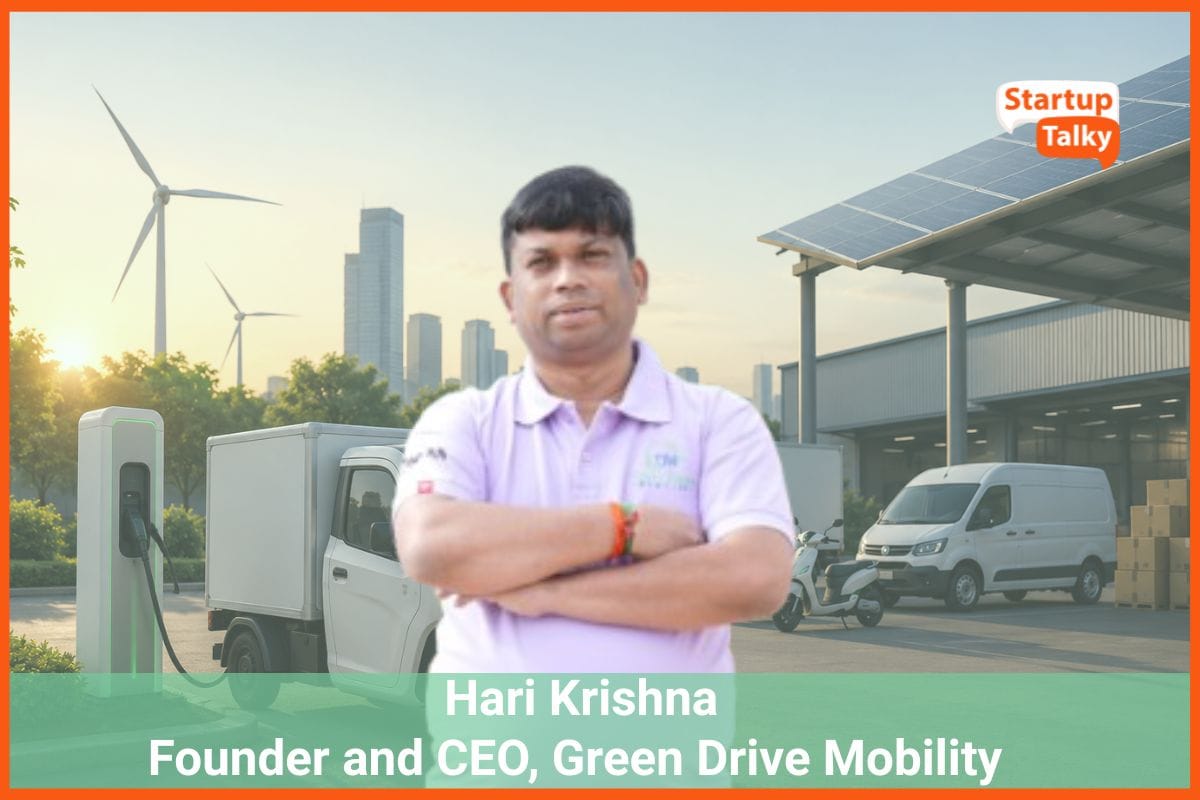
Hari Krishna, Founder & CEO of Green Drive Mobility, discusses EV logistics, fleet electrification, uptime management, driver adoption, charging infrastructure, and the future of India's rapidly evolving electric mobility ecosystem.
India's EV logistics sector is growing rapidly as businesses shift toward cost-efficient and sustainable transportation. With electric two- and three-wheeler adoption expanding at a CAGR of over 40% between 2020 and 2025, the industry is poised for strong growth in the coming years.
In this exclusive StartupTalky interview, Hari Krishna, Founder & CEO of Green Drive Mobility, discusses fleet electrification, EV economics, driver adoption, uptime management, and the future of electric logistics in India.
Why Green Drive Mobility Chose a Full-Stack EV Logistics Model
StartupTalky: Green Drive Mobility built a full-stack EV platform rather than focusing on a single slice, such as vehicle supply or fleet management. What operational reality drove that decision, and what breaks first when an EV logistics company tries to manage only part of the stack?
Hari Krishna: At Green Drive Mobility, we built a full-stack EV platform because every part of the EV logistics ecosystem is deeply interconnected. Managing only vehicles or only fleet operations creates operational gaps that directly impact uptime, utilisation, and delivery commitments.
In real-world logistics, challenges go far beyond vehicle deployment. Charging availability, battery health, maintenance, driver management, route planning, and servicing all influence daily fleet performance. If one layer fails, the entire delivery cycle gets disrupted.
We realised early that EV logistics is ultimately an uptime-driven business, not just a vehicle business. That operational reality led us to integrate vehicle sourcing, leasing, charging coordination, fleet management, servicing, telematics, and driver operations into a unified platform. This full-stack approach helps improve reliability, reduce downtime, optimise fleet utilisation, and deliver scalable EV logistics solutions across first-mile, mid-mile, and last-mile operations.
Comparing EVs and ICE Vehicles for India's Last-Mile Delivery Workforce
StartupTalky: India's last-mile delivery sector runs on razor-thin margins. When you are competing against petrol and CNG two and three-wheelers, what does the total cost of ownership comparison actually look like for a gig delivery worker, and at what fuel price level does the electric option become unambiguously superior?
Hari Krishna: India’s last-mile delivery ecosystem operates on extremely tight margins, which means total cost of ownership becomes far more important than just the upfront vehicle cost. For gig delivery workers, the comparison between EVs and petrol or CNG vehicles largely comes down to daily operating economics, fuel savings, maintenance costs, financing access, and vehicle uptime.
In high-utilisation delivery operations, EVs already offer significantly lower running and maintenance costs compared to ICE vehicles, especially as fuel prices remain volatile. For many delivery riders covering long daily distances, the economics start becoming clearly favourable when fuel expenses begin materially impacting take-home earnings. However, adoption ultimately depends on predictable charging access, financing flexibility, battery reliability, and minimising downtime, because drivers prioritise income stability over technology transition alone.
Rising Fuel Prices Are Accelerating Fleet Electrification
StartupTalky: With oil prices rising sharply following the Iran war and India's import bill under pressure, are logistics companies and delivery aggregators showing more urgency in electrifying their fleets? What is the dominant concern that still holds them back despite rising fuel costs?
Hari Krishna: Rising oil prices and geopolitical disruptions are clearly increasing urgency around fleet electrification across logistics companies and delivery aggregators. India still imports nearly 85-88% of its crude oil requirements, which makes fleet operating costs highly vulnerable to global fuel volatility. At the same time, studies indicate that EVs can already offer a 15-20% lower total cost of ownership in logistics operations compared to diesel vehicles.
But although fuel prices continue to rise, reliability is by far the most important issue that continues to dominate fleet management decisions when considering electric vehicle uptime. EV use continues to be measured using factors like charging capacity, vehicle reliability, battery efficiency, access to financing, and deployment flexibility. Businesses relying on strict time schedules for deliveries cannot afford downtime.
How Green Drive Mobility Minimises EV Downtime During Deliveries
StartupTalky: EV uptime is make-or-break for delivery operations. A petrol vehicle can be refuelled in five minutes anywhere in India. What does Green Drive do when a vehicle's battery is depleted mid-shift, and how does your operational model ensure that downtime does not cost a driver their day's earnings?
Hari Krishna: In delivery operations, vehicle uptime directly impacts driver earnings, so minimising downtime is absolutely critical for EV fleet models. At Green Drive, operational planning is built around route optimisation, battery monitoring, charging coordination, and predictive utilisation tracking to reduce the risk of mid-shift battery depletion. The ecosystem is increasingly moving toward fast-charging access, distributed charging points, and battery-swapping support in high-demand corridors to maintain operational continuity.
If a battery runs low during active operations, intelligent fleet monitoring systems help reroute drivers toward nearby charging or swap points before productivity is affected. The broader goal is to ensure that charging becomes an integrated operational workflow rather than an interruption. Ultimately, EV adoption at scale depends on protecting driver productivity and ensuring predictable daily earnings.
Leveraging AI, Telematics, and Smart Routing in EV Logistics
StartupTalky: Your partnership with Montra Electric to deploy EVIATOR electric small commercial vehicles integrates real-time tracking, smart route planning, and AI-based performance analytics. What specific operational problems does this technology solve, and what data has surprised you most from running these systems in the field?
Hari Krishna: Our partnership around deploying EVIATOR electric small commercial vehicles is focused on solving some of the biggest operational challenges in EV logistics, including route inefficiencies, unpredictable battery utilisation, vehicle downtime, and inconsistent delivery productivity. Through the use of real-time tracking, intelligent route planning, and performance analysis using AI, the operators have a clearer understanding of how the vehicles move, when they charge, how the drivers operate, and how deliveries are conducted.
Some of the most insightful lessons learned on the ground include the extent to which driving behaviour and routes influence battery efficiency and fleet productivity. The data collected showed that through intelligent routes and controlled behaviour, there is an improvement in efficiency and delivery consistency.
Overcoming Range Anxiety and Building Driver Confidence in EVs
StartupTalky: Driver adoption of EVs in India often meets resistance rooted in range anxiety, charging uncertainty, and unfamiliarity with the vehicle. What has Green Drive learned about managing that transition, and what does it actually take to convert a diesel-habituated delivery rider into a confident EV operator?
Hari Krishna: At Green Drive Mobility, we learned early that EV adoption is not just a technology transition, but a behavioural and operational one. Most delivery riders initially resist EVs due to range anxiety, charging uncertainty, fear of downtime, and concerns around income disruption. However, we found that range anxiety reduces significantly once riders experience real-world daily operations and understand route planning and charging discipline.
One of the biggest factors behind successful adoption has been strong operational handholding during the first 30–60 days, including onboarding, route familiarisation, charging guidance, and quick troubleshooting support. We also observed that financial savings drive adoption faster than sustainability messaging. Once riders experience lower running costs and stable earnings, confidence grows rapidly, further strengthened through peer influence and operational reliability
Building the Foundation for India's Used EV and Battery Certification Market
StartupTalky: India's EV logistics sector is still early, but it will eventually need a functioning used-vehicle market and reliable battery health certification to sustain fleet economics. How far away is that infrastructure, and what can fleet operators like Green Drive do now to lay the groundwork for a healthier ecosystem?
Hari Krishna: India's EV logistics infrastructure is at the nascent stages of creating a mature market for secondhand EVs and standardised EV battery health certification procedures. These would gain increasing relevance as fleet-scale adoption grows, and fleet managers start analysing the long-term value, resale potential, and life cycle cost-effectiveness of their EVs.
While the infrastructure is developing, any breakthrough would have to come through better diagnostic capabilities for batteries, standardised performance metrics, and increased willingness on behalf of financiers and insurers to support used EVs as an asset class. We can help fleet operators in creating a foundation for EV logistics in India by recording vehicle performance information, conducting predictive battery monitoring, and establishing maintenance history records.
 Sakshi Jadhav