India's Online Gaming Industry: Banned and Billed ₹1 Lakh Crore at the Same Time
How a sector that built India's first consumer internet unicorn got hit by a tax change, a parliamentary ban, and a Supreme Court verdict within three years.
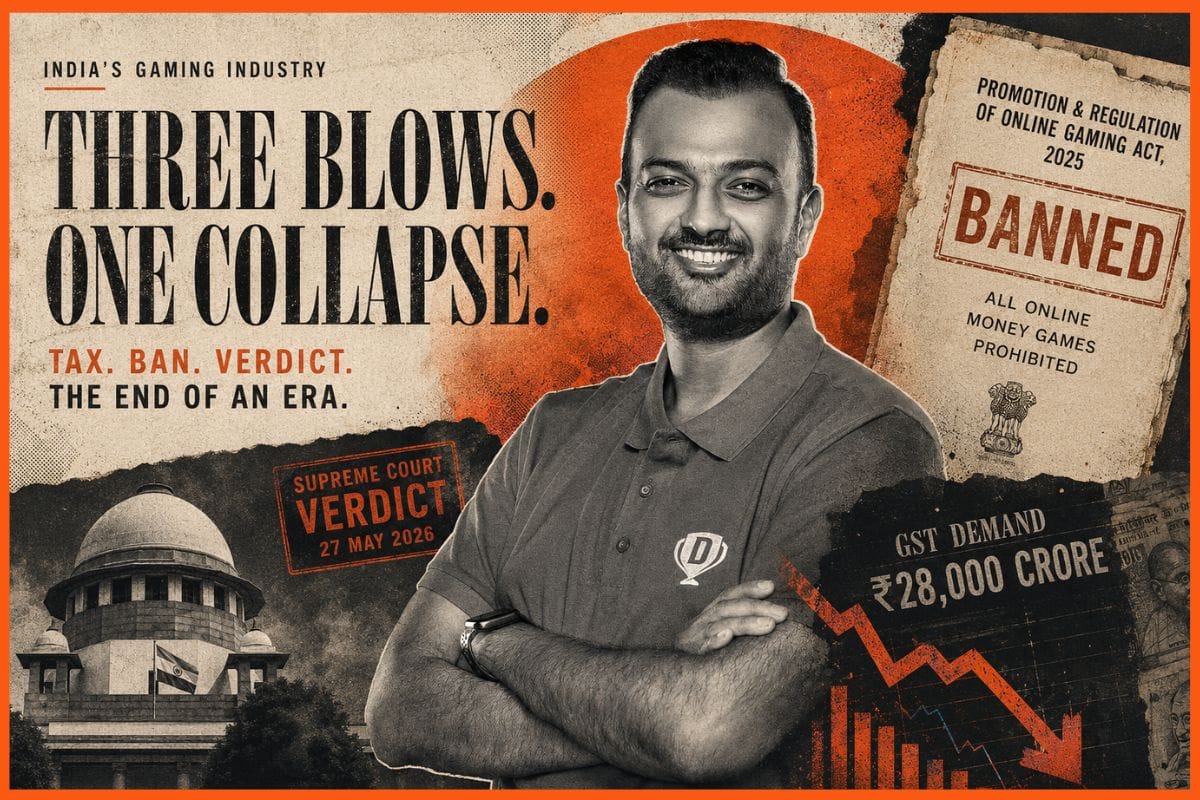
On May 27, 2026, the Supreme Court confirmed what the industry had feared for over two years: backdated GST demands totalling over Rs 1 lakh crore against India's real-money gaming companies are valid, and must be paid.
The companies that owe this money no longer have a legal business to run. Their core product was banned by Parliament nine months ago.
That is the situation. And the full story is worth understanding, because it is not only about gaming.
How the Industry Got Here
Dream11 was founded in Mumbai in 2008 by Harsh Jain and Bhavit Sheth. For the first few years, it was a niche fantasy cricket product. Then cheap mobile data arrived, affordable smartphones spread across smaller cities, and the IPL turned cricket into a daily event. Dream11 grew fast.
In 2019, it became India's first gaming unicorn. By 2021, its parent company Dream Sports had raised $840 million from Tiger Global, D1 Capital, Falcon Edge, and Steadview Capital, valuing it at $8 billion. Dream11 had over 200 million registered users by 2023, per company disclosures, and reported revenue of Rs 6,384 crore and net profit of Rs 188 crore in FY23.
Courts were consistently on the industry's side. Multiple high courts and a 2019 Supreme Court ruling upheld fantasy sports as a game of skill, not gambling. A Deloitte-FIFS report in 2023 valued the online gaming industry at $2.6 billion in FY22 and projected it would reach $8.6 billion by FY27.
The industry built its model on those foundations. Then came three separate regulatory moves that together unravelled it.
The Opening Shot: A Tax That Made the Math Impossible (October 2023)
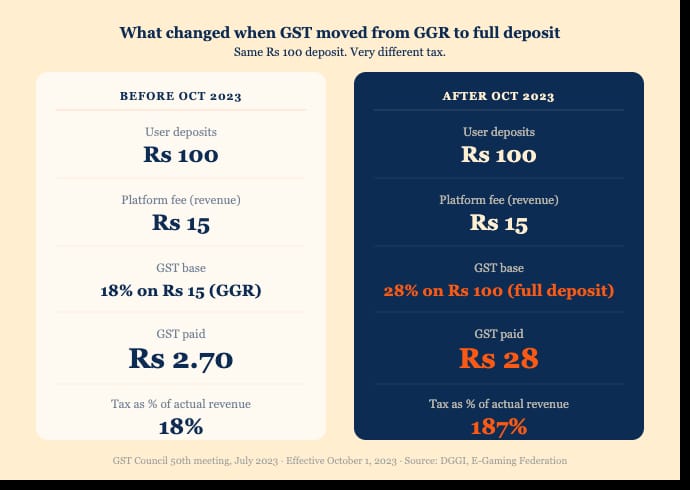
Until September 2023, real-money gaming companies paid 18% GST on their Gross Gaming Revenue (GGR), which is the platform fee they retained after distributing prize money to winners. This was the industry-standard approach used in most regulated markets globally.
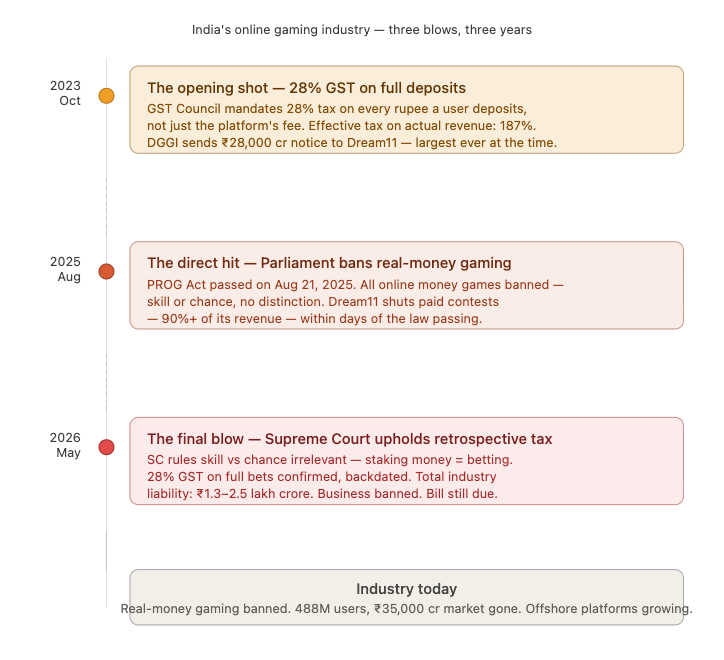
The GST Council changed this at its 50th meeting in July 2023, with the new rate taking effect from October 1, 2023. The 28% GST would now apply to the full Contest Entry Amount (CEA), which is the total deposit a user makes, before any prize money is paid out.
The E-Gaming Federation called this "a nearly 1000% increase in taxation." That number is not as dramatic as it sounds: if a platform earns Rs 15 as fees on a Rs 100 deposit, the old tax was Rs 2.70 (18% of Rs 15). The new tax is Rs 28 (28% of Rs 100), which is 187% of the platform's actual revenue.
Roland Landers, CEO of the All India Gaming Federation (AIGF), responded with a formal statement: "This decision ignores over 60 years of settled legal jurisprudence and lumps online skill gaming with gambling activities. This decision will wipe out the entire Indian gaming industry and lead to lakhs of job losses, and the only people benefiting from this will be anti-national illegal offshore platforms."
The GST Council did not modify its position. Revenue Secretary Sanjay Malhotra stated publicly that this was not retrospective taxation; the law had always been this way, and the Council was merely clarifying it.
The DGGI then began issuing show-cause notices. Dream11 received a notice for Rs 28,000 crore, confirmed by multiple reports citing DGGI sources, which was the largest GST notice ever sent to any company in India at that point. Gameskraft received Rs 21,000 crore, Games24x7 received Rs 20,000 crore, and Delta Corp Rs 16,822 crore. Across 71 companies, cumulative demands crossed Rs 1.12 lakh crore (DGGI filings, December 2023).
The AIGF conducted a survey of 12 gaming companies after the new rate took effect. Nearly 50% reported losses, and more than half said they were experiencing stagnation or decline, per the federation's published findings.
The FICCI-EY M&E Report 2025 noted that the imposition of 28% GST on deposits led some users to migrate towards illegal and offshore platforms, which continued to operate and advertise in 2024.
The Direct Hit: Parliament Bans Real-Money Gaming (August 2025)
While the tax litigation was running through the courts, Parliament passed the Promotion and Regulation of Online Gaming Act, 2025 (PROG Act). It was passed by the Lok Sabha on August 20, signed by the Rajya Sabha on August 21, and received Presidential assent on August 22, 2025.
IT Minister Ashwini Vaishnaw, who piloted the bill, said online money gaming had become "a public health menace" and cited addiction, family financial distress, and money laundering risks. The government estimated that 45 crore people lose around Rs 20,000 crore every year in online games, per the minister's statement in Parliament.
The Act is a prohibitive model. It does not regulate or license real-money gaming; it bans it entirely, regardless of whether the game involves skill or chance. E-sports and online social games are permitted; any game where users deposit money in expectation of a financial return is not.
This is a legally significant distinction. Before 2025, courts had carved out games of skill, including fantasy sports, from gambling restrictions. The PROG Act eliminated that distinction for the purpose of money gaming, though legal challenges from the industry on constitutional grounds are still pending before courts, including on questions of whether Parliament had the authority to legislate on a subject that overlaps with state gambling powers.
Dream11, MPL, Gameskraft, WinZO, Zupee, PokerBaazi, Games24x7, and others suspended real-money operations immediately after the law passed. CEO Harsh Jain told employees there was "no legal pathway to continue once the law takes effect." Dream Sports pivoted to FanCode, DreamSetGo, and Dream Game Studios. MPL moved to free-to-play. Paytm's First Games formally exited real-money gaming.
The paid contests that were shut down accounted for over 90% of Dream11's revenue, per Wikipedia's company entry, citing its own public disclosures.
The Final Blow: Retrospective Tax on a Business Already Banned (May 2026)
On May 27, 2026, a Supreme Court bench of Justices J.B. Pardiwala and R. Mahadevan delivered its judgment in Directorate General of GST Intelligence v. Gameskraft Technologies.
The court held that skill versus chance is not the determining factor for GST classification. Once money is staked on an uncertain outcome, it constitutes betting and gambling under the GST Act, and the entire staked amount, not just the platform fee, is taxable. The court further held that gaming platforms are not intermediaries; they are suppliers of actionable claims, making the full contest entry amount the taxable consideration.
The ruling confirmed all backdated GST demands and restored the Karnataka High Court's Gameskraft notice, which had previously been quashed at the high court level.
The math that follows: Dream Sports faces a confirmed demand of Rs 28,000 crore. Its best-ever annual revenue was Rs 6,384 crore. The business that generated that revenue is now banned by law.
As Sivakumar Ramjee, Executive Director of Nangia Global Advisors, put it in a statement after the ruling: "With reported tax exposure across the sector estimated at over Rs 1 lakh crore, this is no longer merely a litigation issue. It is a balance-sheet event."
Legal experts estimate the total liability, including penalties under Section 74 and interest could reach Rs 2.3 to 2.5 lakh crore, per Republic World reporting on the judgment.
What the Public Is Saying
Reaction on X since the ruling has been divided sharply along two lines: those who see a harmful industry finally held accountable, and those who see dangerous regulatory overreach.
The first group is vocal and, in many cases, speaking from direct experience. "Come and see in tier 2 and tier 3 cities how many households it has destroyed," wrote one commenter. Another said simply: "Getting rid of Dream11 was a good riddance." A chartered accountant added that betting apps should be banned altogether. A commenter noting Puneet Kumar's credentials at IIT Madras, Steadview, and McKinsey made the point bluntly: no one from that background with genuine ethical grounding should be defending what was functionally a betting product.
The second group focused less on whether the industry deserved scrutiny and more on what kind of regulatory tool was used. "Wtf is retrospective GST? That should be illegal," wrote one user, reflecting how unfamiliar the concept is even among engaged observers. Another put it more precisely: paying tax on years of past operations under rules that did not exist at the time is what the retrospective demand amounts to.
The comment that has circulated most among startup and investor circles came from a user in fintech: "The retrospective ruling is what breaks most teams. Dream11 survived because they had capital to absorb retroactive taxes. But younger platforms? The tax bill becomes a hard stop on runway. You can't plan scaling when tax policy rewrites the past."
A separate commenter drew a wider conclusion about what aggressive tax enforcement produces: "GST sometimes works as tax collection goons, where they push the industry so much that people reach out to CAs and advocates not to fight litigation but to find more ways to evade taxes and flee the country."
Both sides of the thread are right about something. Consumer harm from real-money gaming is real. So is the economic and policy harm from how this was handled.
The Scale of What Was Built, and Lost
Before the ban, here is what the sector looked like, per FICCI-EY M&E Report 2025, DGGI filings, and company disclosures:
| Metric | Figure |
|---|---|
| Online gamers in India (2024) | 488 million (FICCI-EY 2025) |
| Gaming market size (FY24) | Rs 35,000 crore (FICCI-EY 2025) |
| Real-money gaming share of spending | 86% (FICCI-EY 2025) |
| Direct jobs in gaming | 1 lakh+ (FICCI-EY 2024) |
| Dream11 peak valuation | $8 billion |
| GST notices to 71 companies | Rs 1.12 lakh crore (DGGI, December 2023) |
| Total liability with penalties and interest | Rs 2.3 to 2.5 lakh crore (legal estimates, Republic World) |
The ripple effects went beyond the platforms. Dream11 was the IPL title sponsor. Fantasy gaming was the single largest advertising category in cricket broadcasting. Hundreds of content creators built channels around team selection tips. Payment gateways processed thousands of crores in deposits and withdrawals. All of this has either stopped or declined sharply.
One outcome the government likely did not intend: according to the FICCI-EY report and industry observers, users have not stopped playing, they have moved to unregulated offshore platforms that have no KYC requirements, no TDS deductions, no grievance systems, and no accountability. The consumer protection rationale for the ban is directly undermined by this shift.
The Retrospective Tax Problem: India Has Been Here Before
The gaming industry's tax situation carries an uncomfortable historical parallel.
In 2012, the then Finance Minister Pranab Mukherjee introduced an amendment to the Income Tax Act that retrospectively taxed indirect transfers of Indian assets, backdated to 1962. The amendment was specifically designed to nullify a Supreme Court verdict that had ruled in Vodafone's favour. The case became internationally infamous.
Cairn Energy faced a similar Rs 10,247 crore retrospective tax demand. Both companies went to international arbitration under bilateral investment treaties and won. India eventually repealed the 2012 retrospective amendment in August 2021 under Finance Minister Nirmala Sitharaman, precisely because the reputational and arbitration cost had become too high.
The gaming situation is structurally different, but the investor signal is the same: decisions made in good faith under the law as it existed can be re-priced years later. The Modi government repealed the 2012 retrospective tax law to restore investor confidence. Now, within the same administration, a Supreme Court ruling has confirmed retrospective demands of an even larger scale against an industry it simultaneously banned.
Puneet Kumar, a former MD at Steadview Capital, one of Dream11's early backers, and now CEO of Mirae Asset Venture India, framed the situation on X this week as three successive regulatory blows landing on the same industry within three years: a tax change that broke the economics, a ban that ended the business, and now a court ruling confirming a tax bill on something that no longer legally exists. His framing resonated widely in investor circles because it names the sequence precisely. It is not one bad policy. It is three compounding ones.
Every founder in a regulated sector, including fintech, edtech, and healthtech, is drawing conclusions from this sequence.
How Other Countries Handle This
The contrast with global regulatory frameworks is instructive.
The United Kingdom applies its Remote Gaming Duty on Gross Gaming Yield, which is the difference between amounts staked and winnings paid out. The rate was 21% for most of the past decade and recently rose to 40% in April 2026 for online games. Even at 40%, the tax base is the operator's actual margin, not the full bet value, and it was announced in advance after a public consultation that ran from April to July 2025.
The United States, following the 2018 Supreme Court ruling that allowed states to legalise sports betting, created a state-by-state licensing model. Fantasy sports operate under a separate federal framework as games of skill. No US state has attempted to retroactively re-tax fantasy platforms on the basis that they were always gambling.
Australia applies a point-of-consumption tax on Gross Gaming Revenue at the player's state of residence.
The consistent pattern across mature regulatory frameworks is: tax on actual revenue, set rules in advance, and provide a licensing pathway. India applied tax on gross deposits, backdated the liability, and ultimately banned the activity entirely.
The Government's Case
The government's concerns were not invented.
Real addiction harm from real-money gaming is documented. Aggressive design features, daily welcome bonuses, and constant notifications were widely criticised even within the industry. The advertising during IPL broadcasts, often targeting younger and lower-income audiences with promises of winnings, generated genuine public concern.
The revenue argument was also legitimate: a sector processing thousands of crores in user deposits and paying tax only on the platform fee did create a structural gap between economic activity and tax yield.
Finance Minister Nirmala Sitharaman said after the 50th GST Council meeting that the decision was made considering the "moral question" that gaming cannot be taxed at par with essential commodities.
The question is not whether the government had valid reasons. It is whether the execution, retrospective liability on top of an outright ban, was proportionate to those reasons, or whether it will achieve the stated goals of consumer protection.
A Contradiction Worth Naming
There is a question this story never quite answers directly, and it is the most important one.
If real-money gaming was harmful enough to be banned in August 2025, why did the government allow Dream11 to be the IPL title sponsor? Why did it allow Tiger Global, Steadview, D1 Capital, and others to invest $840 million at an $8 billion valuation? Why did it collect years of GST revenue from the sector before declaring the tax had always been calculated incorrectly?
The industry was not operating in secret. It was one of the most visible consumer brands in India, advertised during every major cricket match, and celebrated as a Make-in-India digital success story.
The answer may be that regulatory positions changed as social harm became more visible, and that governments everywhere are slow to act until a problem reaches a threshold. That is a defensible explanation.
What is harder to defend is the combination of retrospective taxation on a now-banned business. If the activity was harmful, the ban addresses the harm going forward. The retrospective tax demand does not protect a single consumer. It simply attempts to recover revenue from companies whose business model the government has now made illegal.
What Comes Next
Real-money gaming as it existed in India between 2012 and 2025 is effectively over. What remains is smaller and more uncertain.
E-sports and casual gaming now have the clearest legal runway. The PROG Act explicitly permits e-sports and social games. India hosted over 275 large-scale esports tournaments in 2024, up from 190 in 2023 (FICCI-EY 2025), and the government officially recognised esports as a sport in 2022.
Dream Sports, with FanCode and DreamSetGo providing some alternative revenue, is better positioned than most to survive. Smaller platforms with no secondary businesses face closure or acquisition.
The Rs 2.5 lakh crore in combined tax demands will not be collected in full. The companies do not have assets anywhere near that scale. A settlement framework, legislative waiver, or protracted litigation that keeps enforcement at bay is the only practical path. Several industry sources expect negotiations over payment terms to begin quietly once the initial legal dust settles.
Policy reform remains possible over a longer horizon. The Online Gaming Authority of India, established under the PROG Act, could eventually create a licensed framework for some form of regulated digital sports gaming, taxed on revenue rather than deposits, with responsible gaming requirements built in. Whether that happens depends on whether the government concludes that a regulated market is better than the unregulated offshore one it has inadvertently created.
The gaming sector's story is partly about what happens when an industry operates in a grey zone too long without pushing for formal regulation. And it is partly about what happens when a government reaches for the harshest available instrument to correct a problem it allowed to grow for over a decade.
Both things can be true at the same time.
What India's startup ecosystem will be watching, long after this specific dispute is resolved, is the underlying question that Puneet Kumar and others in the investment community are now asking: if the rules that made a business legal and profitable can be retroactively rewritten after the business reaches scale, how do you model that risk when deciding whether to build in India in the first place?