From GCCs to Global Innovation Hubs: Mohith Mohan on AI, Leadership and the Future of Enterprise Centres
In this interview, Mohith Mohan shares insights on the future of India's GCC ecosystem, AI-driven transformation, leadership challenges, DPDPA compliance, and how global capability centres are evolving into strategic innovation hubs.
India's Global Capability Center (GCC) ecosystem is undergoing a major transformation, evolving from cost-efficient delivery hubs into strategic innovation engines for multinational enterprises. The sector is projected to grow at a 10–12% CAGR through 2030, with the market expected to surpass $100 billion in value. Increasing investments in AI, digital engineering, cybersecurity, product development, and enterprise transformation are pushing GCCs up the value chain, while emerging regions across Eastern Europe, Latin America, Southeast Asia, and Africa are intensifying global competition.
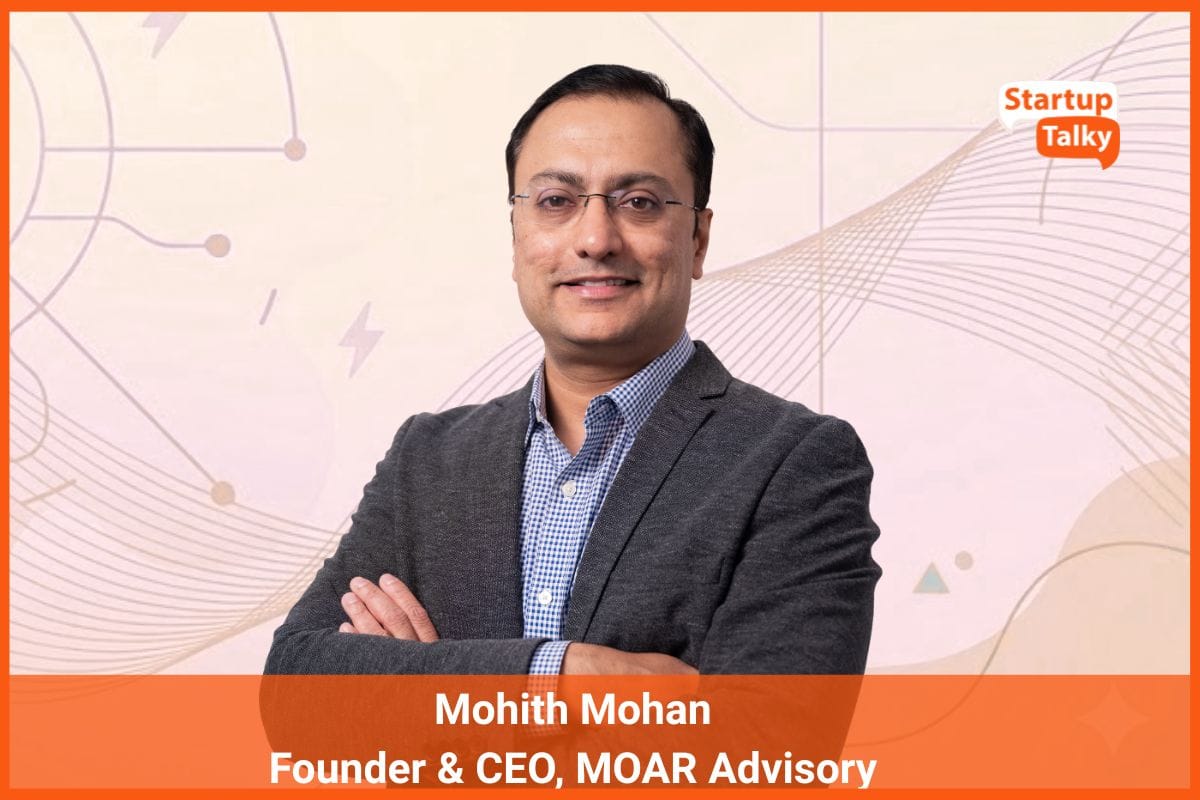
Against this backdrop, Mohith Mohan, founder and CEO of MOAR Advisory, shares his perspectives on the future of GCCs, AI-driven transformation, BOT models, India's competitive advantages, DPDPA compliance, and what it truly takes for a centre to evolve from a Global Capability Centre into a Global Innovation Centre.
StartupTalky: You have said global enterprises are no longer just asking how to enter India but how to get it right. Based on the GCCs you have advised, what are the three costliest mistakes enterprises make in the first 18 months after the setup decision?
Mohith Mohan: One of the most common mistakes enterprises make when establishing a GCC is treating as a location decision rather than a business model decision. Organisations often spend disproportionate time evaluating cities, real estate options, success metrics, and leadership model. Eighteen months later, they have a functioning centre but not a strategically relevant one. The mindset should be to treat the GCC not as a enterprise, but as another corporate office, almost a second headquarters that is integral to enterprise strategy and value creation. The second is importing legacy organisational structures into a new environment.
A GCC should not simply replicate functions that already exist elsewhere. The most successful centres are designed around outcomes, products, or capabilities rather than traditional reporting lines. Replication creates cost centres; reinvention creates strategic assets that drive innovation, agility and business impact. The third is delaying leadership hiring. Many firms often assume they can establish the organisation first and bring in leadership later.
In reality, the earliest leadership decisions can easily translate into an eighteen-month delay in achieving strategic maturity. The common thread across all the three mistakes is a focus on setup rathe than scale. Organisations often concentrate on establishing the centre when they should be designing for long-term value creation from day one. The most successful GCCs are built with the ambition, governance, and leadership of a strategic enterprise hub, not simply another operating location.
StartupTalky: OpenAI and Anthropic moving into AI services directly challenges the engagement model that built the Indian IT industry. How is this shift already changing the mandates that GCCs are being given by their parent companies?
Mohith Mohan: The biggest change is that headquarters are no longer asking GCCs to support AI transformation they are asking them to lead it. Historically, many GCCs were measured on delivery capacity, cost efficiency, and operational excellence. Today, boards are increasingly evaluating them on automation outcomes, AI adoption rates, productivity gains, and business impact. The move by OpenAI and Anthropic into services reinforces a broader shift from manpower-led delivery to outcome-led execution.
As AI-native firms continue to demonstrate that smaller teams can deliver disproportionately larger outcomes, enterprises are raising the bar on how much productivity can be unlocked, how quickly innovation can be delivered, and how effectively AI can drive business value.
This shift is moving India Centre mandates upstream, with centres increasingly being entrusted to build enterprise AI platforms, govern AI risk and compliance frameworks, develop proprietary AI capabilities, and lead large-scale transformation programmes that were traditionally driven by global business units. The focus is no longer just on execution at scale, but on enabling enterprise-wide transformation and measurable business outcomes.
StartupTalky: MOAR has advised on GCC strategy across India, the Americas, and now Africa through the Western Cape engagement. Where is India's competitive advantage as a GCC destination genuinely narrowing, and what does it still offer that no other geography can replicate?
Mohith Mohan: India's enduring advantage is scale combined with complexity. No other market offers the same combination of talent depth, leadership maturity, domain expertise, ecosystem support, and operational experience across virtually every business function.
India is one of the few places where a company can build a 5,000-person operation, recruit specialised AI researchers, run global finance processes, establish a cybersecurity centre, and develop digital products all within a single ecosystem. That ability to scale sophisticated capability across multiple disciplines remains exceptionally difficult to replicate anywhere else. However, India's advantage is narrowing in two areas.
First, talent is becoming more globally distributed. Countries across Eastern Europe, Latin America, Southeast Asia, and Africa are developing strong digital talent pools, particularly in specialised technology domains. Second, the traditional labour arbitrage story is becoming less compelling as AI increases productivity and reduces dependency on large workforces
StartupTalky: The Build-Operate-Transfer model is the dominant GCC entry structure. At what specific stage does the transfer most commonly fail, and what governance arrangements should enterprises insist on before signing a BOT agreement?
Mohith Mohan: Before selecting an operating model for entering India, enterprises should first evaluate the fundamental questions of why, what, where, when, who and how to ensure the model aligns with their strategic objectives. Build-Operate-Transfer (BOT) is one of several available approaches and is not necessarily the right fit for every organisation.
That said, most BOT failures do not occur during the build phase or the operate phase. They occur in the twelve months immediately preceding transfer. That is the point at which enterprises discover they have operational control on paper but not in practice.
Critical knowledge, leadership relationships, talent retention strategies, and cultural norms often remain embedded within the service provider rather than the enterprise. Before entering any BOT engagement, organisations should establish three governance mechanisms.
First, clearly defined transfer-readiness milestones tied to capability development rather than timelines. Second, joint governance structures with shared visibility across talent, operations, finance, and compliance from day one. Third, explicit succession and leadership transition plans that begin well before transfer discussions formally start. A successful transfer is not an event. It is a process that should effectively begin on the first day of the engagement.
StartupTalky: India's DPDPA came into full operational effect in late 2025. How prepared are GCC leadership teams for the practical compliance obligations, and where are the most common gaps between what they think they have done and what the regulation requires?
Mohith Mohan: Most leadership teams understand the intent of the legislation. The challenge is operationalising it consistently. The most common gap is confusing policy creation with compliance readiness. Many organisations have updated policies, governance documents, and internal communications.
Fewer have mapped data flows comprehensively, implemented monitoring mechanisms, or established clear accountability for ongoing compliance. Another gap is consent management. Organisations often underestimate the complexity of demonstrating how consent is obtained, recorded, managed, and withdrawn across multiple systems and jurisdictions.
We also see challenges around vendor ecosystems. Compliance obligations do not stop at the enterprise boundary. Companies must understand how data is handled across partners, suppliers, and third-party service providers. The next phase of DPDPA maturity will be less about legal interpretation and more about operational discipline.
StartupTalky: The industry narrative has shifted from Global Capability Centre to Global Innovation Centre. What concrete, measurable evidence does a GCC need to demonstrate before that language change is earned rather than aspirational?
Mohith Mohan: A centre earns the right to be recognised as a Global Innovation Centre when it can demonstrate measurable influence on enterprise outcomes. That evidence typically falls into four categories.
First, ownership of globally deployed products, platforms, or intellectual property. Second, a significant share of enterprise patents, research outputs, or strategic innovation investments originating from the centre. Third, decision-making authority rather than execution responsibility. Centres that shape strategy create greater enterprise value than those focused solely on implementation. Fourth, measurable business impact whether through revenue generation, productivity gains, customer experience improvements, or the creation of new market opportunities.
The evolution of a centre is not simply from capability delivery to innovation; it is a progression from skill building to capability building and ultimately to driving business outcomes. The strongest proof of that evolution is the ability to create value that influences enterprise direction, accelerates growth, and contributes meaningfully to the organisation's top line. If a centre is primarily executing work designed elsewhere, it remains a capability centre. If it is creating value that shapes enterprise strategy and business performance, it has earned a broader strategic role within the organisation.
StartupTalky: What do GCC leaders who have built their careers entirely within the India ecosystem most consistently misread about how their global headquarters perceives the India centre's strategic contribution?
Mohith Mohan: A common challenge for organisations building leadership teams in India Centres is finding leaders who can operate beyond a local or centre-specific context. While technical expertise and operational excellence are readily available, the differentiator is often the ability to understand enterprise priorities across markets, navigate cultural nuances, and make decisions through a global business lens. As India Centres take on larger and more strategic mandates, organisations are increasingly looking for leaders who can influence outcomes across geographies rather than manage delivery within a single location.
This reflects a broader shift in how global headquarters evaluates India Centres. Strong delivery and operational excellence remain important, but they do not automatically translate into strategic influence. Global leadership evaluates the centre against every other strategic investment competing for capital, attention, and executive sponsorship.
As India Centres take on larger mandates, leaders must combine execution excellence with cultural awareness, business context, and the ability to navigate global nuances. Solutions built in the centre ultimately serve customers, employees, and stakeholders across markets, making it essential for leaders to think globally while acting locally.
 Apoorva Bajj