John Ternus Becomes Apple CEO: Does the Handoff Matter?
John Ternus takes over as Apple CEO on September 1, 2026. History says the CEO handoff itself barely moves the stock, what matters is the valuation and AI cycle he inherits.
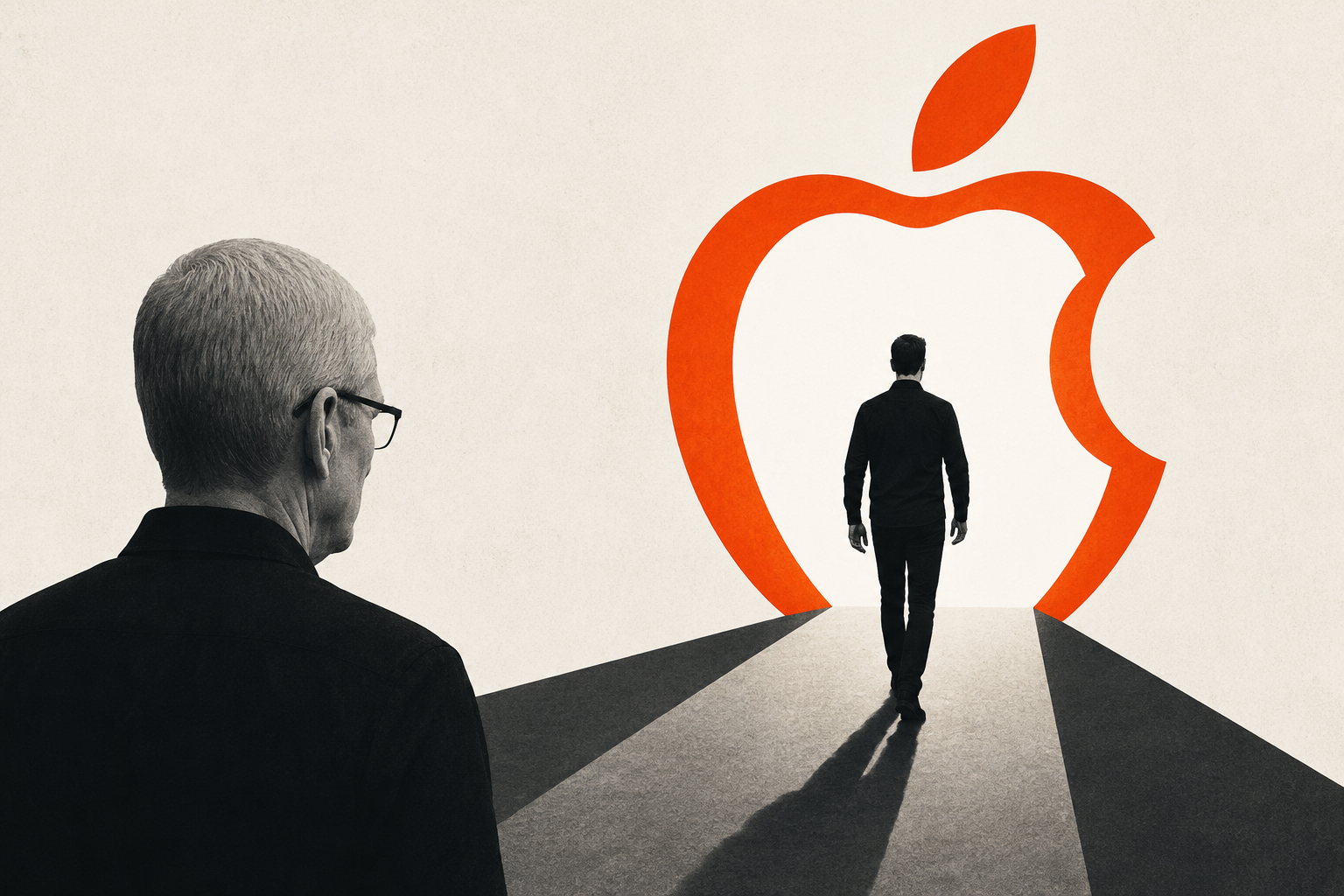
John Ternus spent 25 years making sure Apple's hardware was ready before Tim Cook ever presented it. Starting tomorrow, he's the one presenting it.
Apple confirmed the handover on April 20, 2026: Cook moves to executive chairman, Ternus becomes CEO, effective September 1. The market's first reaction was a shrug in the wrong direction: shares slipped about 1% after hours the day it was announced. Wedbush's Dan Ives called the timing unexpected, coming in the middle of what he called a critical phase of Apple's AI strategy, and said investors would have more questions than answers for a while.
What Cook hands over
Fifteen years, one job. Cook took over from Steve Jobs in August 2011 and built Apple into a $4 trillion company, a market cap that grew more than twentyfold on his watch. As executive chairman, he stays on the board and keeps a hand in policymaker relationships, but he's out of product reviews, supply chain calls, and daily operating decisions. Ternus now owns those.
Ternus isn't an outsider hire. He joined Apple in 2001 on the product design team, worked on the Cinema Display, made VP of hardware engineering in 2013, and became SVP in 2021, picking up oversight of the iPhone, iPad, Mac, AirPods, and Apple's move to its own silicon along the way. Those product lines carry roughly 80% of Apple's revenue today.
The quarter he's inheriting
Apple's most recent results, for the quarter ended June 2026, gave Ternus a strong headline to start with: revenue of $109.4 billion, up 16.4% year-on-year, and net income of $29.8 billion, up from $23.4 billion a year earlier. iPhone revenue hit a June-quarter record of $54.3 billion, up 22%. Mac had its own record quarter at $10.4 billion, up 29%.
The guidance attached to that beat is less clean. Apple told investors to expect September-quarter revenue growth to decelerate to 9-11%, citing supply constraints across iPhone, Mac, and iPad, plus a 2.5-point foreign exchange headwind. Ternus starts the job managing a slowdown Cook already flagged, not a clean handoff into fresh momentum.
What history says about a CEO change
Apple's own 2011 handoff set a high bar: the stock rose about 76% in Cook's first year running the company. Three other megacap successions since then look nothing alike.
| Transition | Year | Entry multiple | First-year return |
|---|---|---|---|
| Jobs → Cook (Apple) | 2011 | ~15x earnings | +76% |
| Ballmer → Nadella (Microsoft) | 2014 | mid-cycle | +15% |
| Page → Pichai (Alphabet) | 2019 | mid-cycle | +41% |
| Bezos → Jassy (Amazon) | 2021 | ~70x earnings | -38% |
| Cook → Ternus (Apple) | 2026 | ~36x earnings | unknown |
Ternus inherits Apple at roughly 36 times earnings, well above Cook's entry point and the stock is already up more than 30% over the past year. That's a long way from Jassy's 70x entry that preceded a crash, but it's nowhere near the cheap multiple Cook started with either. On this table, Ternus sits closer to the middle than either extreme, which is exactly why his first year is genuinely unpredictable rather than a story anyone can call in advance.
The AI bet he's actually judged on
Ternus has been explicit about not wanting to compete on the "we shipped a model" story. At a June town hall, he told employees:
"We don't ship technology for technology's sake... how can we leverage technology to ship amazing products, features, and experiences for our users? That's the way we think about AI."
That philosophy is already being tested. Apple unveiled a rebuilt Siri at WWDC 2026, a needed move after years of lagging Microsoft and Google on AI and leaning on Google's Gemini model to fill the gap. Apple has also paused major Vision Pro development to redirect engineering resources toward smart glasses, now targeted for a late-2027 launch, a product that will ship entirely on Ternus's watch, not Cook's.
Apple had been preparing this succession for at least a year before the April announcement, weighing Ternus against internal candidates like Jeff Williams and Craig Federighi. The board picked the hardware engineer, not the operations or software executive, at the exact moment Apple's AI story needed the most work.
What's actually being tested
Ternus's first year won't prove whether he's a good CEO. Four data points is too small a sample, and the Motley Fool analysis above makes the honest point: none of the last three megacap handoffs tracked the founder-to-successor pattern Apple set in 2011. What it will show is whether Apple's AI push, the one Ives flagged as unfinished business the day the announcement landed, closes the gap with Google and Microsoft before the 36x multiple starts asking harder questions than it is right now.
If you have information related to this story, contact us through StartupTalky's tips line. Anonymity is the default.