
Microsoft’s New AI Wearable Aims to Transform How Employees Work with Digital Agents
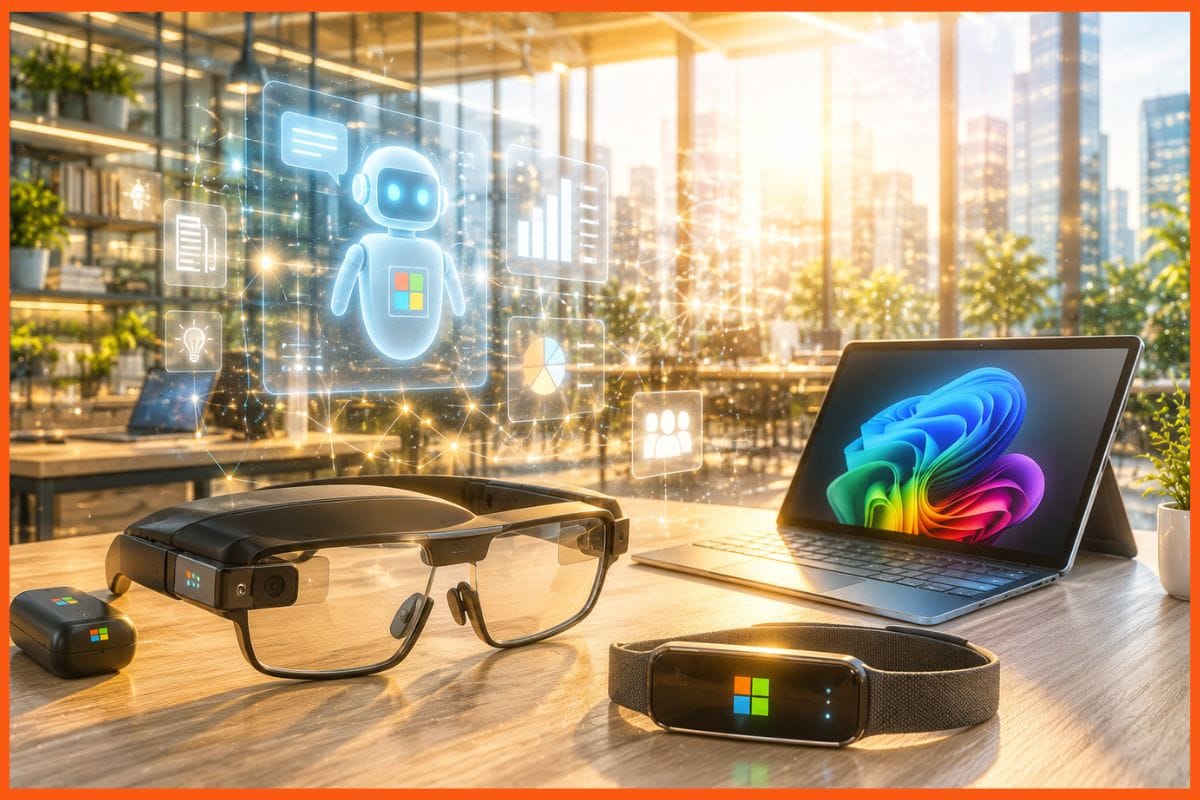
To facilitate better employee-digital agent interaction, Microsoft has unveiled preliminary ideas for wearable and desktop AI gear. Accordingly, introducing the newest initiative by the corporation to transform computers in the workplace for the AI era. During Microsoft's annual developer conference, technical fellow Steven Bathiche presented the prototypes and showed off two devices that are now undergoing internal testing.
The items are still in the development phase and are being piloted by a small group of Microsoft workers. They will not be sold to the general public. The project is a component of a new technological "form factor" for AI-driven work, as outlined by Microsoft CEO Satya Nadella.
Microsoft’s 2 Devices for AI Interaction
Both ideas aim to remove the need for users to rely on desktop or laptop computers when interacting with digital agents and tools driven by artificial intelligence. A desktop cube that can be carried around and used with voice commands and touch screens is one such device. The second option is an access badge that can be worn and fastened to a belt or lanyard.
Both devices are compatible with Microsoft applications and computers, as seen in Microsoft's demos. Consequently, workers will be able to oversee and interact with AI agents while they carry out their duties. This testing phase will help Microsoft figure out how to make these kinds of gadgets in the future, the company added. No intentions to commercialise either product have been mentioned by the corporation. Project Solara, which aimed to make AI agents more approachable in everyday tasks, showcased the prototypes.
Office workers tracked and interacted with digital agents doing chores on their behalf in demonstration movies broadcast throughout the event. Automation of workflows, code generation, and the completion of tedious activities with minimal human participation are some of the many uses for artificial intelligence agents in technology businesses. The wearable badge, according to Bathiche, is compact and made for agents to engage with while they're on the go.
|
Some Interesting
Facts of the Story |
|
1.Unlike current AI assistants that operate
inside apps, these devices are built around the concept of continuous
human-AI collaboration throughout the workday. 2.The initiative reflects a broader trend
among major technology firms to create new hardware categories specifically
optimized for artificial intelligence. 3.If successful, Microsoft's experiments
could influence the future design of workplace technology, much like
smartphones transformed mobile computing over the past two decades. |
Why Microsoft Can Face Backlash on Devices?
The inbuilt camera is a standout feature of Microsoft's wearable badge. After verifying his identity with a fingerprint scan, Bathiche used the gadget to take pictures of the conference attendees as part of the demonstration. The photos were supposedly provided to him for approval, he added. According to Microsoft, the camera will aid AI agents in comprehending and reacting to the user's environment. There will be many people looking at AI-enabled devices with suspicion because of the cameras, especially when similar products have been under fire for data collecting, recording methods, and user privacy.
Other tech companies' AI-enabled eyewear has also been the subject of similar worries. Wearable badges and desktop cubes from Microsoft are still in the testing phase. Nevertheless, the pilot programme provides a sneak peek into the future of employee-AI agent collaboration, going beyond the usual realm of screens, keyboards, and conventional computing.
|
Quick Shots |
|
•Microsoft has developed experimental AI wearable
and desktop devices to help employees interact more naturally with digital AI
agents. •The prototypes include a wearable AI badge
and a portable desktop cube that support voice commands, touch interactions,
and AI-powered workflows. •The devices are currently being tested
internally by a small group of Microsoft employees and are not planned for
commercial release. •The initiative aligns with CEO Satya
Nadella’s vision of creating new AI-driven workplace computing experiences. |