Sugar Cosmetics' Valuation Fell 80%. What Broke
Sugar Cosmetics raised fresh capital at a valuation roughly 80% below its 2022 peak. The founders reportedly paid some salaries personally. The cause: an offline retail expansion that outran the revenue to support it.
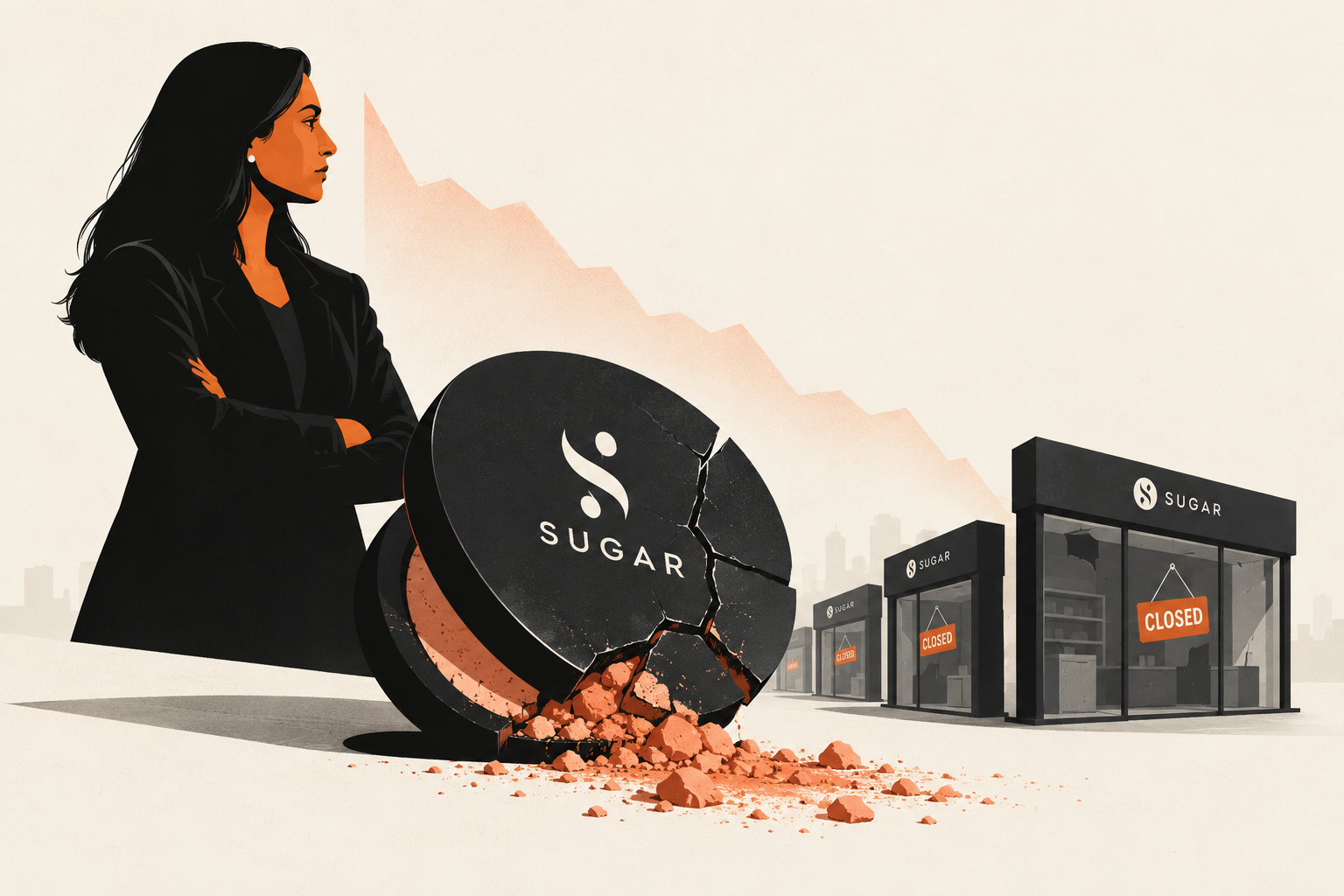
For about six months, Vineeta Singh and Kaushik Mukherjee reportedly covered some of Sugar Cosmetics' employee salaries out of their own accounts, according to multiple reports on the company's cash crunch.
That detail says more about what happened at Sugar than the headline number does. On September 1, 2026, Sugar's board approved a ₹144.47 crore round from existing investor A91 Partners, at a post-money valuation of ₹550-600 crore. In 2022, the same company was worth ₹3,000 crore. That's a fall of roughly 80% in four years, and the operational reason is specific enough to name: physical stores that cost more to run than they brought in.
The valuation, year by year
| Point | Valuation | Context |
|---|---|---|
| 2022 peak | ₹3,000 crore | Series D, $50M led by L Catterton Asia |
| November 2024 | ₹2,600-2,700 crore | First markdown, ~13% down |
| September 2026 | ₹550-600 crore | A91-led round, 75-80% below peak |
Sugar has raised close to $90 million total since founding in 2015, from L Catterton, Elevation Capital, A91 Partners, Anicut Capital, and India Quotient. This latest round wasn't new money coming in to chase growth. It was an existing backer stepping back in to keep the company funded through a cash crunch severe enough that the founders were personally covering payroll gaps.
What actually broke: the stores
Sugar built its brand online, then went hard into physical retail, at one point running more than 45,000 retail touchpoints across 550 cities through a mix of exclusive stores, kiosks, and multi-brand outlets. That expansion is the specific thing that broke the business.
FY24 to FY25, in one table:
| Metric | FY24 | FY25 | Change |
|---|---|---|---|
| Revenue | ₹505.1 crore | ₹404.4 crore | -20% |
| Net loss | ₹68.4 crore | ₹135 crore | Nearly doubled |
| EBITDA loss | ₹48.5 crore | ₹116 crore | More than doubled |
Revenue fell 20%. Losses didn't fall with it, they exploded, because store leases, field sales salaries, and distributor agreements are fixed costs that don't shrink just because sales did. Sugar has since shut 30-40% of the physical stores it opened, closing the ones that were losing money on every unit sold rather than adding to the top line. That's a real fix, but it's also an admission that a large chunk of the retail buildout should never have happened at the pace it did.
Sugar isn't the only one that bet wrong on stores
This isn't a Sugar-specific mistake. India's D2C beauty category has largely made the same bet over the past three years: that offline retail would be the next growth engine once online customer-acquisition costs got too expensive. Mamaearth has poured tens of crores a year into opening exclusive brand outlets while its overall expenses grow faster than revenue. Nykaa has pushed its own multi-hundred-store offline expansion with the same open question hanging over it: whether physical retail actually pays for itself in a category built on digital discovery. Sugar is just the company where the bill came due first and hardest.
Why this is getting more attention than a typical down round
A 75-80% valuation cut isn't rare in Indian D2C right now. What's different here is that Vineeta Singh spends her weekends on national television evaluating other founders' businesses as a Shark Tank India judge, a role that put her in front of more Indian households than almost any founder in the country. When her own company's numbers came out this bad, the reaction wasn't just about Sugar's balance sheet. A post from commentator Rishi Bagree, viewed widely enough to shape how this story spread online, put it bluntly:
"Remember Vineeta Singh from Shark Tank. Her company Sugar Cosmetics is staring at Bankruptcy after 80% meltdown in valuation. Any idea what went wrong??"
That framing (bankruptcy, not a down round) is sharper than what the numbers themselves support, but it's the version that travelled.
That's a real dynamic worth naming, not dismissing: fame built on being seen as a credible judge of other people's businesses invites exactly this kind of scrutiny the moment your own numbers wobble. It doesn't make the criticism automatically fair, and Sugar isn't shutting down. It closed a funding round, its existing investor chose to write another check rather than walk away, and the founders are still personally absorbing the pain rather than exiting. Whether the store closures actually fix Sugar's unit economics, or just buy another year before the same math catches up again, is the part nobody, including Sugar, has proven yet.
If you have information related to this story, contact us through StartupTalky's tips line. Anonymity is the default.