Tata Agratas Strengthens EV Push with $530 Million Battery Supply Deal with JLR
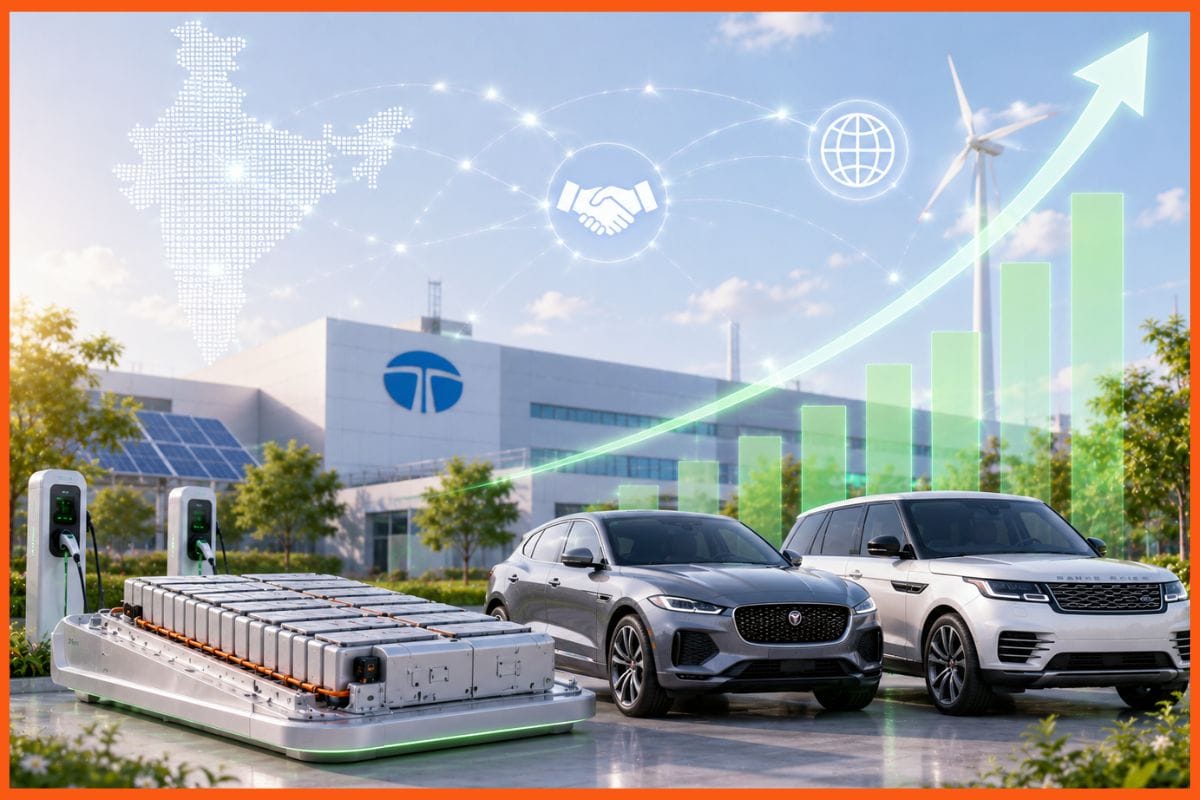
A seven-year supply agreement worth $530 million (approximately INR 5,000 crore) has been inked between group company Jaguar Land Rover and Tata group electric-vehicle battery arm Agratas. Company disclosures and an executive with knowledge of the agreement indicate that it will commence this fiscal year.
According to a resolution seeking shareholder approval for the related-party transaction and the executive, Agratas' first supply agreement is expected to generate approximately $42 million (INR 400 crore) in revenue in FY27. The agreement will initially cover the supply of NMC (nickel manganese cobalt) battery cells.
Specifics of the Tata and JLR deal
According to the resolution, the proposed multi-year agreement brings long-term benefit to shareholders by ensuring supply, keeping costs low, leading in technology, and aligning on sustainability. As mentioned in the agreement, these transactions allow for the uninterrupted and smooth running of business operations by ensuring a consistent supply of batteries of the required quality and quantity. Consequently, this will lead to improved productivity, simplified operations, and reduced costs.
The executive stated that by the end of the current fiscal year, Agratas aims to have scaled up its commercial operations. The deal is anticipated to encompass both NMC and LFP (lithium iron phosphate) battery chemistries in the long run. Electric vehicles use either NMC or LFP cells, the former of which provides better range and the latter of which is more stable. Although NMC cells are more popular in high-end vehicles, LFP chemistry is quickly becoming the standard in mass-market EVs. With a $730 million financing facility in hand, thanks to prospective supply agreements with group car businesses, the company's expansion of commercial operations is of the utmost importance.
|
Some Interesting Facts of the Story |
|
1.JLR's upcoming EV lineup, including the highly
anticipated Range Rover Electric, will benefit from this partnership. 2.The agreement aligns with Tata Group's broader
push into electric vehicles, batteries, semiconductors, and electronics. 3.The deal highlights how vertical integration is
becoming increasingly important in the global EV industry. |
Why it is a Win-Win Deal for Both?
Following Beijing's 2025 export limitations on rare-earth magnets, an essential component in electric vehicle (EV) production, India's manufacturers have been aiming to lessen their dependence on China. The 20 GWh facility in Sanand, Gujarat, and the 40 GWh plant in Somerset, UK, are being constructed by Agratas to meet the captive demand of the Tata group's automotive companies and other clients. As part of their shift to an electric future, JLR are preparing to launch their electric vehicle portfolio, which includes the Range Rover Electric and a new range of Jaguar cars. This agreement comes before their deployment.
To achieve its company aim of saving £1.7 billion over the next two years, JLR plans to use captive suppliers as a cost management tool. Tata Group chairperson Natarajan Chandrasekaran chairs the board of Agratas, a new-age enterprise created in 2023, which also includes JLR chief executive P.B. Balaji.
Under CEO Thomas Flack, Agratas has taken action to ensure a steady flow of funds in the future, which is very important for Natarajan Chandrasekaran. The tenure of Chandrasekaran is being reviewed in light of the increasing scrutiny of investments and returns from emerging companies like e-commerce, electronics, semiconductors, electric vehicle batteries, and aviation.
|
Quick Shots |
|
•Tata Agratas has signed a seven-year EV battery
supply agreement worth $530 million with Jaguar Land Rover (JLR). •The deal is expected to generate around $42 million
(INR 400 crore) in revenue in FY27. •Initial supplies will consist of NMC (Nickel
Manganese Cobalt) battery cells. •The agreement is designed to ensure long-term
supply security, cost efficiency, and sustainability. |