One Complaint, Two Years, and a ₹15 Lakh Crore Hole: Inside SEBI's Case Against Rajesh Exports
A single shareholder complaint in 2024 triggered a two-year SEBI probe into Rajesh Exports, India's gold giant, exposing alleged revenue misrepresentation of ₹15.15 lakh crore, fund diversion, and a Swiss refinery at the centre of it all.
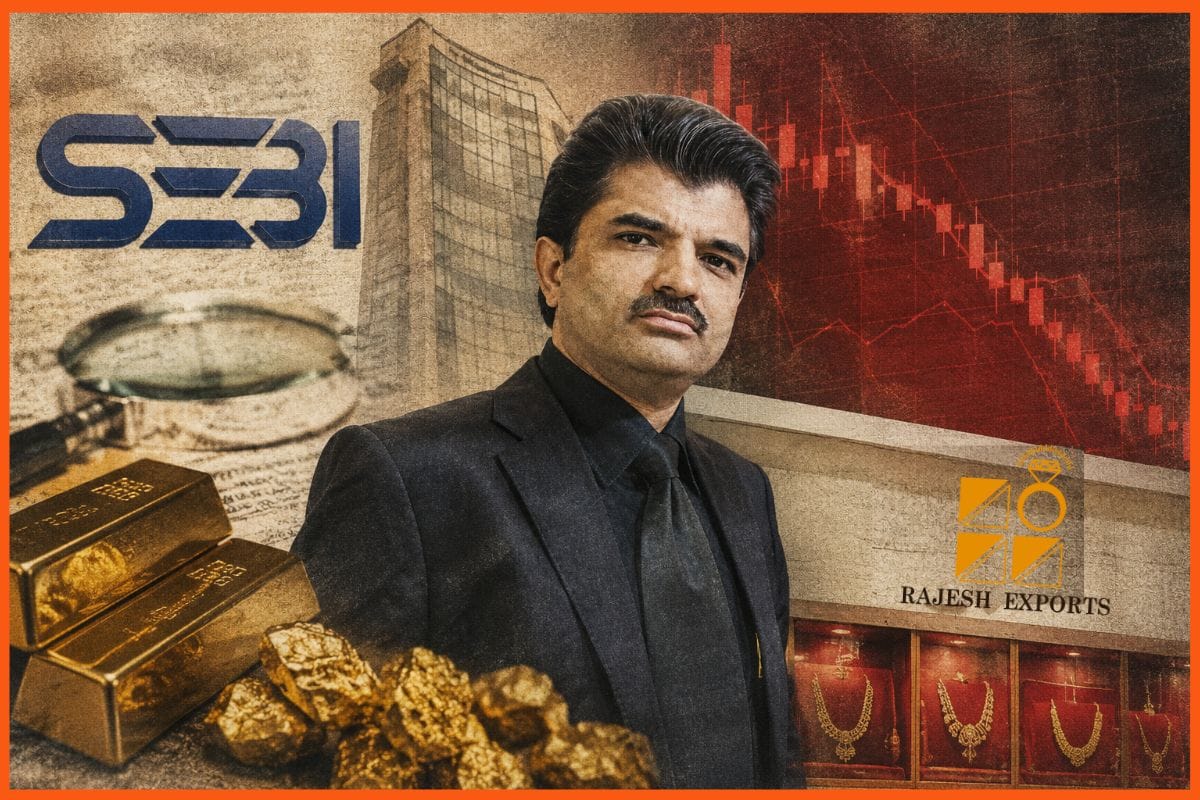
On the evening of 3 June 2026, SEBI released a 109-page ex parte interim order against Rajesh Exports Limited and its executive chairman, Rajesh Mehta. The regulator's own word for what it found was "egregious": the possible misrepresentation of roughly ₹15.15 lakh crore in revenue from overseas subsidiaries across five financial years, FY2020-21 to FY2024-25.
The order, passed by Whole-Time Member Kamlesh Chandra Varshney, barred both the company and its promoter from the securities market until further notice. It also referred the matter to the National Financial Reporting Authority (NFRA) to examine the company's statutory auditors.
By the morning of 4 June, Rajesh Exports had hit the 5% lower circuit on both BSE and NSE. No buyers were on the board. Market capitalisation fell below ₹3,100 crore. The stock had already lost more than 50% from its 52-week high.
Why This Case Matters
This is not a routine governance dispute. If confirmed, the alleged misrepresentation would rank among the largest accounting irregularities ever flagged by an Indian regulator. The ₹15.15 lakh crore figure is said to represent 99.80% of all subsidiary revenue over five years.
Three broader issues make this case significant:
- Reporting gaps: How do Indian listing rules allow revenues generated almost entirely overseas to sit on a listed parent's accounts without proper subsidiary-level disclosure?
- Audit obstruction: How can a forensic auditor, appointed by SEBI itself, be denied access to basic accounting records?
- Institutional exposure: How did LIC, holding a 10.80% stake in the company, remain invested without acting on growing governance concerns?
The case also has a global reach. Rajesh Exports owns Valcambi SA, a Swiss gold refinery that processes a large portion of the world's gold supply. Prolonged regulatory uncertainty at the Indian parent raises real questions about Valcambi's operational future.
Detailed Timeline of The Rajesh Exports Case
| Year / Date | Event |
|---|---|
| 1995 | Rajesh Exports Limited incorporated on 1 February; listed on BSE and NSE |
| Early 2000s to 2014 | Company grows into one of India's largest gold jewellery makers and exporters; Bengaluru plant can process 250 tonnes per year |
| July 2015 | Acquires 100% of Valcambi SA from Newmont Mining and others for $400 million in cash; Q2 revenues surge over 300% to ₹44,320 crore post-integration |
| FY2016 to FY2019 | Consolidated revenues reported between ₹1.5 lakh crore and ₹2.5 lakh crore annually; standalone revenues remain modest |
| 11 March 2024 | Shareholder complaint received by SEBI about large, long-overdue trade receivables |
| 23 October 2024 | SEBI appoints an Investigating Authority |
| 3 December 2024 | BDO India Services appointed as forensic auditor |
| Throughout 2025 | Multiple summons issued; company gives incomplete responses; BDO denied access to ERP systems and account records; supporting documents missing for most of ₹7,000+ crore in transaction samples |
| 17 March 2026 | Rajesh Exports admits in writing that funds were routed through Mehta's personal account without disclosing the source bank |
| 3 June 2026 | SEBI issues 109-page ex-parte interim order; both company and promoter barred from markets; matter referred to NFRA |
| 4 June 2026 | Stock hits 5% lower circuit at ₹104.65 (BSE); market cap falls to ₹3,089 crore; LIC shares also fall; company issues five-point denial to exchanges; Rajesh Mehta personally tells Moneycontrol: "nothing in it is true" |
| 5 June 2026 | Second consecutive 5% lower circuit — stock falls to ₹98.73 (NSE) / ₹99.45 (BSE); market cap drops to ₹2,915 crore; stock now down ~10% in two sessions and ~58% from its 52-week high of ₹239 (December 2025) |
Inside SEBI's Allegations
| Financial Year | Consolidated Revenue (₹ cr) | Standalone Revenue (₹ cr) | Subsidiary Share | Gap (₹ cr) |
|---|---|---|---|---|
| FY21 | 2,58,313 | ~6,000 | 97.7% | ~2,52,313 |
| FY22 | 2,43,000 | ~7,000 | 97.1% | ~2,36,000 |
| FY23 | 3,39,000 | ~8,000 | 97.6% | ~3,31,000 |
| FY24 | 2,80,000 | ~6,500 | 97.7% | ~2,73,500 |
| FY25 | 4,23,099 | 7,027 | 98.3% | 4,16,072 |
| Total | 15,43,412 | ~34,527 | 99.8% | ~15,08,885 |
SEBI's case rests on several distinct but linked claims.
1. The revenue misrepresentation
SEBI alleges that ₹15.15 lakh crore, 99.80% of subsidiary revenues from FY21 to FY25, may have been misrepresented in the company's consolidated accounts. The consolidated statements showed revenues mainly from Valcambi SA in Switzerland. But Valcambi's own audited accounts showed negligible revenue. The gross gold transaction revenues sat instead at Global Gold Refineries AG (GGR), one level up in the ownership chain.
2. The subsidiary structure
The corporate chain runs four levels deep:
Rajesh Exports India (listed parent) → REL Singapore (holding company, no significant operations) → Global Gold Refineries AG / GGR (Switzerland, holds gross revenues) → Valcambi SA (the actual refinery, shows only processing fees)
Rajesh Exports told SEBI that Valcambi recorded only processing charges, while GGR recognised the full value of gold deals. SEBI says the company could not provide any adequate documentation, accounting opinions, or transaction records to support this treatment.
3. The Affluence transactions
SEBI alleges Rajesh Exports recorded ₹11,487 crore in sales and ₹11,488 crore in purchases with a company called Affluence Shares and Stocks Pvt Ltd between FY22 and FY24. These made up roughly two-thirds of standalone sales and purchases. When SEBI contacted Affluence, it said Rajesh Exports was never its client. It said it dealt only with Rajesh Mehta in his personal capacity. SEBI says these were fictitious entries used to inflate reported turnover.
4. Fund diversion
SEBI alleges ₹339 crore of company's money was sent to Mehta's personal accounts. Only ₹232 crore came back. In total, ₹926 crore was routed through unapproved channels, with no board sanction, no audit committee sign-off, and no related-party disclosure.
5. Shareholder wealth erosion
SEBI calculates that the alleged misrepresentation and fund diversion caused ₹12,725.53 crore in investor wealth to be wiped out, hitting both retail and institutional shareholders.
6. The Elest transactions
SEBI flagged a separate concern involving Elest Pvt Ltd, a Bengaluru-based EV and lithium-ion battery company. Elest was incorporated in October 2020 by Rajesh Mehta and his brother, Prashant Mehta. Because Mehta was a common director and held substantial control over Elest, SEBI treated it as a related party of Rajesh Exports. The regulator found that Rajesh Exports transferred ₹565.88 crore to Elest between FY21 and FY26, while Elest returned only ₹350.03 crore, a net outflow of ₹215.85 crore from the listed company. None of these fund movements was disclosed as related-party transactions.
7. The Africa gold mines claim
SEBI also could not verify Rajesh Exports' reported investment in gold mines in Africa. The company's "other non-current investments" rose from ₹879.60 crore in FY21 to ₹1,035.27 crore in FY23, then surged to ₹10,547.72 crore in FY25. When NSE sought details on the ₹1,035.27 crore figure, the company said in July 2024 that it represented investment in gold mines in Africa. SEBI found it could not corroborate this claim against any available financial records. The company's follow-up response, that investments existed through foreign subsidiaries and figures were "tallying and correct", was described by SEBI as "vague, unsupported and incapable of verification."
8. Standalone overstatement
Beyond the consolidated picture, SEBI also alleges Rajesh Exports overstated its standalone revenues by ₹12,557 crore during FY21 to FY24.
Rajesh Exports' Defence
The company responded to the stock exchanges on 4 June 2026 with a five-point statement. Its key positions:
- The order is interim, and SEBI has not reached any final adverse finding.
- All revenues declared are correct. There is no overstatement.
- On the derivative trades: the company says it had planned to trade digital gold through MCX, but due to a dispute with the exchange, trades were routed through Mehta's personal account. The company says Mehta acted only as a pass-through, and the trades were always on behalf of the company, hence their inclusion in company books.
- The company described the matter as a "communication gap and confusion" between SEBI and itself, and said it was in the process of submitting all required documents.
- Rajesh Mehta, speaking to Moneycontrol on 4 June, said: "It is an interim order and nothing in it is true. We are in the process of studying it and will prepare a response."
- In a follow-up exchange filing, the company said it "remains confident that the regulator will arrive at the correct conclusion after reviewing authenticated documents."
SEBI's counter: the MCX litigation explanation was not backed by any written agreement, board approval, or other paperwork from that time. The company's own March 2026 email admitted funds were moved without disclosing the source account.
The Role of Valcambi and Overseas Subsidiaries
Valcambi SA is headquartered in Balerna, Switzerland, and has been refining precious metals for over five decades. It processes gold from mines worldwide to 99.99% purity, the standard set by the London Bullion Market Association (LBMA). Its bars are held in central bank reserves and traded in wholesale bullion markets globally.
When Rajesh Exports bought Valcambi in 2015 for $400 million, it was seen as a landmark deal, an Indian company taking ownership of a key piece of global gold supply infrastructure.
The current case does not allege any problem with Valcambi's operations. The issue is how the financial results flowing through the Swiss subsidiary chain were reported to Indian investors. SEBI's concern is simple: the revenues in the Indian parent's consolidated accounts could not be verified, because Valcambi's own books showed negligible revenue, while the large numbers sat at GGR, one level removed from the entity publicly described as the group's main business.
The investigation examined transactions across REL Singapore, GGR, and Valcambi SA.
Market Reaction and Investor Impact
The market response has been immediate and sustained across two sessions.
Day 1 (4 June): Rajesh Exports hit the 5% lower circuit, closing at ₹104.65 on BSE and ₹103.92 on NSE. Market capitalisation fell to ₹3,089 crore. LIC shares also fell, dropping to an intraday low of ₹397.60 on NSE.
Day 2 (5 June): The stock hit a second consecutive 5% lower circuit, falling to ₹99.45 on BSE and ₹98.73 on NSE. Market cap dropped to ₹2,915 crore. The stock is now down approximately 58% from its 52-week high of ₹239 hit in December 2025, and around 42% for the year so far.
LIC holds a 10.80% stake in Rajesh Exports as of March 2026, the largest public holding. That position has been largely unchanged since at least September 2023. Mauritius-based Bridge India Fund holds another 8.46%. Reports indicate approximately 1.94 lakh retail investors are also directly affected by the fallout.
Governance experts raised pointed questions about institutional due diligence. The broader point: large shareholders should act on credible evidence of accounting concerns rather than wait for a regulator to intervene.
Domestic brokerages moved quickly to warn retail clients. Circuit breakers contained the daily decline, but sentiment across both sessions remained deeply negative with virtually no buyers stepping in at either level.
Corporate Governance Questions
The case raises serious concerns across several governance dimensions.
Board and audit oversight: SEBI found that ₹926 crore in transactions were processed without board or audit committee approval, and without disclosing them as related-party deals. No board resolutions were produced to justify routing funds through the promoter's personal account.
Auditor accountability: The referral to NFRA puts the spotlight squarely on the company's statutory auditors. If auditors signed off on consolidated accounts that included ₹15 lakh crore in revenues they could not independently verify, that is a serious professional failure. SEBI flagged the non-availability of audit working papers linked to overseas subsidiaries.
Forensic audit obstruction: BDO India Services, appointed by SEBI, was reportedly denied access to the company's ERP systems, account books, and journal records. Refusing access to a regulator-appointed forensic auditor is itself a major governance red flag, separate from whether the underlying numbers are accurate.
Mixing personal and company finances: The alleged routing of company money through the promoter's personal account — and recording his personal derivatives trades in the company's books, mirrors the pattern seen in earlier Indian corporate failures. It points to a breakdown in the basic separation of promoter and company finances, a recurring theme in India's governance controversies from Satyam to Zee.
 Sakshi Jadhav
What We Know vs What Remains Unclear
Verified Facts
- SEBI issued a 109-page ex parte interim order on 3 June 2026 against Rajesh Exports and Rajesh Mehta.
- Passed by Whole-Time Member Kamlesh Chandra Varshney.
- BDO India Services appointed as forensic auditor from December 2024.
- Both the company and the promoter are barred from the securities market until further orders.
- Matter referred to NFRA for examination of statutory auditors.
- LIC holds 10.80% of Rajesh Exports as of March 2026.
- Rajesh Exports shares fell to the 5% lower circuit for two consecutive sessions on 4 and 5 June 2026. Stock now at ₹98.73, down ~58% from its 52-week high.
- Rajesh Exports admitted in writing on 17 March 2026 that funds were routed through Mehta's account without disclosing the source.
- Rajesh Mehta personally denied all allegations to Moneycontrol on 4 June 2026.
SEBI Allegations (Prima Facie, Not Yet Adjudicated)
- ₹15.15 lakh crore in subsidiary revenues from FY21 to FY25 may have been misrepresented.
- ₹339 crore sent to promoter-linked accounts; only ₹232 crore returned; total unapproved routing: ₹926 crore.
- ₹11,487 crore in derivative trades recorded as company transactions.
- Standalone revenues overstated by ₹12,557 crore during FY21 to FY24.
- Net outflow of ₹215.85 crore to promoter-linked EV firm Elest Pvt Ltd, not disclosed as related-party transactions.
- ₹1,035.27 crore reported as investment in African gold mines (surging to ₹10,547.72 crore by FY25) could not be verified by SEBI.
- Investor wealth erosion: ₹12,725.53 crore.
Company's Position
- Revenues are correct; no overstatement.
- The order is interim; no adverse conclusion reached.
- The matter is described as a "communication gap and confusion" between SEBI and the company.
- Derivative trades were routed through Mehta's account due to MCX litigation; he acted as a conduit only.
- The company says it is submitting all required documents and is confident the regulator will reach the right conclusion.
Unresolved Questions
- What documents support consolidated revenues recorded at GGR?
- Why were overseas subsidiary accounts not regularly disclosed under listing rules?
- What exactly was the MCX dispute that justified routing trades through personal accounts?
- Who are the company's statutory auditors, and what is their liability?
- What is Valcambi's operational status during this investigation?
- What are the actual assets behind the reported African gold mine investments?
- What is the full picture of fund flows between Rajesh Exports and Elest?
- Will the Enforcement Directorate or SFIO open parallel cases?
- Can the ₹107 crore not yet returned to the company be traced?
What Happens Next
Several regulatory and legal tracks are likely to run at the same time.
- SEBI proceedings: The interim order starts a formal investigation. The company will get a chance to respond and request a hearing. A final order may include monetary penalties, recovery of alleged gains, and longer market bans.
- NFRA examination: The referral to the National Financial Reporting Authority puts statutory auditors under direct scrutiny. NFRA can penalise, suspend, and refer audit firms for further action.
- SFIO and ED: Given the cross-border fund flows and alleged personal account routing, legal experts expect involvement from the Serious Fraud Investigation Office under the Companies Act and the Enforcement Directorate under money laundering laws.
- SAT appeals: The company and Mehta may approach the Securities Appellate Tribunal for a stay or relief. SAT has granted relief in past SEBI interim orders, but ex parte orders in cases of this nature face a higher bar.
Future Scenarios
Best case for the company: SEBI finds the revenues, though poorly disclosed, reflect genuine gold trading through GGR and Valcambi. Fund routing is found improper but not criminal. Penalties are imposed, accounts restated, governance improved, and market access restored. Valcambi keeps running without disruption.
Moderate scenario: SEBI confirms major disclosure and governance failures. Substantial penalties and account restatements follow. Mehta steps away from his executive role. LIC and other investors take write-downs. The board is reconstituted. The company's ability to raise funds is limited for several years.
Worst case: SEBI's full investigation confirms revenues were largely fictitious. Criminal referrals follow. SFIO and ED seize assets. Bank lenders review their exposure. Valcambi's standing is damaged by the prolonged uncertainty at its parent. Minority shareholders face severe losses.
What this means for India's disclosure rules: Regardless of how the Rajesh Exports case ends, it has already opened a wider debate. The fact that 97 to 99% of a listed company's consolidated revenue could go unverified for years before a complaint triggered action raises pointed questions about whether India's current disclosure rules for foreign subsidiaries are fit for purpose.
Final Thoughts
The Rajesh Exports story is, at its heart, a test of what Indian capital markets can honestly tell their investors. A Bengaluru gold business grew, through a $400 million Swiss acquisition, into one of India's highest-revenue companies on paper. When a regulator finally came asking for documents, the documentation was not there.
This remains an interim order. SEBI's findings are prima facie allegations, not final judgments. Rajesh Exports has the right to a full hearing and may yet produce evidence that changes the picture.
But for now, the ₹15 lakh crore question hangs over one of India's most globally connected gold businesses, over the institutions that backed it, and over the disclosure standards that were meant to protect every investor who bought into the story.
FAQs
What did SEBI allege against Rajesh Exports?
SEBI's June 2026 interim order alleges that Rajesh Exports misrepresented roughly ₹15.15 lakh crore in revenue from overseas subsidiaries between FY21 and FY25. The regulator also alleges that ₹926 crore in company funds was routed through promoter Rajesh Mehta's personal accounts without board approval, and that his personal derivatives trades were recorded as company transactions.
What is Valcambi SA, and what is its role in the Rajesh Exports case?
Valcambi SA is a Swiss gold refinery bought by Rajesh Exports in 2015 for $400 million. It is one of the world's leading LBMA-approved refineries. In this case, it matters because Rajesh Exports' consolidated revenues were attributed to the Swiss subsidiary chain headed by Valcambi, yet Valcambi's own accounts showed negligible revenue. The large numbers sat instead at an intermediate holding company, Global Gold Refineries AG.
Has Rajesh Exports accepted the allegations?
No. In a five-point exchange filing on 4 June 2026, the company said revenues are correct, there is no overstatement, and the order is interim with no adverse conclusion reached. A fuller clarification was promised.
What is LIC's exposure to Rajesh Exports?
LIC holds a 10.80 per cent stake in Rajesh Exports as of March 2026, the company's largest public holding. The position has been broadly stable since at least September 2023. Following SEBI's order, LIC's own shares saw selling pressure as investors weighed the insurer's exposure.