“From Vision to Intelligent Machines”, Raviteja Chivukula on Reimagining Robotics with Perceptyne
In this interview, Raviteja Chivukula, co-founder of Perceptyne, shares how the startup is building AI-powered robots for manufacturing, tackling deep-tech challenges, and making automation more scalable, efficient, and accessible.
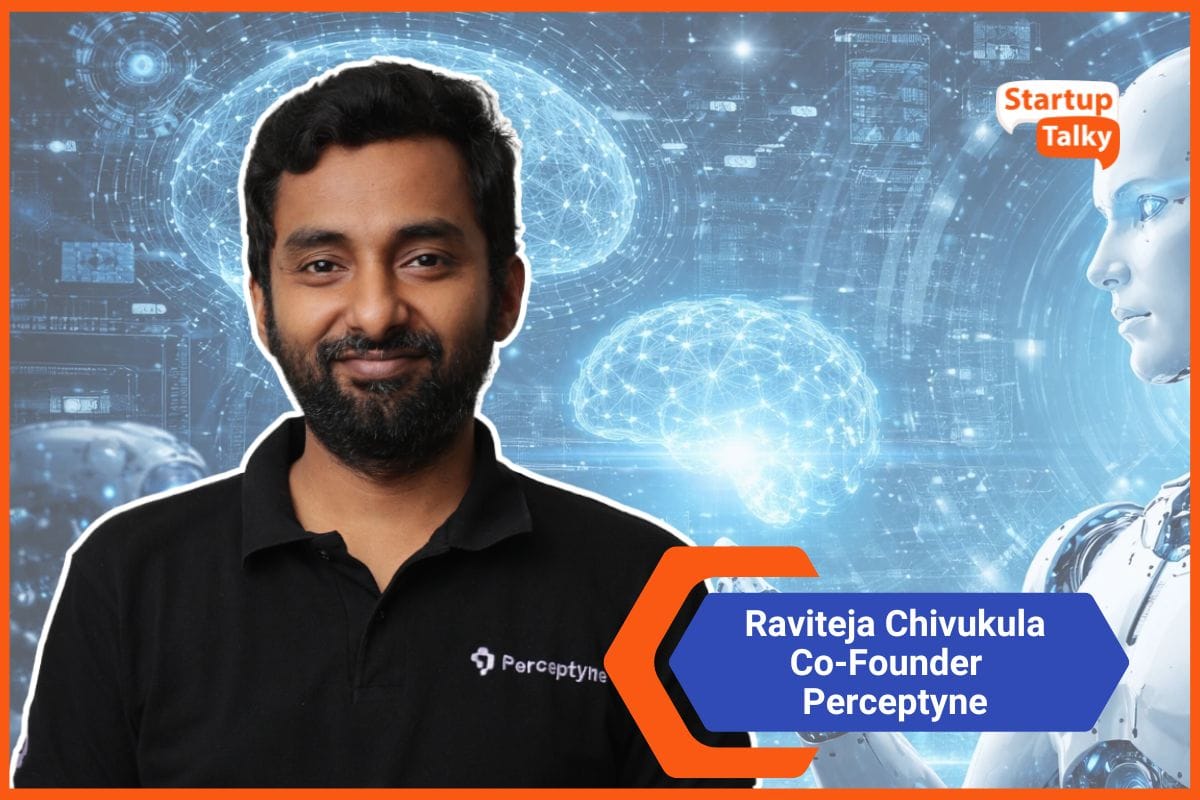
The rise of AI-driven automation is transforming how industries operate, especially in manufacturing, where precision, speed, and adaptability are becoming critical.
At the forefront of this shift is Perceptyne, a Hyderabad-based deep-tech robotics startup building intelligent, human-like robots designed to handle complex industrial tasks. Founded in 2021 by IIT and BITS alumni, the company is focused on making advanced automation more accessible, scalable, and practical for manufacturers in India and beyond.
In this conversation, co-founder Raviteja Chivukula shares insights into Perceptyne’s vision, product innovation, industry trends, challenges, and the road ahead in the rapidly evolving robotics landscape.
Company Overview & Founding Vision
StartupTalky: What does your company do, and what was the motivation or vision behind starting it?
Raviteja Chivukula: Perceptyne is a deep-tech robotics company that builds AI-driven industrial robots to automate complex, human-like tasks in manufacturing and other industries. We started the company with a simple vision: to make intelligent physical assistance more accessible and use automation to enhance human potential.
Founded in Hyderabad in 2021 by IIT and BITS alumni Raviteja Chivukula, Jagga Raju Nadimpalli, and Mrutyunjaya Nadiminti, Perceptyne was born out of the need to address gaps in traditional automation. Our focus has been on building intelligent, dexterous robots that can handle complex manufacturing tasks with human-like precision, especially in electronics and automotive assembly. By reducing integration time and overall costs, we aim to make advanced automation more practical and scalable for manufacturers.
Product Differentiation & Core USPs
StartupTalky: What are the key USPs of your products?
Raviteja Chivukula: Our key USP lies in building intelligent, dexterous robots that are designed to handle complex manufacturing tasks with human-like precision.
Our AI-powered humanoid robots are especially suited for electronics and automotive assembly, where accuracy and flexibility are critical. By closely mimicking human movements, our robots help reduce integration time and overall costs for manufacturers, making advanced automation more accessible.
This approach supports our larger vision of transforming automation in India, a journey that has also helped us secure strong funding and industry recognition since our founding in Hyderabad in 2021.
Industry Evolution & Company Adaptation
StartupTalky: How has your industry evolved in recent years, and how has your company adapted to these changes?
Raviteja Chivukula: Over the past few years, the robotics and automation industry has shifted from traditional, rigid automation toward AI-driven, adaptable robotic solutions that can handle more complex, dexterous tasks.
This change is driven by the need for smarter, faster, and more flexible systems in sectors like electronics and automotive manufacturing. Perceptyne has responded by focusing on building its own intelligent robotics platform from the ground up, combining AI, perception systems, and vertically integrated hardware to deliver plug-and-play robots that reduce deployment time and make automation more accessible for manufacturers.
By doing this, the company is aligning with industry trends of faster automation adoption and reducing reliance on imported components, positioning itself to compete globally while supporting local manufacturing needs.
Growth Metrics & Performance Indicators
StartupTalky: What key metrics do you track to assess the company’s growth and performance?
Raviteja Chivukula: We track a balanced set of metrics across product, customers, and business outcomes. On the product side, we closely monitor development milestones, deployment readiness, and the transition from pilots to live manufacturing use cases.
Customer adoption, repeat engagements, and on-ground performance improvements are key indicators for us. From a business perspective, revenue traction, strategic partnerships, and paid pilots help us gauge how sustainably we are scaling Perceptyne while building globally competitive, indigenous robotics solutions.
Challenges & Problem-Solving Approach
StartupTalky: What were the most significant challenges your company faced in the past year, and how did you overcome them?
Raviteja Chivukula: Over the past year, one of the biggest challenges for Perceptyne was building complex robotics technology from the ground up in India, especially when most automation hardware and components are traditionally imported.
Developing core elements such as actuators, firmware, perception systems, and AI intelligence locally meant tackling supply-chain limitations and engineering complexity head-on.
To overcome this, the team chose to vertically integrate design and manufacturing, essentially creating critical hardware and software in-house, which reduced dependency on foreign suppliers and improved product iteration speed. Another challenge has been attracting the right multidisciplinary talent with expertise in mechanical design, AI, control systems, and perception.
Perceptyne addressed this by investing in building a strong core team capable of innovating across these domains and creating a robotics stack tailor-made for Indian manufacturing needs. This focus has helped the company deliver advanced, adaptable robots while positioning itself for global competitiveness.
Marketing Strategy & Growth Initiatives
StartupTalky: What marketing strategies do you use, and can you share any growth initiatives that worked particularly well?
Raviteja Chivukula: At Perceptyne, our marketing approach is focused on building visibility, credibility and direct engagement with the right stakeholders in the robotics and manufacturing ecosystem.
We actively leverage strategic communications and thought leadership to position our AI-driven robotics platform as a solution for modern automation challenges - highlighting how our robots reduce integration time and improve productivity for manufacturing partners.
Fundraising announcements and industry recognitions also serve as organic visibility boosters, helping us reach new audiences and potential customers. The recent seed funding of $3 million was widely published in the media, amplifying our growth story and attracting interest from manufacturing leaders who are exploring robotics solutions.
This combined focus on storytelling, targeted media outreach, and showcasing real use cases has supported Perceptyne’s market traction and expansion.
Tools, Technology & Operational Stack
StartupTalky: What tools and software are critical to running your business efficiently?
Raviteja Chivukula: Running a deep-tech robotics company like Perceptyne requires a strong combination of in-house engineering platforms and standard business tools.
On the technology side, our teams rely heavily on proprietary software frameworks for AI, perception, motion planning, and robot control, which are developed in-house to tightly integrate hardware and intelligence. Simulation tools and testing environments are also critical, as they allow us to validate robot performance before deployment on manufacturing floors.
Alongside this, we use collaboration, project management, and data-tracking tools to ensure smooth coordination across engineering, operations, and customer engagements. This blend of custom-built robotics software and proven enterprise tools helps us move fast while maintaining reliability and scalability.
AI Integration & Impact on Users
StartupTalky: How are you integrating AI into your product, across features, personalisation, or backend optimisation, and what measurable impact has this created for users?
Raviteja Chivukula: AI is at the core of everything we build at Perceptyne. It powers our robots’ perception, decision-making, motion planning, and task execution, allowing them to perform complex, human-like tasks with precision and consistency.
On the product side, AI enables our robots to adapt to different manufacturing environments without extensive reprogramming, which significantly reduces deployment and integration time. In the backend, AI-driven learning and optimisation help improve performance, reliability, and efficiency over time.
For users, this translates into faster automation rollout, improved productivity on the shop floor, and reduced dependency on manual intervention, making automation more practical and scalable for manufacturers.
Market Opportunities & Regional Insights
StartupTalky: What growth opportunities do you see for the industry in India and globally? Have you observed any differences in market behaviour across Indian states?
Raviteja Chivukula: The robotics and automation industry is witnessing strong global growth, driven by rising adoption of AI-led automation across manufacturing, logistics, and other sectors. In India, adoption is accelerating as manufacturers focus on productivity and Industry 4.0 transformation.
Our focused market includes Hyderabad, Chennai, and Bangalore. We are currently working with some large clients and have initiated paid pilots with 4 global companies across these cities. Other regions are gradually catching up, presenting long-term growth opportunities.
Future Plans & Expansion Strategy
StartupTalky: What are your plans to expand the customer base, product portfolio, and team in the future?
Raviteja Chivukula: Looking ahead, Perceptyne is focused on scaling both our impact and reach in the robotics and automation space. With recent seed funding, we are enhancing our robotics platform with new capabilities, expanding into additional use cases, and onboarding more enterprise clients to broaden our customer base.
At the same time, we are growing our multidisciplinary team across AI, mechanical design, software development, and operations to accelerate innovation and ensure seamless deployment of our solutions. These steps will help us deliver high-value, AI-driven automation solutions while strengthening our position in the industry.
Advice for Aspiring Entrepreneurs
StartupTalky: One piece of advice you would like to share with aspiring entrepreneurs.
Raviteja Chivukula: My advice to aspiring entrepreneurs would be to stay persistent and focus on solving real problems. Success doesn’t come overnight, and challenges are inevitable, especially in deep-tech or emerging sectors. It’s important to build a strong team, remain curious, and be willing to iterate constantly on both your product and approach. The key is to combine vision with disciplined execution, learn from every setback, and keep pushing forward.
 Muskaan Kapoor