The Payday Problem: Why India's Monthly Salary Cycle Is a Financial Trap Nobody Talks About
Should India Move to a Twice-a-Month Salary System? Examining Anupam Mittal's Proposal and the Future of Employee Financial Wellbeing
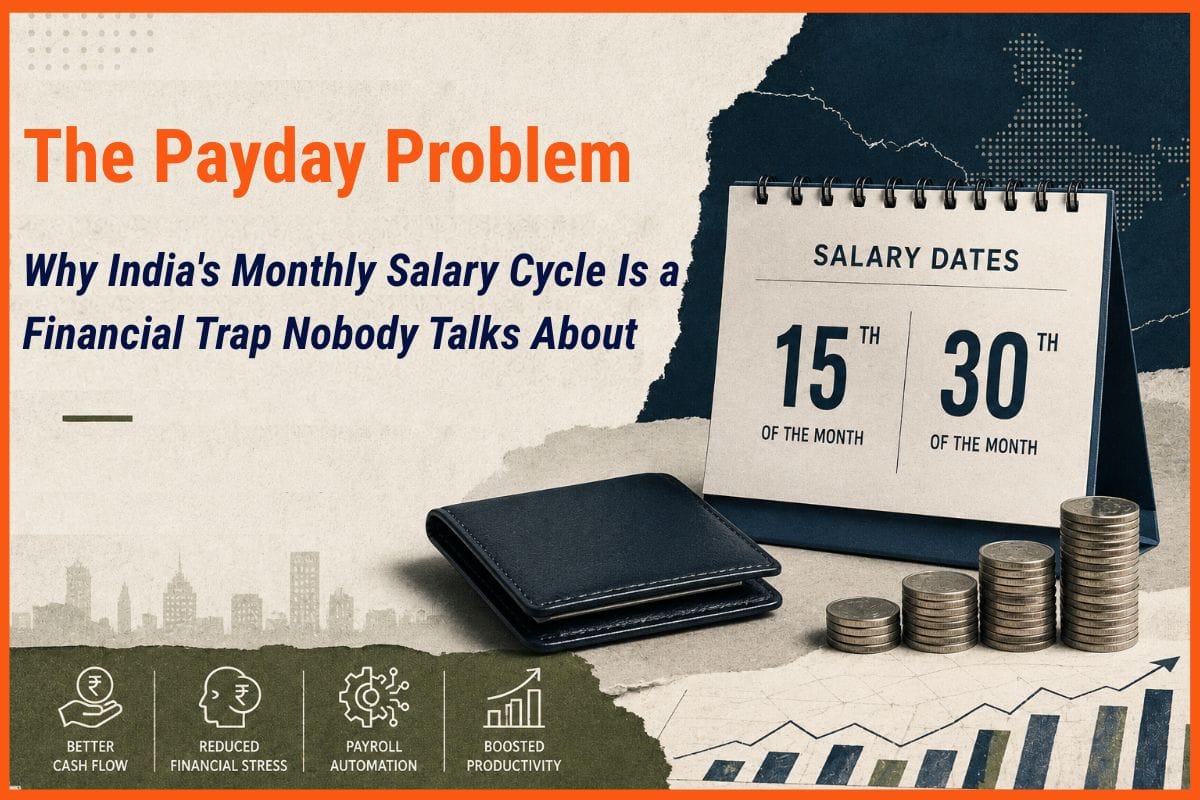
When Anupam Mittal, Founder and CEO of People Group and one of India's most recognisable Shark Tank judges, posted on LinkedIn recently about reforming India's payroll calendar, it hit a nerve. His argument was simple: companies should pay employees on the 15th and 30th of each month rather than following the inherited colonial-era practice of monthly, lag-period payouts. "Cash flow is dignity," he wrote. The post drew over 5,400 reactions and sparked a wider debate that goes well beyond payroll logistics.
It raises a harder question: in a country where household debt is rising, financial stress is silently damaging productivity, and fintech is rewriting what is operationally possible, does India still have a good reason to stick with the monthly salary cycle?
How India Got Here
India's monthly payroll norm is a colonial inheritance that simply never got questioned after Independence. The Payment of Wages Act, enacted in 1936, technically permits more frequent salary cycles. It only requires wages to be paid within seven to ten days of the wage period ending. But in practice, the infrastructure of monthly payroll, built around manual bank transfers, manual compliance calculations, and government departments on fixed monthly disbursement dates, hardened into an unquestioned default.
Today, 90% of Indian companies run monthly payroll cycles, primarily because they align more cleanly with statutory obligations: EPF contributions due by the 15th of the following month, TDS deposited by the 7th, and ESI remittances following their own calendar. The result is a system where an employee who works through October may not receive that month's salary until the 7th of November. That is a delay of up to five weeks from when earnings began.
Mittal's Shaadi.com decided some years ago that salaries should go out at the end of the current month. Not as a perk, as he put it, but as "common sense."
The Financial Stress Nobody Puts on a Slide
India's household debt-to-GDP ratio climbed to 40% in 2024, up from 32% just five years prior, according to RBI data. That number, while below the levels seen in advanced economies, reflects something specific about how salaried Indians manage cash: they borrow to bridge gaps that a better payroll calendar could prevent.
The fintech market has built an entire industry around this gap. EarlySalary, now rebranded as Fibe after crossing approximately $2.3 billion AUM, built its entire business on salaried Indians who needed money five days before payday. Instant payday loan platforms advertising approvals within minutes for amounts up to Rs 50,000 have proliferated across app stores, with interest rates that can translate to annualised costs far higher than any credit card. These are not products that exist because Indians are irresponsible with money. They exist because the payroll calendar creates a predictable, recurring cash crunch.
According to ADP's Future of Pay in India 2025 report, which surveyed over 300 senior HR, payroll, and finance leaders, 55% of business leaders acknowledged that financial stress reduction is a key area where payroll systems can influence employee experience. Yet 46% of organisations still listed expanding financial wellbeing programmes as their top priority for the year ahead, suggesting the gap between awareness and action remains wide.
The stress is not abstract. A 2023 McKinsey Health Institute survey across 30 countries found India had the highest rate of burnout symptoms at 59%, significantly above the global average of 20%. Financial precarity, the low-grade anxiety of rent, EMIs, and utility bills clustering in the first week of each month while salary arrives on the 7th, sits quietly beneath much of that stress.
| Indicator | Data Point | Source |
|---|---|---|
| India household debt-to-GDP (2024) | 40% (up from 32% in 2019) | RBI, 2024 |
| Employee burnout rate, India | 59% | McKinsey Health Institute, 2023 |
| Global average burnout rate | 20% | McKinsey Health Institute, 2023 |
| Organisations prioritising financial wellbeing (2025) | 46% | ADP Future of Pay India, 2025 |
| Leaders citing payroll's role in reducing financial stress | 55% | ADP Future of Pay India, 2025 |
| EWA users reporting reduced financial stress | 78% | PwC, 2023 |
| Indian employees on EWA platforms (mid-2025) | 3 million+ | Billcut Research, 2025 |
What the Rest of the World Does
India's monthly payroll cycle keeps it company with much of continental Europe and China, but those markets have very different household savings rates and social safety nets. The comparison that matters more is with economies where workers face similar financial pressures.
In the United States, biweekly pay is the most common frequency, covering 43% of workers, followed by weekly at 33%, semi-monthly at 19%, and monthly at just 4.7%, per US Bureau of Labour Statistics data. Canada follows a similar pattern. The Philippines mandates that wages be paid at least twice monthly by law. In Australia, while monthly is the legal minimum, around 53% of companies choose to pay fortnightly and 33% weekly, making India's near-universal monthly cycle look like a deliberate choice rather than a neutral default.
The important nuance: many of these countries have payroll infrastructure, automation, and HR technology that India's SME sector is only now beginning to access. The comparison is aspirational, not immediately replicable.
| Country | Most Common Pay Frequency | Semi-Monthly Mandated? |
|---|---|---|
| India | Monthly (90% of companies) | No |
| United States | Biweekly (43% of workers) | No (varies by state) |
| Philippines | Semi-monthly | Yes, by law |
| Australia | Fortnightly (53% of companies) | No |
| Canada | Biweekly | No |
| United Kingdom | Monthly | No |
| China | Monthly | No |
| Belgium | Monthly (white-collar) / Semi-monthly (blue-collar) | Partial |
Sources: US Bureau of Labour Statistics; Deel Global Payroll Guide 2025; CloudPay Global Pay Frequency Report
The Employer's Side of the Story
The business case against twice-monthly pay is genuine, and it deserves more than dismissal.
India's payroll compliance architecture is, frankly, punishing. EPF contributions must be deposited by the 15th of each following month, TDS by the 7th, ESI on its own schedule, and professional tax deadlines vary by state. India's four new Labour Codes, which came into force in November 2025, consolidating 29 old laws, have added further complexity, including a mandate that basic salary now constitutes at least 50% of total CTC, affecting how EPF and gratuity are calculated. Doubling payroll cycles without corresponding automation doubles every one of these processing points.
For large technology companies with sophisticated HRMS platforms, this is manageable. For a 35-person manufacturing firm in Rajkot running payroll on spreadsheets (and over 40% of Indian SMEs still do), it is a genuine operational burden. The compliance error risk scales with frequency, and in India, payroll penalties are not trivial: late EPF deposits attract up to Rs 3 lakh in penalties, and a wrong PF calculation in April can cascade into incorrect statutory filings for the entire financial year.
The cash flow argument is also real, if often overstated. Companies running on 45-to-60-day receivable cycles cannot simply pay employees twice monthly without their own working capital position improving first. For SMEs, the constraint is structural, not a matter of will.
Could More Frequent Pay Help Retention?
The evidence suggests yes, though the effect is indirect.
India's overall attrition rate has declined steadily, from 18.7% in 2023 to 16.4% in 2025, according to EY's Future of Pay 2026 report. But in financial services, attrition still sits at 24%, and in professional services at 21.3%. In the BPO sector, which historically saw 50% annual attrition, rates have only recently improved to 30-35%, partly through direct financial wellbeing interventions.
A BPO company cited in global EWA research saw a 25% drop in attrition after introducing earned wage access. The mechanism is straightforward: when employees do not need to borrow to cover the gap between earnings and expenses, one significant driver of job-switching loses its power. The appeal of a company with better pay timing or a joining bonus that can clear a debt becomes far less compelling.
Whether twice-monthly pay specifically drives retention is harder to isolate. But ADP's research is clear that financial stress reduction directly influences engagement and retention, and payroll timing is one of the levers available.
Earned Wage Access: A More Practical Bridge
For businesses that cannot restructure their payroll cycles, Earned Wage Access offers something more immediately usable. EWA platforms allow employees to withdraw a portion of their already-earned wages before the official payday. Not a loan, not an advance, but access to wages that have already been accrued.
By mid-2025, over 350 companies in India, including major platforms like Swiggy and Zomato, had tied up with EWA fintechs, serving more than 3 million employees. Most platforms charge Rs 10 to Rs 100 per transaction, which is materially cheaper than a credit card rollover or a personal loan. The model does not disrupt employer cash flows, requires no payroll architecture overhaul, and can be deployed by an SME without compliance risk.
The RBI is developing clearer guidelines for EWA under the digital lending framework, which will eventually formalise what is currently a grey area. The direction of travel is positive. For many Indian employers, EWA is not a compromise. It is actually the most proportionate response to the problem Mittal identified.
The GDP Argument
Mittal made a macroeconomic argument in his post: better cash flow means more spending velocity and, as he put it, "a GDP nudge."
This is not far-fetched. Consumer spending, measured as Private Final Consumption Expenditure, accounted for 61.4% of India's GDP in FY25, the second-highest share in two decades. A system that smooths consumption across the month rather than concentrating spending in a post-payday burst could, at scale, reduce volatility in retail and small commerce.
The effect would be modest rather than transformative, and difficult to attribute specifically to payroll timing. But the direction of the logic is sound. When workers are not borrowing at high interest rates to bridge a cash gap, they have more disposable income, not less. And more disposable income, spent across the month rather than in a single concentrated burst, is genuinely better for the small traders, landlords, and service providers who are the real texture of India's consumption economy.
A Realistic Path Forward
India does not need a regulatory mandate to change payroll frequency overnight. What it needs is a recalibration of what large, technology-equipped employers treat as the default.
The minimum viable step is the one Mittal's own company took: pay employees for the current month's work within the current month, not in the first week of the next one. The 7th-of-following-month norm persists not because the technology requires it, but because no one in most organisations has made redesigning the workflow a priority worth the one-time effort.
For larger employers, a move to semi-monthly payroll, enabled by modern HRMS platforms that handle statutory compliance automatically, is achievable within the next two to three years. For SMEs, EWA is the proportionate and practically sound alternative that does not ask them to restructure their working capital.
For gig workers and blue-collar employees, who arguably need payment flexibility most, weekly pay or on-demand access is more relevant than a fixed semi-monthly date. The proposal is not one-size-fits-all. The gig economy already operates this way, paying daily or weekly. The irony is that India's most financially vulnerable formal workers are the ones waiting longest.
The broader question Mittal raised is not really about the 15th and the 30th. It is about whether Indian employers, in 2026, with UPI enabling real-time bank transfers and payroll automation making compliance manageable, have any legitimate reason to hold an employee's October earnings until November. In most cases, they do not. The constraint has outlasted the reason it was designed for.
Cash flow is dignity. The practical question is which mechanism delivers that dignity without destabilising the businesses that must provide it. The answer is a combination of payroll reform for those who can manage it, and earned wage access for those who cannot, yet.