India’s Employee Retention Problem Isn’t Fixed, Here’s What Actually Works in 2026 | HR Leaders Share Insights
On International HR Day 2026, StartupTalky speaks to HR leaders across tech, BFSI, and EdTech to understand what actually drives employee retention in India today, from career visibility and leadership trust to AI-led skilling and emotional engagement.

India’s attrition rate fell to 16.2% in 2025, the lowest in five years, down from 18.7% in 2023, according to Aon’s survey of over 1,000 companies. On the surface, this looks like progress. But the reality is more complex.
Nearly 75% of exits in India are voluntary, much higher than the 50-66% seen in global markets. Attrition remains high across sectors: e-commerce at 28.7%, IT services at 25%, and financial services at 24.8%. Replacing a mid-level employee earning ₹10 lakh can cost between ₹4 lakh and ₹20 lakh when hiring, onboarding, and lost productivity are included.
The numbers suggest one thing: employee retention is still a challenge across India. So what is actually working? On International HR Day 2026, StartupTalky asked HR leaders who have lived this problem, across sectors, scales, and geographies, what they have found to be true.
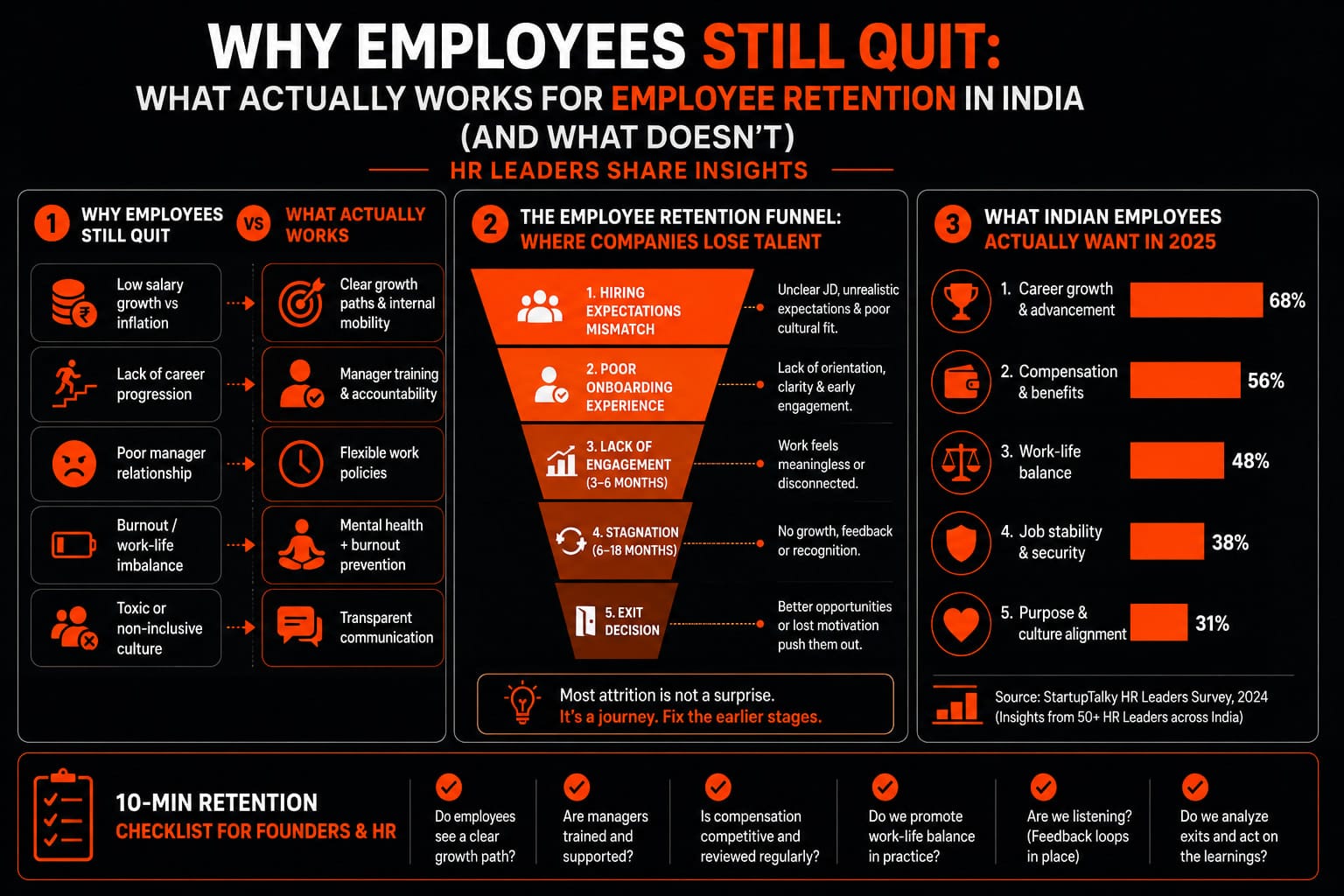
The Real Reason People Leave (It Is Not the Money)
Dr Rajani Tewari has worked across twelve geographies and 25,000-plus workforce organisations across her career. Her answer to the retention question strips away the noise.
“One of the biggest reasons employees leave is not workload or compensation alone, it is the feeling of no longer being valued. Incredibly talented people disengage when organisations focus only on targets and productivity, but forget human connection, trust, and meaningful conversations,” Dr Rajani Tewari, Global CHRO | ESG & Board-Level HR Strategy
This is not a soft observation. Gallup’s global engagement data consistently shows that only 21% of employees are engaged at work. The majority are present but not invested. And disengagement is expensive. Gallup estimates it costs the global economy over $8.8 trillion annually in lost productivity.
“Retention is not built through policies alone, but through culture, empathy, leadership behaviour, and how consistently people feel seen beyond their job titles.” Tiwari added.
This finding tracks with what Aon’s 2025 data shows: the most durable retention gains in India are emerging not from surface-level engagement levers, free lunches, game rooms, wellness apps, but from structural redesign of how growth, recognition, and leadership are experienced day to day.
The Mid-Size Advantage: How Smaller Companies Win at Employee Retention
For mid-size tech companies, the retention battle often feels structurally unfair. They cannot match large enterprises on brand, scale, or compensation structures. So how do they retain talent when competing with MNCs?
Ambrish Kanungo, Head of HR at Beyond Key, an IT services company serving US, UK, and Australian clients, has spent years turning this challenge into a strategic advantage.
“Where companies genuinely win on retention is by giving people something the big firms rarely can: visibility into their own growth. When someone can see clearly where they are headed and feel that progress is happening in real time, they tend to stay,” Kanungo explained.
In practice, this translates into faster ownership of meaningful work, cross-functional exposure instead of siloed roles, direct access to leadership, and projects that actively stretch employees. For high-potential talent, often the most at risk of attrition, these factors play a decisive role in whether they stay.
“Retention gets harder the moment an organisation grows past the point where culture can carry itself informally. Once teams stop being close-knit, employees start paying closer attention to whether growth opportunities, honest communication, and genuine recognition are still showing up consistently,” he added.
This insight is supported by data. Ravio’s 2026 Compensation Trends Report shows that early-stage companies often have lower attrition than late-stage firms, not because they offer higher pay, but because employees experience stronger mission alignment and visible impact.
For mid-size companies, this becomes a clear retention strategy: build growth visibility and culture deliberately before scale begins to dilute both.
 Muskaan Kapoor
The BFSI Reality: Retention at Scale in Tier 2 and Tier 3 India
Retention looks very different in financial services, especially in branch-heavy organisations, where employees are distributed across smaller cities and local job markets.
Preeti Kannan, President and CHRO at IIFL Finance, highlights how retention in this environment is shaped by both scale and proximity. With over 15,000 employees across 2,900+ branches, even small shifts in sentiment can quickly translate into attrition.
“At IIFL Finance, our approach to retention begins with active listening at scale through AI-enabled tools that help us understand employee sentiment in real time and enable more proactive, meaningful connections with our people,” she explained.
This allows the organisation to stay closely connected to a widely distributed workforce while designing more personalised employee experiences. The focus goes beyond compensation, towards building a culture rooted in respect, recognition, learning, and leadership accessibility.
At the core are clearly defined values: Fairness, Integrity, and Transparency, supported by continuous learning, leadership development, and strong local engagement initiatives that reinforce belonging across regions.
Kannan’s perspective also adds a deeper layer to why employees leave.
“Attrition data only captures the final decision, not the emotional journey preceding it,” she noted, adding that disengagement often builds gradually through fatigue, lack of recognition, or weak manager connection.
In high-performance sectors like BFSI, these signals are easy to miss, but critical to address. As organisations scale, the quality of everyday employee experience becomes a key differentiator.
She also points to a broader shift across financial services.
“Employees today seek accelerated learning, career mobility, leadership accessibility, wellbeing, and a stronger sense of purpose in their work,” she added.
For companies operating at scale, this changes the retention equation. The focus is no longer just on preventing exits, but on building trust, growth, and long-term employability.
The EdTech Lesson: What Hypergrowth Gets Wrong About Retention
No sector in India has seen a sharper retention reset than EdTech. The 2022-24 cycle of aggressive hiring followed by mass layoffs, across companies like BYJU’s, Unacademy, and Vedantu, exposed how fragile retention strategies built on high salaries and rapid growth can be.
Shruthi Sudhanva, Chief People Officer at Excelsoft Technologies, a B2B assessment and learning platform that followed a more measured growth path, observed this shift from a more stable vantage point.
“What the period reinforced for us is that retention cannot be built only on compensation, perks, or hypergrowth. What truly matters are meaningful growth opportunities, clear career paths, empathy during times of need, and support for both personal and professional development,” she noted.
The distinction here is critical: retention built on hype versus retention built on trust. Companies that managed to retain talent through the EdTech downturn were typically those where employees had clear career visibility and experienced honest, transparent communication from leadership during uncertain periods.
“If people enjoy the work they do, feel valued, and can see growth and long-term potential for their efforts, they are far more likely to stay, even during uncertain times,” Sudhanva added.
The AI Dimension: How Continuous Skilling Is Changing What Retention Looks Like
AI is reshaping not just jobs, but also why employees choose to stay. In 2026, continuous learning and skill development are becoming central to retention strategies.
Sammir Inamdar, Co-Founder & CEO of Enthral.ai, points to a long-standing gap: learning and development (L&D) has often been treated as a cost centre, disconnected from real business outcomes. That disconnect has direct consequences for retention.
Employees who do not see clear technical or professional growth within an organisation are far more likely to leave. In an AI-driven economy, where 39% of core job skills are expected to change by 2030 (WEF 2025), the risk of feeling left behind becomes a major trigger for attrition.
“The future of skilling lies in AI-powered ecosystems that can identify skill gaps in real time, automate learning interventions, and continuously improve workforce readiness at scale,” he explained.
This shifts retention from policies to infrastructure. When employees see their company actively investing in their future capabilities, beyond basic training or compliance modules, it signals long-term intent.
In a skills-first economy, retention increasingly depends on one clear question: Does the organisation grow as fast as its people need to?
The Bottom Line: What Actually Works in Retention
Attrition in India may be slowing, but the problem is far from solved. People are still leaving, and it’s still expensive for companies.
What’s working is actually simple.
Employees stay when they can see growth, trust leadership, and feel valued consistently, not just when things are going well. Fancy perks may help attract talent, but they don’t make people stay.
As companies move into a more skills-focused future, one thing is clear: retention is not just HR’s job. It depends on how leaders build and run the organisation every day.
Muskaan Kapoor