The Hiring Red Flags HR Leaders Say You Can’t Afford to Miss in 2026 – AI, Bias & Bad Hires
From defensive mindsets and rushed hiring to AI-driven bias, HR leaders across industries talk about the silent hiring red flags shaping recruitment decisions in 2026.
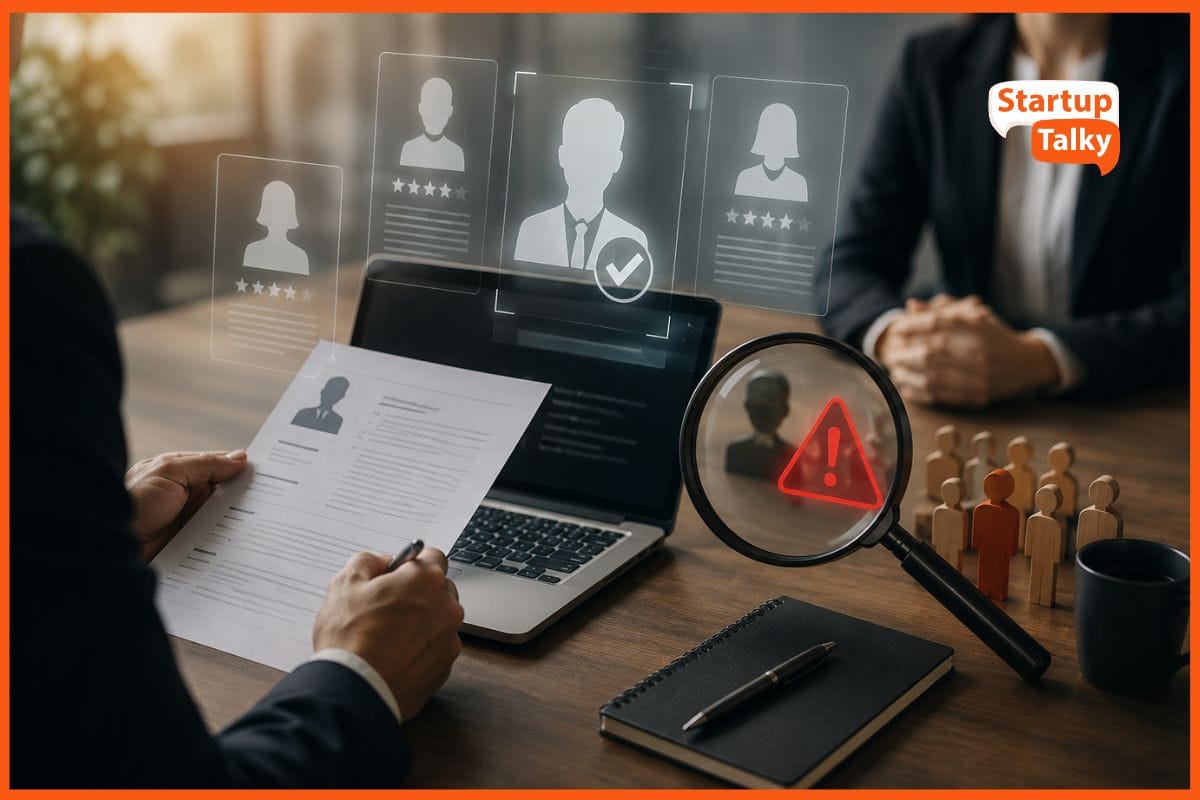
Hiring has never been more advanced, or more unreliable. In 2026, a typical corporate job opening gets over 250 applications, many of them AI-optimised, keyword-heavy, and hard to tell apart in resume screening. A 2025 survey found that 90% of HR leaders have seen a sharp rise in low-effort, AI-generated applications. At the same time, the tools used to filter candidates are also creating new biases and blind spots.
Because of this, experienced hiring leaders now focus less on systems like platforms, tests, or structured interviews, and more on the one signal that actually matters. On International HR Day 2026, StartupTalky asked HR leaders across sectors to name their single, non-negotiable red flag. What they said is worth every recruiter’s attention.
Defensive Mindset in Hiring: The Red Flag That Cuts Across Industries
At Decimal Point Analytics, a data analytics and AI firm serving global financial services clients, Chief People Officer Arun Pratap Singh highlights a hiring red flag that goes beyond skills and experience. In his view, mindset becomes the real differentiator in high-pressure environments.
“The biggest red flag is not lack of skill, but a defensive mindset. We usually observe that when a problem arises, a candidate either tries to solve it or immediately starts blaming systems, teams, timelines, or circumstances. People who stay curious, ask the right questions, and work toward solutions usually succeed, even if they are not technically perfect on day one.”
This distinction between ownership-driven candidates and those who default to blame often doesn’t show up in standard hiring frameworks. Skills can be tested and rehearsed, but defensiveness only becomes visible under real pressure.
He also points out that while AI has improved how candidates prepare, it hasn’t changed how they perform in real conversations.
“AI-assisted hiring has definitely made candidates better prepared. However, the actual difference can be seen in face-to-face discussions. We give candidates a situation similar to actual client challenges and observe how they think, structure problems, and respond under pressure. AI cannot entirely duplicate depth of experience, clarity of thought, or practical judgment in real-world conversations.”
Even with AI shaping applications, the real signal in hiring, he suggests, still comes from how candidates think when they are pushed beyond prepared answers into real problem-solving situations.
Accountability in SaaS Hiring: The Red Flag That Impacts Startup Growth
At Sekel Tech, a Pune-based hyperlocal SaaS platform, Co-Founder and CHRO Hemlatha Raghuvanshi approaches hiring from a founder’s lens—where every hire directly affects product timelines, execution speed, and revenue outcomes. For her, the real concern is not just performance, but how a candidate handles failure.
Her focus is on whether accountability is truly internalised or simply performed during interviews.
“Questions based on operating behaviour, asking if they were heading a project that failed because of their decisions, will help in finding out whether the person metabolises accountability without being defensive or passing the failure by blaming others. Mature ones will not resort to blame games. Their decision making is strong and they take complete outcome ownership.”
This approach helps identify a pattern that often gets missed in structured interviews: candidates who can describe situations well, but don’t actually own outcomes.
She refers to such profiles as “narrators”, people who are articulate about problems and conflicts, but rarely accountable for results.
“Binary thinkers often create friction themselves and will give immature answers putting the blame on others, process, systems, or the company. They will describe conflict emotionally and not structurally. Their colleagues feel more relieved when they are out of the system, that is a classic giveaway.”
In her experience, this becomes especially risky in lean SaaS teams. A technically strong hire who avoids accountability or creates internal friction can slow down execution and impact overall team performance significantly.
 Muskaan Kapoor
The HR Tech Sector’s Own Red Flag Problem
In the HR tech and enterprise hiring space, one pattern continues to stand out: candidates who look highly accomplished on paper but struggle in fast-moving, resource-constrained environments.
At Benevolve, a global HR tech platform, Founder and CEO Aditya Singh highlights this as a recurring mismatch, especially when professionals transition from large organisations to startups.
“The profile that often looks perfect on paper but struggles in reality is the ‘big-company HR transformation expert’ who has only operated inside highly resourced environments. On paper, they have all the right logos, titles, and transformation stories. But in a startup, success requires ambiguity tolerance, speed, and a willingness to go from strategy to execution in the same day.”
The issue, he explains, is not experience itself but context dependency, where success is built on systems, teams, and scale that may not exist in smaller setups. In such cases, the gap between expectation and execution becomes quickly visible.
He further adds that in today’s AI-driven hiring environment, adaptability matters more than credentials.
“More than technical skills, meta skills such as fungibility, critical thinking, and problem-solving are more important as the business situation changes very frequently, especially where AI is impacting every industry and every job.”
Across roles and industries, the underlying hiring challenge remains the same: the ability to operate with speed, ambiguity, and flexibility is becoming more valuable than traditional experience markers.
The Rushed Hire: The Industry’s Most Normalised Red Flag
In senior HR leadership discussions, one concern that repeatedly comes up is not about candidates, but about the hiring process itself. A growing number of organisations, according to Global CHRO Dr Rajani Tewari, are normalising rushed hiring decisions in the pressure to close roles quickly.
“One hiring red flag that genuinely concerns me today is how normalised rushed hiring has become. In the urgency to close positions quickly, many organisations end up evaluating resumes more deeply than people. Skills can be developed, but mindset, integrity, adaptability, and emotional intelligence are far more difficult to build later,” highlighted Tewari.
The concern here is structural: when speed becomes the priority, evaluation often shifts toward surface-level credentials instead of deeper behavioural fit. This, she notes, leads to a critical blind spot in hiring decisions.
According to her, the real cost of this approach only becomes visible later, when misalignment starts affecting teams and outcomes.
“The biggest hiring mistakes happen when companies ignore cultural alignment and human values just to meet immediate business demands.”
This gap between urgency and alignment often results in long-term consequences such as attrition, conflict, and reduced team performance, costs that far exceed the time saved during hiring.
Industry estimates also support this concern: replacing a culturally misaligned hire can cost anywhere between 40% to 200% of their annual salary, depending on seniority. This makes rushed hiring not just a cultural issue, but a financial one as well.
The underlying message is clear: slowing down the hiring process, even slightly, to evaluate values, mindset, and adaptability can significantly reduce long-term hiring risk.
The AI Blind Spot in Hiring: A Structural Warning
In discussions around modern hiring systems, one of the most overlooked risks is not human error, but algorithmic bias. Corporate trainer and POSH expert Kruti Sharma, who works closely with organisations on compliance and workplace safety, warns that AI-driven hiring tools can quietly reinforce existing workplace inequalities.
“If a company has hired only a few women for technical roles for many years, an AI system may also end up following the same pattern. Companies need to ensure human oversight to avoid AI bias. Candidates should be able to report AI-based decisions and track bias patterns.”
The concern, she explains, is that AI systems are trained on historical hiring data—meaning they often replicate past decisions rather than challenge them. This can unintentionally strengthen long-standing exclusion patterns instead of correcting them.
Recent research reinforces this risk. A Stanford study (October 2025) found that AI screening tools rated older male candidates higher than equally qualified female applicants. Separately, a 2025 People Matters study found that AI systems often preferred AI-written CVs over equally strong human-written ones.
These findings suggest that the issue is not isolated, but structural, built into how optimisation is defined in many hiring tools.
The broader red flag in AI hiring, therefore, is not only candidate behaviour. It is what these systems consistently fail to see, and the groups that are disproportionately affected by those blind spots.
Vivek Dev Jacob
The Presence Trap: A Red Flag That Runs Both Ways
Most hiring conversations focus on what candidates reveal about themselves. Vivek Tiwari, Founder of Pragyan Advisory, who advises companies on HR strategy, flips that lens, arguing that one of the most telling red flags in 2026 is not what a candidate does, but what an organisation signals to them.
"One workplace trend that organisations refuse to let go is 'office presence productivity', where an employee's performance is still judged by their presence in the office rather than actual outcomes. This seat-time culture has continued even after the Covid work phase, which clearly showed that performance depends more on outcomes than physical presence."
The numbers back this up. Stanford's landmark study on hybrid work — one of the largest of its kind- found no performance difference between fully in-office and hybrid workers. McKinsey's 2025 analysis found that well-run hybrid teams are around 5% more productive than fully remote or fully in-office ones. A University of Pittsburgh study found that return-to-office mandates hurt job satisfaction without improving financial results, and data shows 8 in 10 companies lost people after bringing in strict office policies.
For candidates looking at a potential employer, the point is clear: a company that still measures hours over results is already telling you how it will manage and trust you, before you have even joined.
"Excessive monitoring creates work stress, reduces trust, and affects employee interest. The upcoming Gen Z will value flexibility, ownership, and meaningful work more than rigid attendance systems," Tiwari added.
His advice is straightforward: move to a hybrid model, set clear and measurable goals for every role, train managers to lead on trust, and make the shift gradually with honest communication from the top. Owl Labs' 2025 State of Hybrid Work report found that 67% of in-office workers say they do only the bare minimum at work, compared to just 5% of remote workers. Seat-time culture does not just fail to improve performance. It actively works against it.
The red flag is not always the person sitting across the table. Sometimes it is the culture they are being asked to walk into.
Final Thoughts: AI Hiring, Red Flags & Human Judgment in 2026
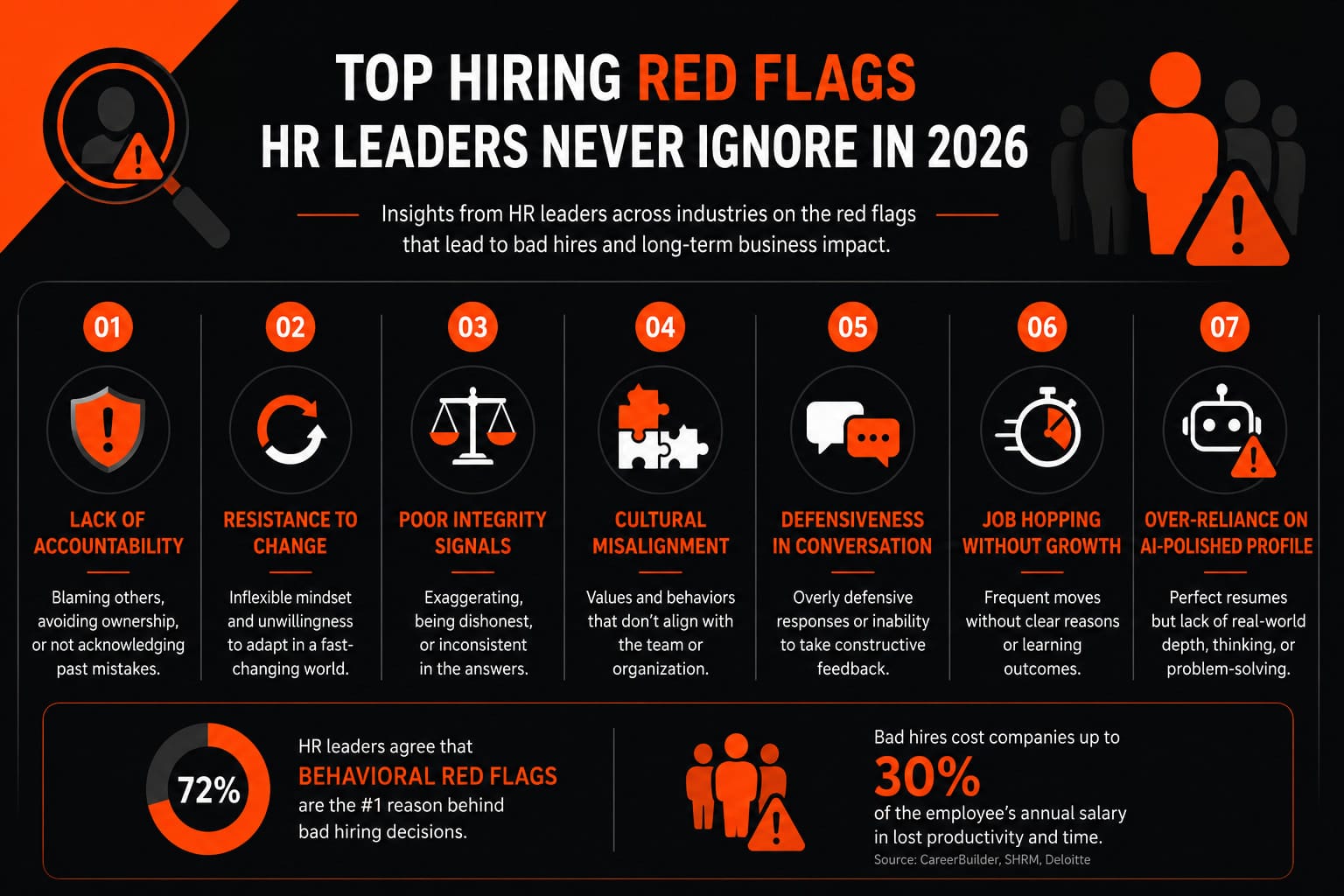
Across industries, HR leaders’ hiring red flags highlight one clear gap in modern recruitment: accountability, adaptability, integrity, and cultural fit are still the hardest traits to measure in today’s AI-driven hiring process.
In 2026, as AI recruitment tools make resumes and applications more polished and keyword-optimised, spotting real talent has become more complex. While automation improves efficiency, it often misses deeper behavioural signals.
That’s why human judgment in hiring remains critical. The best hiring decisions now depend on asking better questions and identifying signals beyond AI-screened resumes.
Muskaan Kapoor