AI in HR: 78 Million Jobs Ahead, But India Faces a Massive Reskilling Gap
On International HR Day 2026, StartupTalky explores how AI is reshaping hiring, skills, and the future of work. While 78 million new jobs are expected globally by 2030, India faces a widening gap between AI adoption and workforce readiness, raising urgent questions for businesses and HR leaders.
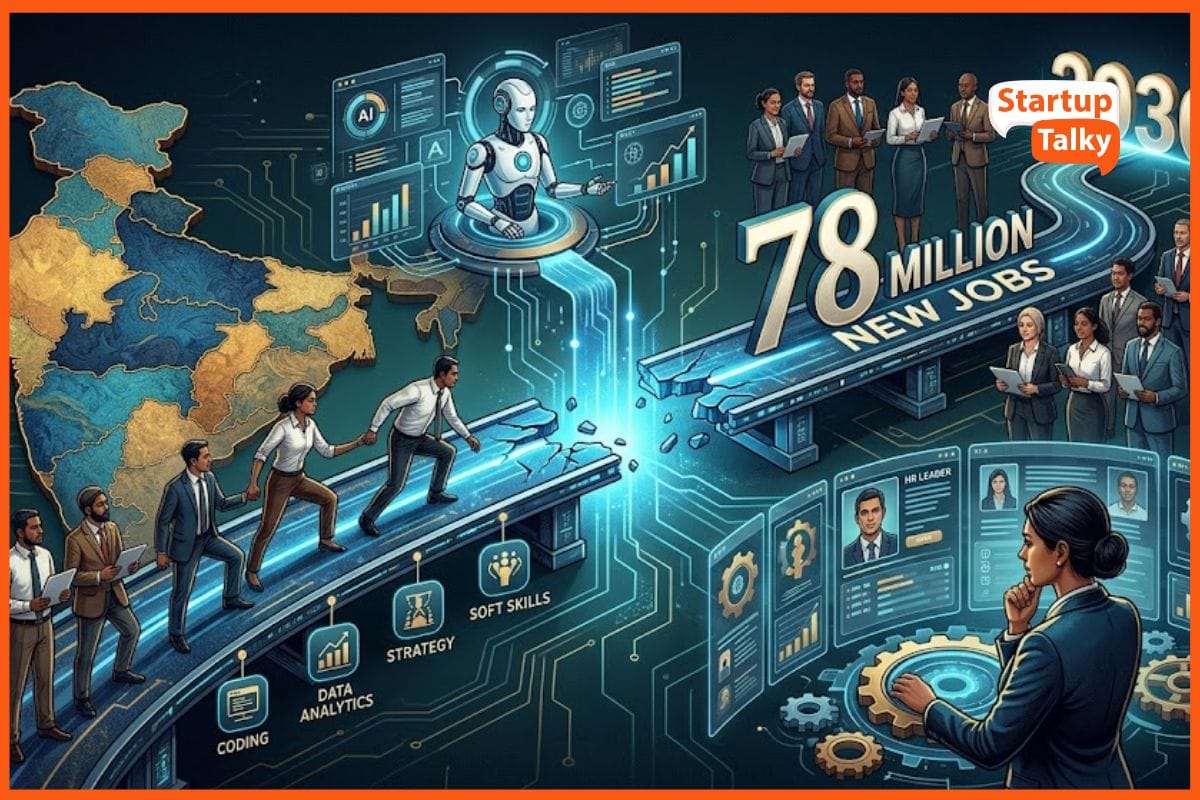
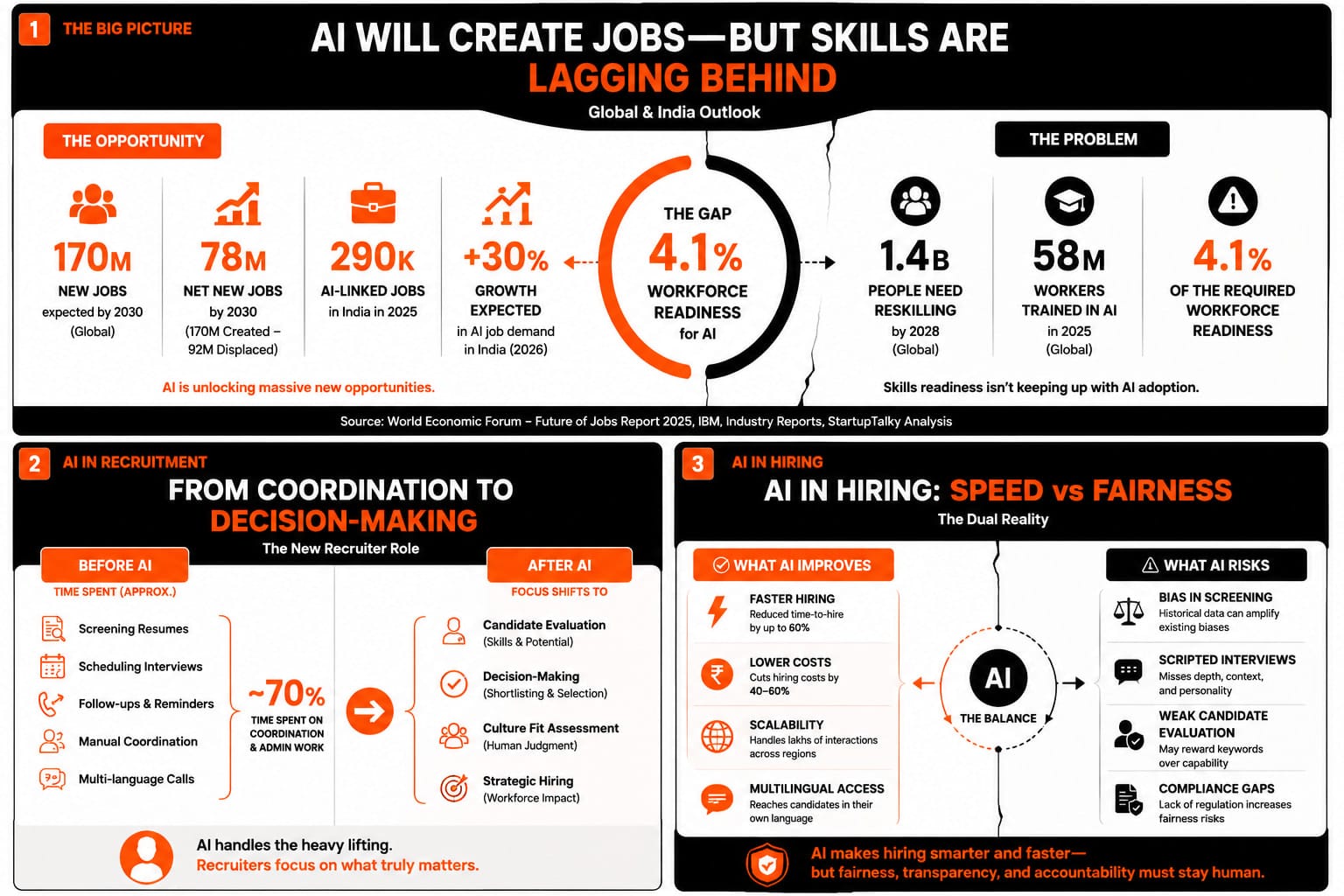
In 2025, the World Economic Forum’s Future of Jobs Report delivered a stark projection: 22% of global jobs will be disrupted by 2030. Not gradually replaced but disrupted. At the same time, 170 million new roles are expected to emerge, against 92 million jobs that could disappear, creating a net gain of 78 million jobs.
But that opportunity comes with a condition: skills readiness.
In India, the urgency is sharper. The country recorded 290,000 AI-linked job roles in 2025, with demand expected to grow by over 30% in 2026. Skills in generative AI and large language models surged by nearly 60% year-on-year. Yet, globally, only 58 million workers completed AI training in 2025, against an estimated 1.4 billion people who need reskilling by 2028.
That’s just 4.1% of the required workforce readiness.
This widening gap between AI adoption and workforce preparedness is where the real story lies. On International HR Day 2026, StartupTalky spoke with HR leaders, founders, and global experts to understand how AI is reshaping hiring, skills, and the future of work, not in theory, but on the ground.
AI in Recruitment: Why Frontline Hiring in India Needs Automation
The case for AI in hiring becomes clearest when viewed through the lens of India’s frontline workforce.
With over 400 million frontline workers, the largest such workforce globally, the scale of hiring has long outpaced human capability. High attrition rates, fragmented talent pools, and multilingual communication challenges have made traditional recruitment models inefficient and expensive.
“The math was always impossible for humans alone. 250,000 hires in 72 hours. 400 million+ frontline workers. No recruiter team on earth closes that gap. AI doesn’t replace recruiters, it finally gives them leverage,” Krishna Khandelwal, Co-Founder & CEO, Hunar.ai
Khandelwal’s Gurugram-based platform has facilitated over 21 million candidate conversations in Hindi, Marathi, and other regional languages, entirely via voice AI on ordinary phone calls, no app, no data plan required. This was a deliberate design choice rooted in inclusion, not convenience.
“Every AI hiring tool built on apps, portals, and PDF uploads quietly excluded India’s frontline workforce. The answer was always simpler: start where the worker already is. In India, that’s a phone call,” Khandelwal.
Beyond scale, the economics are equally compelling. Frontline attrition across sectors like logistics, retail, and manufacturing ranges between 25-35%, while hiring costs can reach 40-60% of annual salaries for these roles.
AI is not just reducing time-to-hire; it is fundamentally changing how recruitment resources are allocated.
Khandelwal highlighted, “The 10,000 recruiters aren’t disappearing, they’re graduating. Today, recruiters spend nearly 70% of their time on coordination, follow-ups, scheduling, and screening calls across languages. AI absorbs that. What remains is the work that actually requires human judgment.”
In this model, AI does not eliminate human roles; it redefines them. Recruiters move from process execution to decision-making, from coordination to candidate evaluation.
And at India’s scale, that shift is not optional, it is inevitable.
Challenges of AI in HR: Bias, Poor Interviews, and System Limitations
For all its promise, AI in HR is still far from perfect.
Anil Agarwal, Co-Founder and CEO of InCruiter, a platform that has conducted over 200,000 AI-powered interviews, offers a grounded view of where the technology stands today. While AI has reduced manual workload, it has also exposed structural limitations in how hiring systems are built.
“I’d challenge that premise. We haven’t replaced recruiters; we’ve freed them from monotony. Manual screening, scheduling, and calendar juggling aren’t jobs we want talented people doing.”- Anil Agarwal, Co-Founder & CEO, InCruiter
Yet, the deeper issue lies in how most AI interview systems function.
“Most AI interview platforms fail at one critical thing: they ask scripted questions and rank responses mechanically. They can’t adapt. A candidate gives an interesting answer, but the system has already moved to the next canned question. They miss depth, context, and personality,” explained Anil Agarwal, Co-Founder & CEO, InCruiter.
This limitation has broader implications. AI systems trained on historical hiring data often inherit existing biases, amplifying inequalities rather than eliminating them.
A Stanford study (2025) found that AI-driven resume screening tools consistently rated older male candidates higher than equally qualified female and younger applicants. Similarly, a People Matters report highlighted that AI systems often rank AI-generated CVs higher than human-written ones, creating a loop where candidates skilled at optimising for AI, not necessarily the job, gain an advantage.
The result is a paradox: AI is improving efficiency in hiring, but not always accuracy or fairness.
 Vivek Dev Jacob
AI Hiring Risks: Bias, Compliance Gaps, and Lack of Regulation in India
As AI adoption accelerates, regulation is struggling to keep pace, especially in India.
Kruti Sharma, a corporate trainer and POSH expert, points to a critical but under-discussed issue: algorithmic fairness and compliance.
“If a company has hired only a few women for technical roles for many years, an AI system may also end up following the same pattern. The candidates should be able to report AI-based decisions and track bias patterns. Continuous monitoring is important to avoid AI-related biases.”- Kruti Sharma, Corporate Trainer & POSH Expert
The risk is not theoretical. Amazon had to scrap an internal AI hiring tool after it was found to systematically downgrade resumes referencing women’s organisations, due to biased training data.
Globally, governments are beginning to respond. The Colorado AI Act (effective June 2026) mandates that companies take “reasonable care” to prevent algorithmic discrimination in hiring systems.
India, however, lacks a comparable regulatory framework.
This creates a widening gap between AI adoption and governance readiness, at a time when hiring decisions are increasingly influenced by automated systems.
At the same time, human judgment still plays a decisive role. Nearly 78% of hiring managers globally say they value personalised applications, while 62% report rejecting generic AI-generated applications.
The takeaway is clear: AI may optimise the process, but accountability still rests with humans.
Muskaan Kapoor
AI in Learning & Development: Why Reskilling Is Now a Business Priority
If AI is reshaping hiring, it is fundamentally transforming how organisations think about skills.
Sammir Inamdar, Co-Founder and CEO of Enthral.ai, argues that traditional learning models are no longer viable in a fast-changing, AI-driven workplace.
“In an AI-driven workplace, workforce skills can no longer depend on static courses or one-time training programs. Skills are evolving rapidly, and organisations need learning systems that are continuous, flexible, and connected with real business results.” - Sammir Inamdar, Co-Founder & CEO, Enthral.ai
The data reinforces this shift. According to the Future of Jobs Report 2025, 44% of core workforce skills will change within five years.
Yet, most organisations still measure L&D success through outdated metrics like course completion rates and training hours, indicators that reveal little about actual job readiness.
“For years, L&D was viewed as a cost centre because organisations struggled to connect learning with measurable business impact. AI is now changing that conversation,” Inamdar.
What is emerging instead is a model where learning is tied directly to performance outcomes.
In India, the focus remains on transitioning from “learning for completion” to “learning for role readiness.” In more mature markets like the US, the challenge has shifted toward reskilling experienced professionals at speed.
Across both contexts, one trend is clear: continuous, AI-driven skilling is becoming a core business function, not an HR side initiative.
Global AI Workforce Trends: Where India Stands vs the US and Europe
The global AI workforce transition is not playing out uniformly, and India’s position is uniquely complex.
Achal Khanna, CEO – APAC & MENA at SHRM, highlights that countries leading this transition, such as Singapore, Germany, and Canada, share a common advantage: they invested early in reskilling infrastructure.
“Genuine preparedness is rarer than the headlines suggest. The economies doing this well, Singapore, Germany, Canada, share a common thread: they invested in workforce reskilling infrastructure before AI arrived at scale, not in response to it.” - Achal Khanna, CEO, APAC & MENA, SHRM
India, Khanna argues, sits in a structurally different position to Western economies, and that difference is not just cultural but mathematical.
“Western economies are managing AI transition against a backdrop of ageing populations, labour shortages, and established social safety nets. India is managing it with a young, growing workforce where employment generation remains a primary national priority. AI that displaces jobs in Germany creates a policy challenge. AI that displaces jobs in India at scale creates a social one,” Khanna.
This framing matters for how Indian organisations should be thinking about AI adoption in their HR functions. The technology is not culturally neutral, and Khanna’s point that “tools succeed here when they complement human connection, not replace it” has direct implications for everything from performance management systems to AI-driven engagement platforms.
On the CHRO of 2028, Khanna offers a profile that is already beginning to emerge at the most forward-thinking Indian companies.
“The CHRO of 2028 is not primarily an HR professional in the traditional sense. They are a business leader who happens to own the people agenda. AI will handle much of what currently consumes HR bandwidth, and we’re already seeing mandates where the CHRO is also being requested to take on the role of the Chief AI Officer,” explained Khanna.
The Bottom Line
The debate around AI and jobs has evolved.
It is no longer about whether AI will replace humans, it is about how work itself is being redefined.
AI is already transforming hiring, reshaping skills, and influencing how organisations make talent decisions. But its impact is not predetermined. The projected 78 million net new jobs globally are not a guarantee, it is conditional on how effectively businesses invest in reskilling, governance, and human-centric design.
For India, the stakes are higher. The scale of its workforce, combined with uneven access to skills and infrastructure, makes this transition both an economic opportunity and a structural challenge.
The leaders shaping this shift agree on one thing: AI is a tool, not a strategy.
And as organisations navigate this transition, the role of humans is not diminishing, it is evolving.