
World Entrepreneurs’ Day 2026: Founders on What It Takes to Build a Business That Lasts
From earning customer trust to managing financial runway and knowing when to adapt, founders share lessons from their journeys and advice for those starting a business in 2026.
Starting a business often begins with an idea. Building one that survives requires much more.
India now has more than 2.47 lakh DPIIT-recognised startups, compared with 502 in 2016, according to government data as of 12 August 2026. The number shows how much entrepreneurship has grown in India. It says less about what happens after a founder takes the first step.
A good product still needs customers. A new idea may need years to earn trust. Revenue may take longer than expected. Founders also have to decide when to stay the course and when to change it.
On World Entrepreneurs’ Day, StartupTalky spoke to entrepreneurs across financial services, consumer brands, legal finance, energy and hospitality about what they wish they had known before starting out and what they would tell someone starting a business in 2026.
Their businesses are different. Many of their lessons are not.
A Good Product Does Not Guarantee a Customer
Founders can be convinced that they have solved an important problem. Getting customers to see it the same way can be harder.
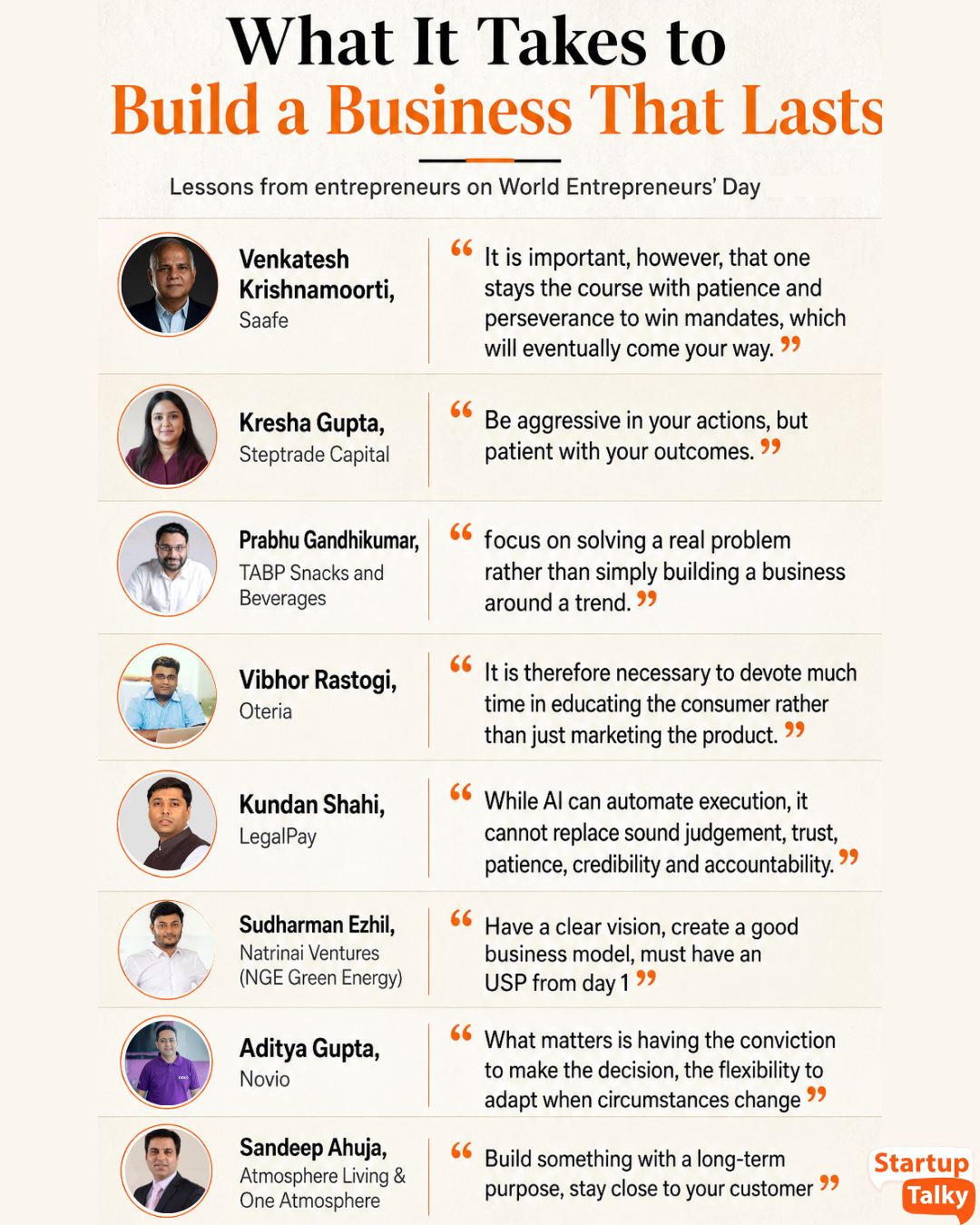
For Venkatesh Krishnamoorti, Co-Founder and CEO of Saafe, an account aggregator, this was one of the lessons that came with experience.
“Even if you see the product/solution to be a perfect fit for your prospective customers, it is excruciatingly hard to get their mind space in the long laundry list of their priorities.”
His answer points to a gap founders can underestimate. Building a useful product and getting someone to prioritise it are separate challenges.
Prabhu Gandhikumar, Founder and CEO of TABP Snacks and Beverages, learnt a similar lesson from the consumer market. For him, the product is only one part of the business.
“One thing I wish I had understood better before starting TABP is that building a business is not just about having a good product, it is about building the right ecosystem around it.”
In FMCG, he says, that means understanding consumers, maintaining quality and building distribution.
His advice for new entrepreneurs is equally clear: “focus on solving a real problem rather than simply building a business around a trend.”
Sometimes the Customer Needs to Understand the Idea First
Finding a gap does not mean customers will immediately understand what is being offered.
Vibhor Rastogi, Founder of Oteria, found this while building a brand around circadian rhythm skincare. Introducing a less familiar concept meant the company also had to explain it.
“It is therefore necessary to devote much time in educating the consumer rather than just marketing the product.”
That distinction matters for founders bringing a new category or concept to market. Marketing can create visibility. But if customers do not understand the proposition, visibility alone may not lead to adoption.
Rastogi’s advice for 2026 is to “understand the need of the consumer and create a product that will fill the gap in the market.”
Sandeep Ahuja, Managing Director of Atmosphere Living and One Atmosphere, also puts the customer at the centre of long-term decisions.
“Build something with a long-term purpose, stay close to your customer, and do not compromise on the fundamentals while chasing growth.”
Trust and Revenue Take Time
Kresha Gupta, Director and Fund Manager at Steptrade Capital, describes an entrepreneur as the “Chief Everything Officer”. But knowing every part of a business does not automatically convince others to trust it.
“Knowing your business inside out does not automatically make people trust you with their money.”
For Gupta, trust is built through judgement, consistency and showing up over time. Her experience has also shaped how she thinks about the time it takes to generate revenue.
“Have patience.”
She adds: “Be aggressive in your actions, but patient with your outcomes.”
That patience also requires financial preparation.
Aditya Gupta, Founder and CEO of Novio, advises aspiring entrepreneurs to have enough funds to support themselves for at least 18 months without depending on income from the new business.
“Building something meaningful takes time, and having that runway gives you the freedom to experiment, test your ideas, learn from what doesn’t work and improve without making short-term decisions simply because you need to start earning.”
Krishnamoorti makes financial discipline part of his advice too. He urges founders to think carefully about the founding team, its skills and the runway available to “keep lights on”, while maintaining focus on a positive bottom line.
Founders Have to Learn When to Change
Patience does not mean refusing to change.
Kundan Shahi, Founder and CEO of LegalPay, says one of his biggest lessons is that the founder’s job itself changes as the company grows.
“In the start, my focus was on building the product, finding customers, and proving that an idea could work. As the company grew, my responsibilities matured towards building the right team, creating strong processes, and uncovering leaders who could take the organisation forward.”
What worked at one stage may not work at another.
Ahuja makes a similar point. He says he wishes he had understood earlier that entrepreneurship is less about having all the answers and more about knowing what to ask and when to adapt.
“Markets change, customer expectations evolve, and what works today may not work tomorrow.”
Aditya Gupta approaches the same problem through decision-making. Founders, he says, often have to act before they have complete information.
“What matters is having the conviction to make the decision, the flexibility to adapt when circumstances change, and the resilience to keep moving forward.”
AI Can Speed Up the Start, Not Replace the Fundamentals
For someone starting in 2026, technology can make parts of building a company easier. Shahi points specifically to AI, which can help entrepreneurs test ideas, build products and reach customers.
But he draws a line between faster execution and building a lasting company.
“While AI can automate execution, it cannot replace sound judgement, trust, patience, credibility and accountability.”
His advice is to choose a problem important enough to hold a founder’s commitment for the next decade, understand the customer and practise financial discipline from the beginning.
It is a useful distinction at a time when the tools needed to create and test products are becoming more accessible. A shorter path to launching does not necessarily mean a shorter path to building a viable business.
Know What You Will Not Compromise On
Not every lesson is about changing direction.
For Sudharman Ezhil, Director and CEO of Natrinai Ventures (NGE Green Energy), one of the most important lessons has been sticking to the original plan and goals.
“If you deviate or compromise on it, the entire journey gets harder, so whether it be project timelines, customer negotiations, or whatever is the right, stand by it.”
His advice to new entrepreneurs is to begin with a clear vision, a sound business model and a USP from day one.
Final Thoughts
Taken together, the responses reveal a tension that every founder eventually has to manage. A business needs enough flexibility to respond to customers and changing conditions, but enough conviction not to change direction with every new trend or setback.
That may be the more useful lesson on World Entrepreneurs’ Day.
Starting a business requires an idea and the willingness to act on it. Staying in business asks different questions. Is there enough money to keep going? Do customers understand the product? Can they trust the people behind it? Is the founder willing to change what is not working while protecting what matters?
There is no single answer to those questions. But across eight entrepreneurs and very different businesses, the advice repeatedly comes back to patience, customers, financial discipline, judgement and time.
Those fundamentals may matter long after the excitement of starting has passed.
 Sakshi Jadhav