Anooshka Soham Bathwal on Women-Centric Wealth Management, PMS Investing, and Building Long-Term Investor Trust
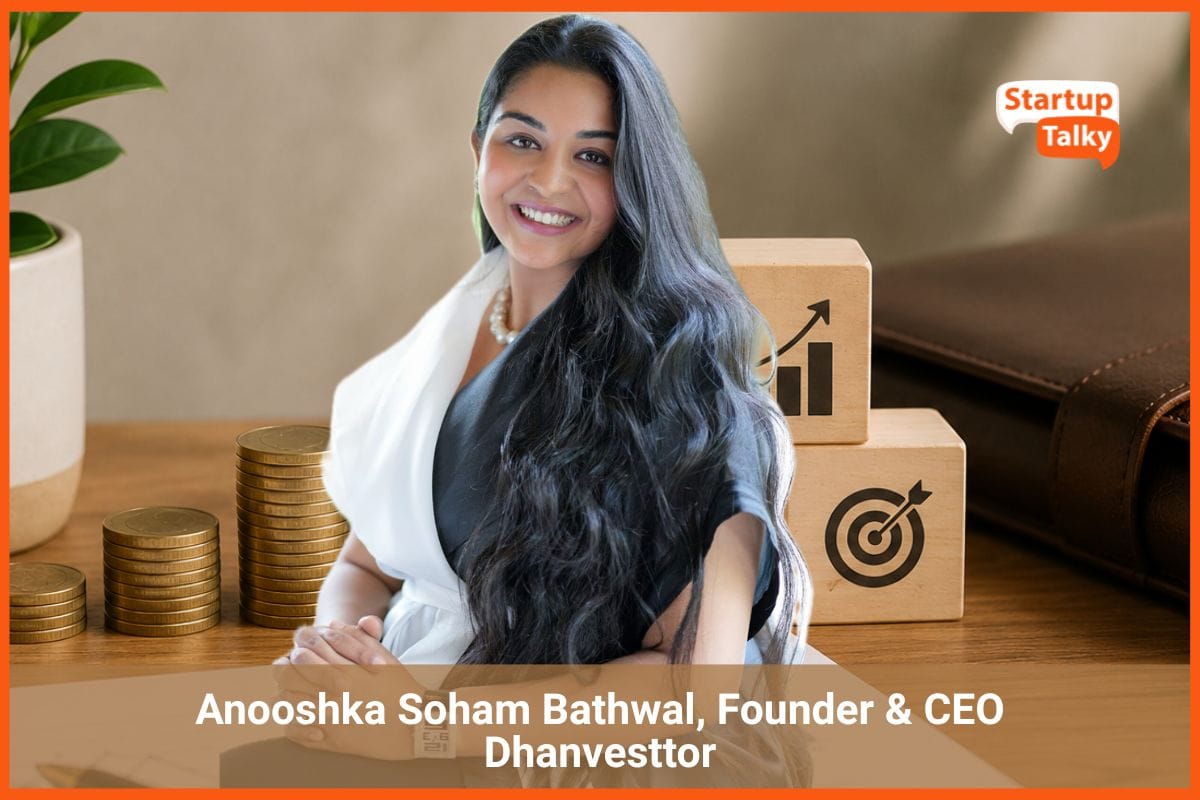
In this StartupTalky WealthTech Leaders Insights Series interview, Anooshka Soham Bathwal shares how Dhanvesttor is redefining PMS with suitability-first investing, long-term wealth creation, women-focused financial advisory, and investor education.
India's portfolio management services (PMS) industry has witnessed rapid growth, with assets under management (AUM) crossing ₹10.5 lakh crore and the broader wealth management sector expected to grow at a CAGR of around 12–14% over the next few years. Rising financial literacy, increasing participation from women investors, and growing demand for personalized investment solutions are expected to shape the future of wealth management. As investors move beyond one-size-fits-all products, suitability-based advisory and long-term wealth creation are becoming key industry trends.
In this edition of the StartupTalky WealthTech Leaders Insights Series, Anooshka Soham Bathwal, Founder of Dhanvesttor, shares her insights on suitability-first investing, the FAITH investment strategy, the evolution of PMS, women-centric wealth management, building investor trust, and expanding financial inclusion across Tier-2 and Tier-3 cities.
Suitability-First Investing
StartupTalky: At a time when there is a lot of competition in terms of returns, the platform Dhanvesttor has adopted a suitability-first approach. What exactly does it mean to prioritise suitability over product recommendation in practice?
Anooshka Soham Bathwal: A returns-first approach asks what's performing well. A suitability-first approach asks who you're actually investing for. Those are two very different starting points, and they lead to very different conversations.
Suitability isn't a box we tick on a form. In practice, we start with the person, not the product. Before any recommendation, we want to know where the investor stands today: her commitments, the liquidity she might need, how she reacts to volatility, what she's actually trying to achieve, and the timeframe she's working with.
Only once that picture is clear do we move to products. Something can be popular and high-performing and still be the wrong fit. Prioritising suitability sometimes means saying no to a product altogether.
We don't want our clients investing in something purely because it's the name everyone is talking about that month. A woman should understand exactly why a recommendation suits her financial situation, not just that it's been recommended. That makes the process slower. It also makes it far more responsible.
The FAITH Investment Strategy
StartupTalky: The FAITH strategy focuses on fundamental analysis and long-term discipline over market timing. How do you maintain client conviction during phases when the portfolio underperforms the broader index?
Anooshka Soham Bathwal: Maintaining client conviction during periods of underperformance, especially when adhering to our fundamental, long-term FAITH strategy, hinges on transparent communication and anchoring expectations in our investment philosophy rather than in short-term noise. We emphasise that short-term tracking error is an inherent feature of strategies focused on long-term themes. We consistently revisit the core investment thesis for each holding and the portfolio as a whole, ensuring that the underlying fundamentals remain intact or have even improved, regardless of whether the market has recognised it yet.
Furthermore, we evaluate the portfolio's performance and the index based on the time horizon; the gap may narrow or reverse when viewed over 3-5 years. The key is reinforcing that we are here for the long run, not to match the index next quarter. This disciplined approach ensures that the portfolio remains aligned with the strategy's intended outcome.
PMS vs Mutual Funds
StartupTalky: India's PMS AUM crossed INR 10.5 lakh crore, roughly doubling since 2022. For an investor considering PMS for the first time, what is the difference between a PMS and a mutual fund that actually matters in practice, not just on paper?
Anooshka Soham Bathwal: The biggest difference is that they're designed for different types of investors. In a mutual fund, you hold units in a collective scheme. In a PMS, you directly hold the stocks in your own demat account. It's personal in a way mutual funds simply aren't structured to be.
You can see exactly what you own, why it's there, and how it connects to your goals, because a PMS isn't built to be a standard product handed out to everyone. There's real room for customisation.
That doesn't make PMS automatically better than a mutual fund. Mutual funds are efficient, diversified, and the right fit for most investors. PMS is built for someone with sufficient capital, a longer horizon, and the stomach for market volatility. It's not about chasing something that sounds premium; it's about whether the structure actually fits the investor.
Women-Centric Wealth Management
StartupTalky: You built Dhanvesttor with women investors as the primary audience. What does financial product design look like when it starts from women's relationship with money rather than adapting a generic model?
Anooshka Soham Bathwal: It starts with listening, not designing. Women already know how to manage money. At home, in business, within families. What they're usually handed is an investing conversation that makes them feel like outsiders in their own financial lives. That's not a skills gap. It's a confidence and access gap, and a lot of it comes down to how the industry communicates.
At Dhanvesttor, the conversations we build are anchored in wealth-building itself; not generic life-stage milestones, but real financial independence, ownership, and the confidence to make decisions without needing anyone else's approval. We don't want a woman investing because someone told her to. We want her investing because she understands what she's doing and why.
That's also why the portfolio was never going to be the whole offering. Wealth advisory sits inside something larger: workshops, peer communities, ongoing financial literacy programmes, because confidence isn't built in a single meeting. It's built over time, in spaces where women can ask the basic questions, get real answers, and watch their own decision-making get sharper. The portfolio is one output. The ecosystem is what actually changes how a woman relates to her money.
Building Trust with First-Time PMS Investors
StartupTalky: You have said trust is built through predictable processes rather than performance claims. How do you communicate that to a first-time PMS investor who has only ever evaluated a fund by its one-year returns?
Anooshka Soham Bathwal: With a first-time PMS client, the shift we try to make is from "what was the return last year?" to "how is this money actually being managed?" What's the approach? What kind of companies do we like? What risks do we stay away from? How often do we review the portfolio? Under what conditions would we sell? These questions tell you far more than a single number.
A one-year return is useful, but it says very little about whether the result is something that can be repeated. Returns matter, but only alongside the process, the risk taken to get there, and the horizon involved.
A defined process gives clients something solid to hold onto when markets get uncertain, and it takes a lot of emotion out of decision-making. Trust comes from clients understanding exactly what we do and why we do it, not from a number on a screen.
Expanding Wealth Management in Tier-2 and Tier-3 Cities
StartupTalky: Dhanvesttor is expanding into Tier-2 and Tier-3 cities. What barriers do women in those markets face when engaging with structured investment products, and how does the platform address them?
Anooshka Soham Bathwal: Women in Tier-2 and Tier-3 cities run into a few consistent obstacles.
The first is access. Most professional financial advice is concentrated in a handful of large metros, which is part of why Dhanvesttor is headquartered in Kolkata rather than Mumbai or Delhi.
The second barrier is confidence. Many women in these cities have savings. What they've rarely had is a seat in a serious investment conversation, which makes it harder to act with conviction.
The third is language and relatability. Investment products are often explained in ways that feel disconnected from how people actually live, and in smaller cities, trust is everything. Women want to know who they're speaking to, whether that person understands their reality, and whether the advice is actually meant for them.
That's why our sessions are built around real situations rather than textbook concepts; a small business owner figuring out how to set aside profits for the first time, for instance, walks through that exact scenario rather than a generic introduction to mutual funds. We work with women across every stage of financial literacy, from someone opening her first investment account to someone ready to explore more sophisticated products.
Over time, what changes is not just what these women know, but how they see themselves in relation to money: less like an outsider waiting for permission, more like someone capable of making the call herself.
Our larger goal is a financial ecosystem that includes women across India, regardless of where they live or what they already know. Give women the right access, education, and environment, and they won't just participate in finance. They'll lead it.
 Apoorva Bajj