Best AI Returns Management Tools to Reduce Ecommerce Returns
Returns don't have to hurt your profits. Discover the best AI returns management tools that automate returns, reduce fraud, improve customer satisfaction, and encourage exchanges instead of refunds.

Online shopping is easier when people know what to expect. AI helps by giving clear product details, better size and fit advice, and personalized suggestions. This helps shoppers make better choices and reduces the chance of buying the wrong item. AI can also spot products that are returned often, allowing sellers to improve listings or fix quality issues.
When a return is needed, AI speeds up approvals, refund decisions, and routing while checking for fraud. This creates a faster and smoother experience for both shoppers and businesses. The result is fewer returns, lower costs, and happier customers.
Key Features to Look for in an AI Returns Management Tool
Not every AI returns management platform offers the same capabilities. Before choosing a solution, evaluate the features that best match your business size, product catalog, and return volume.
1. AI-Powered Fraud Detection
Look for tools that can identify suspicious return behavior, policy abuse, and repeat offenders. Fraud detection helps reduce unnecessary losses and protects profit margins.
2. Self-Service Returns Portal
A branded self-service portal lets customers initiate returns, exchanges, or refunds without contacting support. This improves customer satisfaction while reducing the workload for your support team.
3. Exchange and Store Credit Options
The best platforms encourage customers to exchange products or accept store credit instead of requesting refunds. This helps businesses recover more revenue and improve customer retention.
4. Smart Automation
Automation speeds up return approvals, generates shipping labels, routes returned items, and applies return policies automatically. This reduces manual work and ensures consistent decision-making.
5. Ecommerce Platform Integrations
Choose a tool that integrates seamlessly with platforms like Shopify, or your existing ERP and customer support software. Easy integration simplifies implementation and improves operational efficiency.
Selecting a platform with these features can reduce operational costs, improve customer satisfaction, and turn returns into an opportunity to retain revenue instead of losing sales.
AI Returns Management Tools Comparison
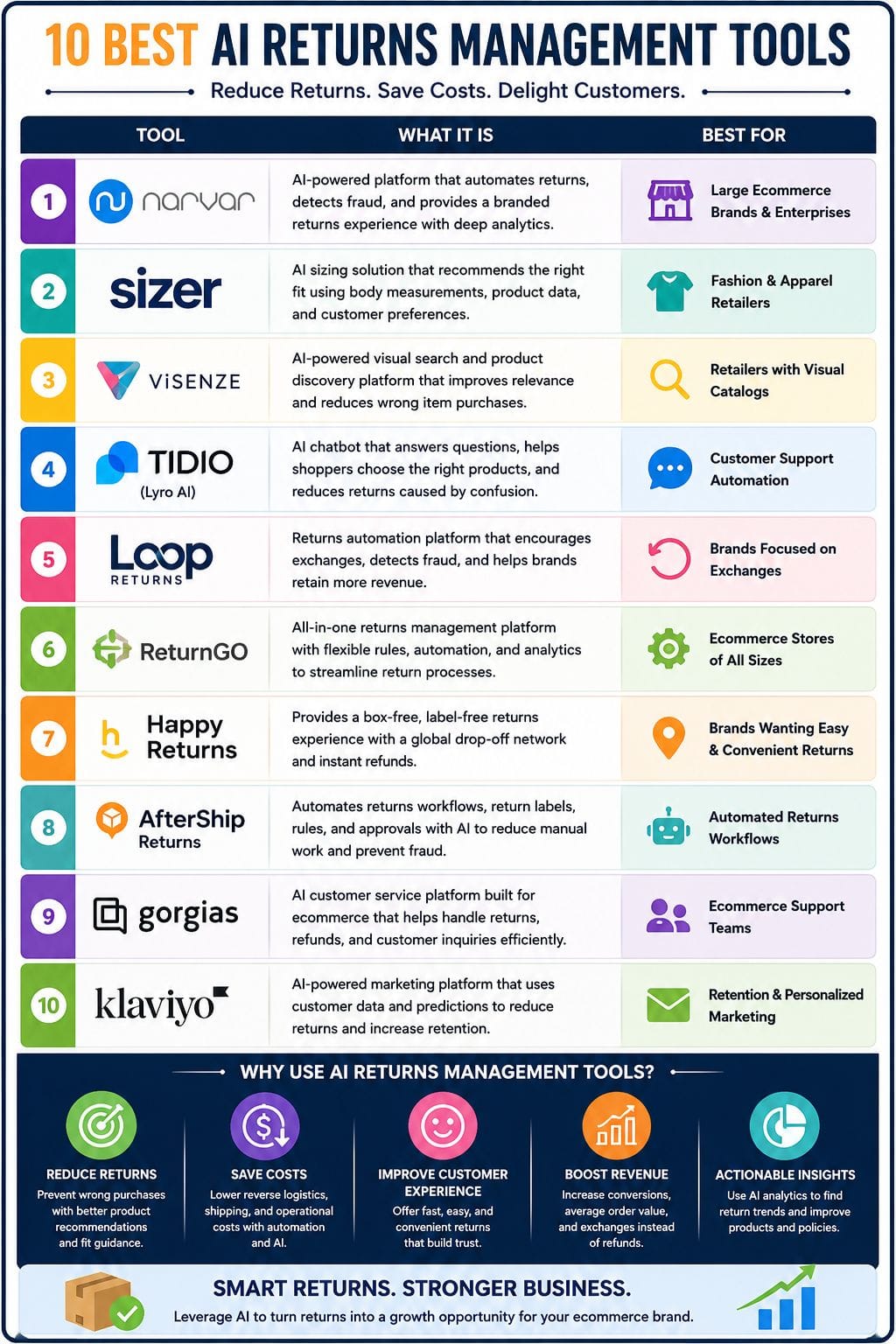
| Tool | Best For | Key Features | Pricing Level | Drawbacks |
|---|---|---|---|---|
| Narvar | Large ecommerce brands | AI fraud detection, branded returns portal, analytics, workflow automation | Custom Quote | Complex setup and premium pricing |
| Sizer | Fashion retailers | AI sizing recommendations, body measurement analysis, conversion optimization | Custom Quote | Requires customer and product data integration |
| ViSenze | Visual commerce | Visual search, AI recommendations, automated tagging | Custom Quote | Best suited for image-rich catalogs |
| Tidio (Lyro AI) | Customer support automation | AI chatbot, FAQs, multilingual support, product recommendations | Medium | Mostly optimized for Shopify |
| Loop Returns | Exchange-first returns | Exchange portal, AI fraud detection, analytics | Custom Quote | Learning curve for smaller teams |
| ReturnGO | Flexible return automation | Refund rules, exchanges, store credit, analytics | Medium | Requires proper rule configuration |
| Happy Returns | Box-free returns | QR returns, drop-off network, instant refunds | Custom Quote | Drop-off fees may add up |
| AfterShip Returns | Automated return workflows | Return portal, labels, fraud prevention, analytics | Medium | Limited enterprise analytics |
| Gorgias | Support teams | AI customer support, Shopify integration, automation | Low–High | Usage-based pricing |
| Klaviyo AI | Personalized marketing | AI recommendations, customer profiles, omnichannel messaging | Custom Quote | Best for brands with larger customer lists |
Narvar
Narvar is an AI-powered platform that helps online brands reduce product returns and improve the customer experience after a purchase. It gives shoppers a simple, branded portal to return or exchange items while letting businesses set their own return rules. Its AI tool, IRIS, spots risky returns and helps prevent fraud by offering different return options based on customer behavior.
The platform also automates return workflows, chooses the best shipping routes, and connects with major carriers. In addition, Narvar provides clear insights into return reasons, customer trends, and return rates, helping brands fix problems, improve products, and protect revenue.
Pros
- Strong, polished customer experience “beyond buy”
- Helps retain revenue through exchanges and store credit
- Built for scale with deep integrations and robust analytics
Cons
- Opaque, higher‑end pricing, best for mid‑large brands
- Setup and integrations can be complex and time‑consuming
Pricing
| Plan | Pricing |
|---|---|
| Request for Pricing | Contact Sales |
Sizer
Sizer uses AI to help shoppers find the right clothing size before they buy. The platform studies body measurements, garment details, past purchases, and customer preferences to recommend the best fit.
This helps shoppers feel more confident and reduces the guesswork that often comes with online shopping. For retailers, Sizer can cut size-related returns by up to 50%, lower operational costs, and improve customer satisfaction.
Better fit recommendations also increase conversion rates and average order value, as shoppers are more likely to complete a purchase when they trust the sizing. The result is a smoother shopping experience.
Pros
- Reduces size and fit returns, lowering reverse logistics costs
- Increases conversion and basket size by boosting buyer confidence
- Supports better customer experience and sustainability by limiting shipments
Cons
- Needs data integration with product and customer systems
- Does not solve returns driven by taste or fabric feel
Pricing
| Plan | Pricing |
|---|---|
| Request for Pricing | Contact Sales |
ViSenze
ViSenze is an AI platform that helps online shoppers find the right products faster through visual search, text search, and smart recommendations. It understands what customers are looking for and matches them with relevant products, making shopping easier and more accurate.
The platform also uses AI to automatically tag products with rich details, improving search results and product filters across large catalogs. This helps retailers increase sales, raise average order value, and reduce returns caused by incorrect purchases.
With built-in analytics and a cloud-based system that scales easily, ViSenze enables brands to deliver a faster, smarter shopping experience.
Pros
- Strong visual search that helps reduce “wrong style/colour” returns in fashion and lifestyle
- Automated tagging cuts manual catalog work and improves product data quality
- Flexible integration into existing e-commerce sites and apps with API-first design
Cons
- Best suited to retailers with rich visual catalogs; less impact for simple, utility products
- Requires clean base catalog data and implementation effort to unlock full benefits
Pricing
| Plan | Pricing |
|---|---|
| Request for Pricing | Contact Sales |
 Vivek Dev Jacob
Tidio (Lyro AI)
Tidio’s Lyro AI helps online stores reduce product returns by giving customers quick and accurate answers before and after they buy. It learns from your FAQs, product details, and store policies, so it only shares trusted information.
Lyro helps shoppers choose the right product, answers questions about orders, shipping, and returns, and clears up confusion that often leads to refunds. It can also suggest products based on a shopper’s needs and budget.
The AI supports many languages and works across live chat, email, and social media, while handling routine questions.
Pros
- High automation rates (often above 60% of customer queries)
- Human‑like, unscripted replies that stay grounded in your own knowledge base
- Strong fit for small and mid‑size e-commerce brands that need a quick setup
Cons
- Focused mainly on Shopify, limited use for non-Shopify stores
- Cost may be high for very small merchants
Pricing
| Plan | Pricing |
|---|---|
| Essential | $155/month |
| Advanced | $272/month |
| Enterprise | Contact Sales |
Loop Returns
Loop Returns helps online brands turn refunds into exchanges instead of lost sales. Its platform uses automation and AI to make returns simple for both shoppers and merchants. Customers get a branded self-service portal where they can start a return, choose an exchange, or shop for another product with ease.
The platform encourages exchanges first, which helps businesses keep more revenue while reducing return costs. It also uses AI to detect fraud, policy abuse, and other risky return behavior. Clear analytics show why products are returned and highlight trends that help improve product quality and customer satisfaction.
Pros
- Helps keep more revenue through exchanges instead of refunds
- Reduces manual CX work with automated workflows
- Better customer experience with fast, guided returns
Cons
- Complexity and breadth of features may require training and change management
- Not ideal for very small merchants needing a simple, plug-and-play tool
Pricing
| Plan | Pricing |
|---|---|
| Request for Pricing | Contact Sales |
ReturnGO
ReturnGO is an AI-powered platform that helps ecommerce brands manage returns and exchanges with less effort. It gives customers a simple self-service portal while using smart automation to decide whether an order should be refunded, exchanged, credited, donated, or even kept.
The platform encourages exchanges and store credit, helping businesses recover more revenue instead of losing sales through refunds. It also provides clear analytics that show why products are returned, helping brands spot trends and improve their operations.
ReturnGO works with Shopify and other ecommerce platforms and connects easily with customer support, shipping, email, and subscription tools.
Pros
- Strong focus on keeping revenue through exchanges, credit, and non-physical returns
- Highly customizable rules that handle complex return scenarios
- Easy, portal-based customer flow that reduces support load
Cons
- Does not run its own global reverse-logistics network or physical hubs
- Value depends on how well teams configure rules and incentives
Pricing
| Plan | Pricing |
|---|---|
| Premium | $147/month |
| Pro | $297/month |
| Enterprise | Contact Sales |
Vivek Dev Jacob
Happy Returns
Happy Returns helps online stores manage returns in a faster and simpler way. Customers can return items without a box or shipping label by showing a QR code at one of more than 8,000 drop-off locations. They can also receive instant refunds once the return is scanned.
The platform uses AI to detect fraud and verify returned items, helping merchants reduce losses. Bulk shipping and automated sorting speed up restocking by up to 34%. It also offers a branded returns portal that encourages exchanges, with some brands seeing up to twice as many exchanges.
Pros
- Strong in‑person return experience with very high shopper NPS (around 93–94)
- Designed to boost exchanges over refunds, helping brands retain more revenue
- Eco‑friendly reverse logistics with cardboard‑free returns and consolidated shipments
Cons
- Per‑item fees at Return Bars can add up for low‑margin catalogs if not balanced by savings elsewhere
- Setup and integration may be complex for smaller teams without dedicated ops or tech resources
Pricing
| Plan | Pricing |
|---|---|
| Request for Pricing | Contact Sales |
AfterShip Returns
AfterShip Returns is an AI-powered platform that makes returns and exchanges easier for both brands and customers. It offers a branded self-service portal where shoppers can start a return without contacting support.
Smart automation speeds up approvals, creates return labels, and helps stop fraudulent claims. The platform also gives brands useful insights into return reasons, repeat offenders, product issues, and refund trends.
Instead of losing a sale, businesses can encourage exchanges or offer store credit. It also supports "green returns," where low-value items are refunded without being shipped back, helping brands lower costs, reduce waste.
Pros
- Strong automation for approvals, labels, and routing saves support time
- Branded, self-service returns page improves customer experience and loyalty
- Rich rule engine (windows, item type, customer lists) helps prevent fraud and misuse
Cons
- Daily, not real‑time, updates may limit very aggressive pricing plays
- Fewer advanced analytics than some enterprise rivals
Pricing
| Plan | Pricing |
|---|---|
| Professional | $99/month |
| Premium | $199/month |
| Platinum | $399/month |
Gorgias
Gorgias helps online stores reduce returns by using AI to handle common customer support tasks. It answers questions about order tracking, return rules, shipping, sizing, refunds, and return labels in real time.
The platform connects with Shopify and other e-commerce systems, so support agents and AI can see live order details in one place. It also sends instant replies to common questions, helping customers find answers before they decide to return a product.
This cuts confusion, speeds up support, and lowers avoidable returns. As a result, support teams spend less time on routine requests.
Pros
- Deep Shopify-style order integration that makes refunds and return changes fast
- Strong automation for “where’s my order” and return-policy tickets
- Revenue attribution to show how support saves sales and prevents churn
Cons
- Ticket-based pricing and AI interaction fees can spike during peak seasons
- AI auto-replies need training time before they feel truly hands-off
Pricing
| Plan | Pricing |
|---|---|
| Starter | $40/month |
| Basic | $90/month |
| Pro | $550/month |
| Advanced | $1430/month |
Vivek Dev Jacob
Klaviyo AI
Klaviyo AI helps online stores reduce returns by using live customer data to guide shoppers before they buy. It sends personalized emails, SMS messages, and chat replies based on what each customer views and purchases.
The AI also answers product, order, and return questions in real time, helping shoppers make better choices and set the right expectations. This cuts confusion, lowers wrong purchases, and reduces repeat returns.
Klaviyo includes AI tools for marketing and customer support, real-time customer profiles, AI-generated content in your brand voice, and support across email, SMS, WhatsApp, and chat to improve loyalty.
Pros
- Deep ecommerce data integrations for accurate targeting
- Strong personalization at scale with minimal manual work
- Always-on support that can deflect tickets and speed resolutions
Cons
- Best value comes when you have sizable lists and traffic
- Advanced features may require higher-tier plans
Pricing
| Plan | Pricing |
|---|---|
| Request for Pricing | Contact Sales |
Final Thoughts
Returns have long been a major cost for online stores. AI is changing that. It finds patterns in why customers send products back and helps brands fix weak product pages, size guides, and descriptions.
It also helps shoppers choose the right size and style before they buy, which reduces avoidable returns. When a return does happen, AI makes the process faster with clear steps, smart routing, and quick refunds or exchanges. It can also spot fraud and return abuse, helping protect profits. Instead of seeing returns as a loss, businesses can use them to support long-term growth.
FAQs
What are AI returns management tools?
AI returns management tools use artificial intelligence to automate return approvals, detect fraud, recommend exchanges, analyze return reasons, and simplify the returns process for both businesses and customers.
Can AI help reduce ecommerce returns?
Yes. AI helps reduce returns by improving product recommendations, offering accurate sizing guidance, detecting fraudulent claims, and providing shoppers with the right information before they make a purchase.
Which AI returns management tool is best for Shopify stores?
Several tools work well with Shopify, including ReturnGO, AfterShip Returns, Loop Returns, Gorgias, and Tidio (Lyro AI). The best choice depends on whether you need returns automation, customer support, fraud prevention, or exchange management.
Are AI returns management tools worth it for small businesses?
Yes. Many AI returns platforms automate repetitive tasks, reduce support workload, encourage exchanges over refunds, and improve customer satisfaction, making them valuable even for small and growing ecommerce businesses.