Best AI Supply Chain Tools: Top Platforms, Features & Comparison
AI supply chain tools are transforming how businesses manage operations. From demand forecasting to real-time tracking, discover the best platforms and how they improve efficiency, reduce costs, and enhance decision-making.

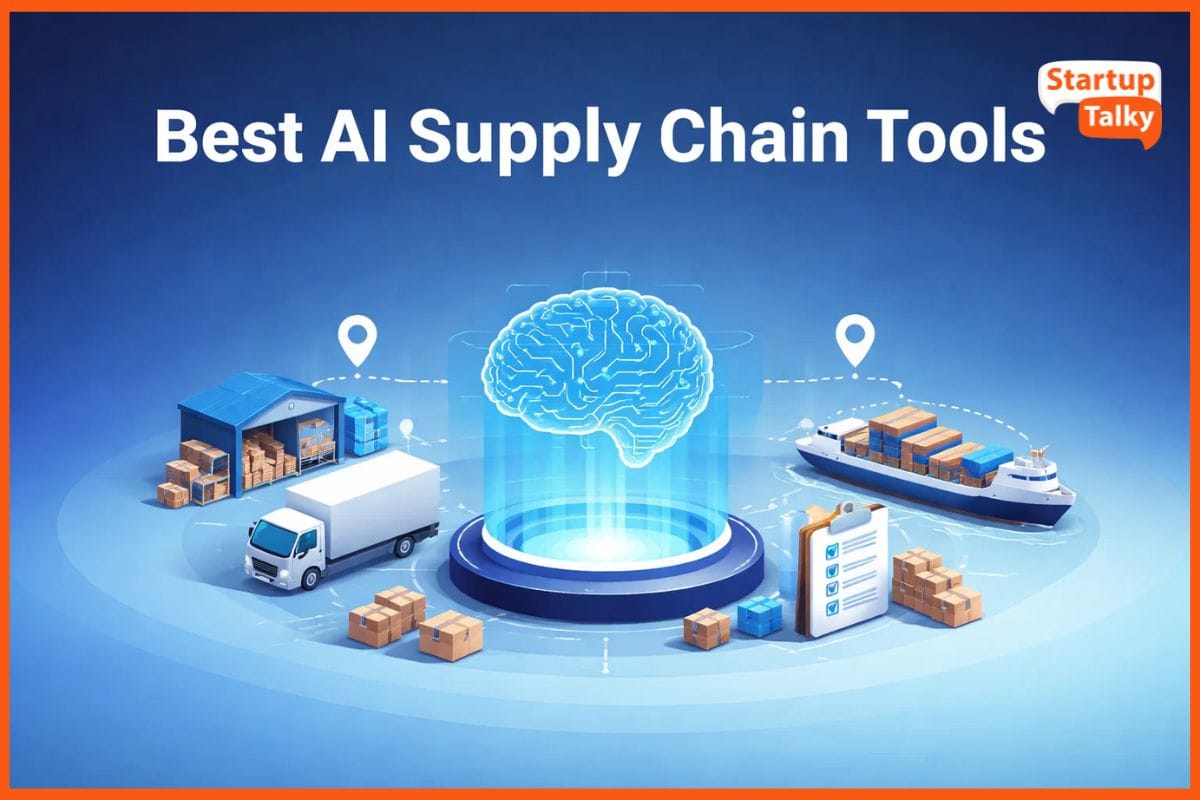
AI tools create new methods to handle supply chain operations. It processes data to create demand forecasts, identify potential problems, and reduce unnecessary expenses. Advanced systems monitor product movement throughout the day while enabling rapid truck rerouting and maintaining proper inventory levels.
It uses previous disruptions to create resilient networks. Factories receive alerts about machine problems that need fixing before equipment failures disrupt production.
The company experiences cost reductions because its inventory downtime decreases and its delivery routes become shorter. Leaders make sharp calls with clear forecasts. Global chains maintain their flexibility during disruptive events.
How to Choose the Right AI Supply Chain Tool
Choosing the right tool depends on your business size, complexity, and goals:
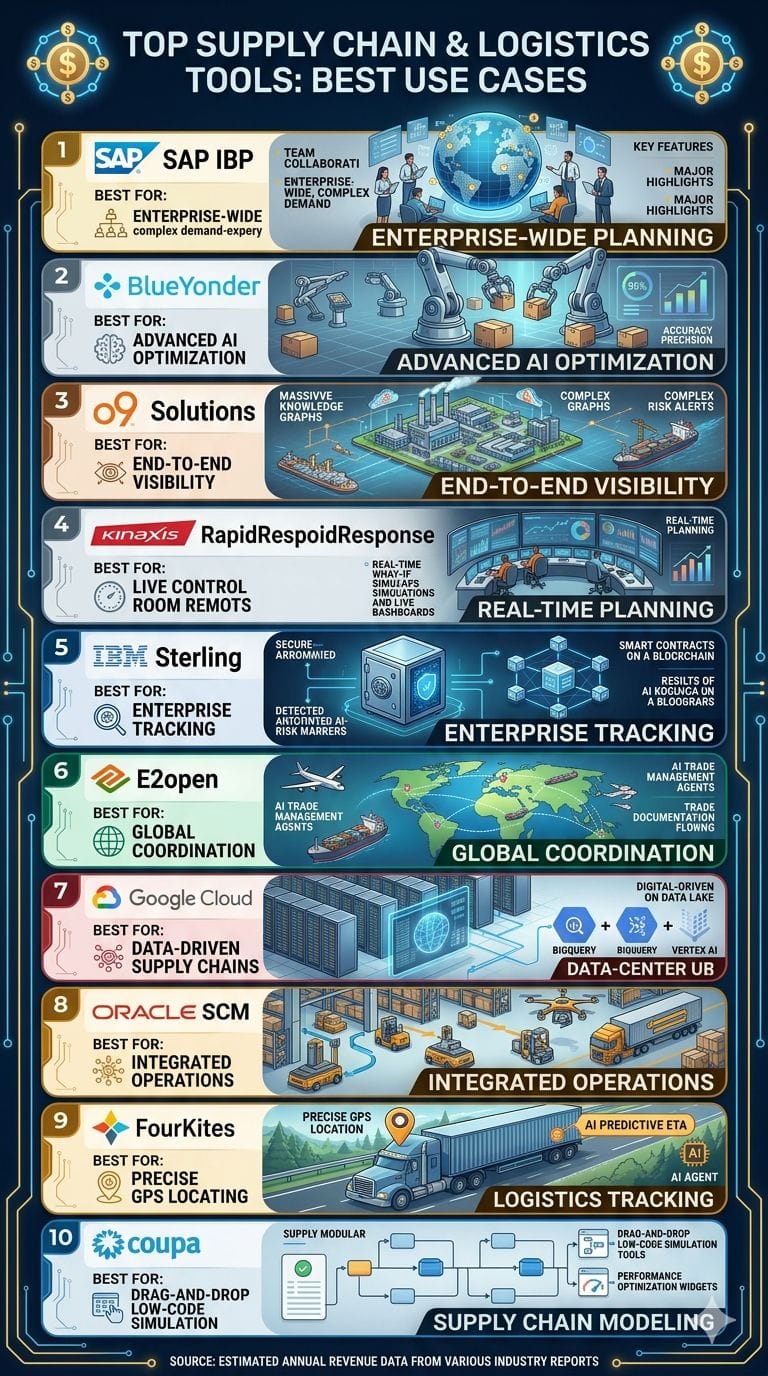
- Large enterprises: SAP IBP, Oracle, IBM
- AI-heavy forecasting: Blue Yonder, o9
- Logistics tracking: FourKites
- Cloud-first businesses: Google Cloud
- Collaboration & planning: Kinaxis, E2open
Top AI Supply Chain Tools Comparison
| Tool | Best For | Key Features | Drawbacks |
|---|---|---|---|
| SAP IBP | Enterprise planning | AI forecasting, real-time planning, what-if analysis | Expensive, needs clean data |
| Blue Yonder | Advanced AI optimization | 95% forecast accuracy, AI agents, simulations | Steep learning curve |
| o9 Solutions | End-to-end visibility | Digital twin, knowledge graph, risk alerts | Complex setup |
| Kinaxis RapidResponse | Real-time planning | What-if analysis, live dashboards | Needs trained users |
| IBM Sterling | Enterprise tracking | Blockchain, AI risk detection | Complex installation |
| E2open | Global coordination | AI agents, trade management | Learning difficulty |
| Google Cloud | Data-driven supply chains | Digital twin, BigQuery, Vertex AI | Data silos issues |
| Oracle SCM | Integrated operations | AI forecasting, routing, warehouse mgmt | High cost |
| FourKites | Logistics tracking | Predictive ETA, AI tracking agents | Needs strong infrastructure |
| Coupa | Supply chain modeling | Simulations, low-code apps | Performance issues |
SAP IBP
SAP IBP uses AI to help manage supply chains. It uses machine learning to forecast future demand. Seamlessly detects demand changes before they occur. It enables teams to respond to situations with greater speed.
The tools handle real-time supply planning, stock management, and sales forecasting. It uses mathematical models to decrease excess stock while minimizing operational risks.
Users can run what-if tests to see the best options. The cloud system connects teams, so they can decide quickly. It increases operational speed while decreasing operational expenses.
Pros
- The ability to generate precise predictions that eliminate situations of stock shortages
- Enables immediate access to information that supports quick solution implementation.
- Quick execution of tasks through its user-friendly design
Cons
- An expensive initial investment, which makes it difficult for small businesses to afford
- Requires clean data to operate successfully
Blue Yonder
Blue Yonder tops the market with its AI supply chain solutions, which provide complete operational intelligence. It combines cloud-based architecture with AI data clouds to deliver rapid access to both planning and execution processes.
Provides three main advantages, which include instant disruption detection, and 95% accurate demand predictions, and AI agents who monitor, evaluate, and respond to port delays and inventory shortages.
The organization achieved a reduction in waste through 13000 scenario runs, which resulted in a 10-30% inventory decrease and 60% increase in planner efficiency. It connects factories and trucks, and shops into a unified network.
Pros
- Reduces inventory expenses by 10 to 30 percent through precise demand predictions
- Increases planner productivity by 60 percent through its automatic insight generation
- Performs what-if simulations at the speed of machines
Cons
- Requires new teams to complete a difficult learning process before they can succeed
- High initial expenses, which prevent small businesses from accessing its services
o9 Solutions
o9 Solutions uses artificial intelligence to control supply chain operations. It connects its data streams through its Digital Brain platform and Enterprise Knowledge Graph.
It provides four main functions, which include demand planning, supply matching, inventory cuts, and risk alerts. It creates digital twins that perform what-if testing while achieving 87 percent forecast accuracy and a 60 percent reduction in stock-outs.
Control towers enable organizations to identify problems before they happen, while their teams work to resolve them. It requires human adjustments only 10 to 30 percent of the time for touchless planning.
Pros
- Decreases inventory losses through its smart optimization feature by 53 percent
- Achieves complete visibility through its real-time monitoring capabilities
- Maintains excellent relationships with both its suppliers and its internal teams
Cons
- Needs extensive resources for its initial setup
- Must overcome a steep learning curve
 Vivek Dev Jacob
Kinaxis RapidResponse
Kinaxis RapidResponse is a cloud tool for supply chains. It provides centralized access to demand, supply, stock, and production information. Teams observe real-time data, which extends from suppliers to customers.
It performs rapid "what-if" analysis while identifying potential risks. It updates plans immediately when any changes occur. AI technology improves forecasting accuracy while decreasing operational delays.
The solution enables businesses to achieve a 20% reduction in lead times and a 33% decrease in inventory levels. It reduces planning cycle time by 57%. The user interface of dashboards provides straightforward access to essential information.
Pros
- Enable all teams to access a single version of the truth while eliminating silo plans
- Provides real-time risk notifications together with testing capabilities to resolve them
- Precise forecasts that reduce material waste and prevent stock shortages
Cons
- Requires trained personnel who need to operate deep learning-based artificial intelligence technologies
- Makes users dependent on the cloud service provider's operational updates
IBM Sterling Supply Chain Suite
IBM Sterling Supply Chain Suite powers smart supply chains with AI. It provides continuous updates about order status, available inventory, and outgoing shipments. Watson AI identifies potential risks and anticipates upcoming needs while resolving problems at an accelerated pace.
Blockchain technology establishes trustworthiness between trading partners. The software enables users to monitor patterns while simultaneously reducing wait times and developing new strategies for immediate implementation.
It notifies users about interruptions while improving inventory management and maintaining efficient partner relationships. It supports large enterprises by integrating cloud and on-premises environments and enhancing decision-making capabilities through data analysis.
Pros
- Complete tracking ensures better inventory management
- Detects potential threats at an early stage, which allows for immediate resolution
- Open links function with existing systems while allowing for simple system expansion
Cons
- The installation process requires advanced technicians who need an extended period to complete
- The expensive requirements of the business operation will create financial difficulties for small retail stores
E2open
E2open uses AI to run modern supply chains. The solution anticipates future requirements while minimizing unnecessary resources and identifying potential threats at an early stage.
It senses needs, plans inventory, tracks shipments, and manages trade rules. It enables partners to work together through a single platform. Smart agents automate buying and routing decisions. The teams use current information to resolve delays within a brief period.
Clean data flows enable better network coordination between different teams. Through their operations, companies achieve financial savings while maintaining proper inventory levels and delivering products within scheduled timeframes.
Pros
- Establishes connections through multi-tier links that operate to end information silos
- Harmony AI technology provides faster call response times
- Decreases expenses connected to both route planning and inventory management
Cons
- Outdated systems become overloaded because of increased data processing requirements
- The learning process requires teams to overcome significant challenges
Vivek Dev Jacob
Google Cloud Supply Chain Solutions
Google Cloud Supply Chain Solutions uses artificial intelligence to create a digital twin of your supply chain operations. It obtains real-time data from suppliers and inventory and shipment records to provide live tracking capabilities.
The platform provides access to demand forecasts, risk alerts, and workflow updates all in one location.BigQuery enables fast data processing while Vertex AI detects patterns within the data.
The Supply Chain Twin displays essential performance indicators through user-friendly dashboard interfaces. It enables users to conduct what-if simulations on operational efficiency while optimizing resources to the fullest.
Pros
- Uses predictive alerts to decrease operational hazards
- Real-time dashboards to enhance decision-making speed
- Cloud technology to provide global coverage for international business operations
Cons
- User experience suffers because the presence of data silos prevents users from accessing the initial advantages
- Costs increase when users implement specific modifications
Oracle SCM Cloud
Oracle SCM Cloud employs artificial intelligence to enhance both the speed and intelligence of supply chain operations. It uses sales data together with weather information and event data to forecast upcoming customer demand.
Artificial intelligence technology identifies potential delays and shortages by monitoring supply chain operations. It determines optimal delivery routes and inventory levels to decrease operational expenses.
The agents provide workers with assistance regarding their claims and order procedures, and the established regulations. The tools establish warehouse locations and determine shipment schedules. It monitors product movement throughout the entire process while providing immediate notification of any updates.
Pros
- Provides a single interface that connects sales information with inventory data and shipping details
- Uses intelligent slots to improve the speed of the picking and packing process
- Manages unexpected events, which include labor strikes and severe weather conditions
Cons
- Requires an extended period for installation, which also needs specialized IT expertise
- The price is too high for small businesses to afford
FourKites
FourKites enhances supply chain operations through its artificial intelligence capabilities. It monitors shipment progress through continuous tracking of land, ocean, rail, and air transportation routes.
The AutoGate AI system enables users to complete gate check-in procedures within a time frame of less than two minutes. The digital worker system Tracy performs track-and-trace operations while managing alert notifications and resolving technical issues.
Predictive ETAs operate through machine learning, which processes data from billions of miles of traveled distance. AI technology identifies potential dangers while establishing optimal travel paths and allowing teams to focus on essential tasks.
Pros
- AI agents enable organizations to achieve an 80 percent reduction in their manual workload
- Provides accurate delivery time estimates that surpass traditional methods of estimating delivery times.
- Supports daily operations that handle up to 1 million shipments throughout its entire operation period.
Cons
- Requires an extensive data infrastructure to deliver its optimal performance capabilities
- Restricts users with its requirement to remain connected to its proprietary network
Avinash kumar mahato
Coupa
The Coupa company provides artificial intelligence solutions to assist teams in their supply chain management. It creates transparent models that define all aspects of supply networks. The software enables users to easily plan stock levels, route paths, and product distribution.
The tool performs basic what-if tests to identify potential risks at an early stage. It employs machine learning techniques to forecast future demand patterns. Using low-code tools, teams can create applications at a rapid pace.
The simulations evaluate uncommon incidents such as labor strikes and transportation disruptions. The solution enables businesses to maintain operational readiness at all times.
Pros
- The deep network mathematical system identifies optimal locations and route options
- Simulation models demonstrate how risks will impact the existing plans
- Rapid application software meets the specific requirements of the business
Cons
- The combination of office work and cloud services creates performance issues for large-scale operations
- The company experienced a halt in its development process after the acquisition
Final Thoughts
The supply chain industry benefits from AI tools, which provide positive changes. It enables companies to predict future trends while preventing potential problems. The process reduces waste while increasing the speed and efficiency of product delivery.
Intelligent predictions enable teams to manage potential risks, which include strikes and material shortages. The entire organization maintains constant awareness regarding inventory levels, transportation assets, and production facilities.
It provides teams with essential information that enables them to make informed decisions while responding to emergencies. The financial results show decreasing expenses while increasing revenue.
FAQs
What are AI supply chain tools?
AI supply chain tools are software platforms that use artificial intelligence to manage and optimize supply chain operations. They help in demand forecasting, inventory management, route optimization, and risk detection.
Which is the best AI tool for supply chain management?
The best tool depends on your needs. SAP IBP and Oracle SCM are ideal for large enterprises, Blue Yonder and o9 are best for advanced forecasting, while FourKites is great for logistics tracking.
How do AI tools improve supply chain efficiency?
AI tools improve efficiency by predicting demand, reducing inventory waste, optimizing delivery routes, and providing real-time insights. This helps businesses make faster and smarter decisions.
Are AI supply chain tools expensive?
Most AI supply chain tools operate on enterprise-level pricing and require a high initial investment. However, they reduce long-term costs by improving efficiency and minimizing operational risks.