
Best AI Tools for Automated Campaign Management
AI tools can automate campaign creation, optimization, audience targeting, reporting, and budget management. Explore the best AI tools for automated campaign management and find the right platform for your marketing workflow.

AI tools for automated campaign management make marketing easier and more efficient. They help teams plan campaigns, group audiences, schedule messages, test different ideas, and manage budgets with less manual work.
These tools also track customer activity across channels, helping marketers send the right message at the right time. By using live campaign data, teams can quickly see what is working and what needs to change.
This helps improve engagement, reduce wasted spending, and fix weak areas before they affect results. Overall, AI makes campaign management smoother, faster, and more consistent while helping brands create more personal experiences.
Best AI Tools for Automated Campaign Management: Comparison
| AI Campaign Management Tool | Best For | Key Features | Drawbacks |
|---|---|---|---|
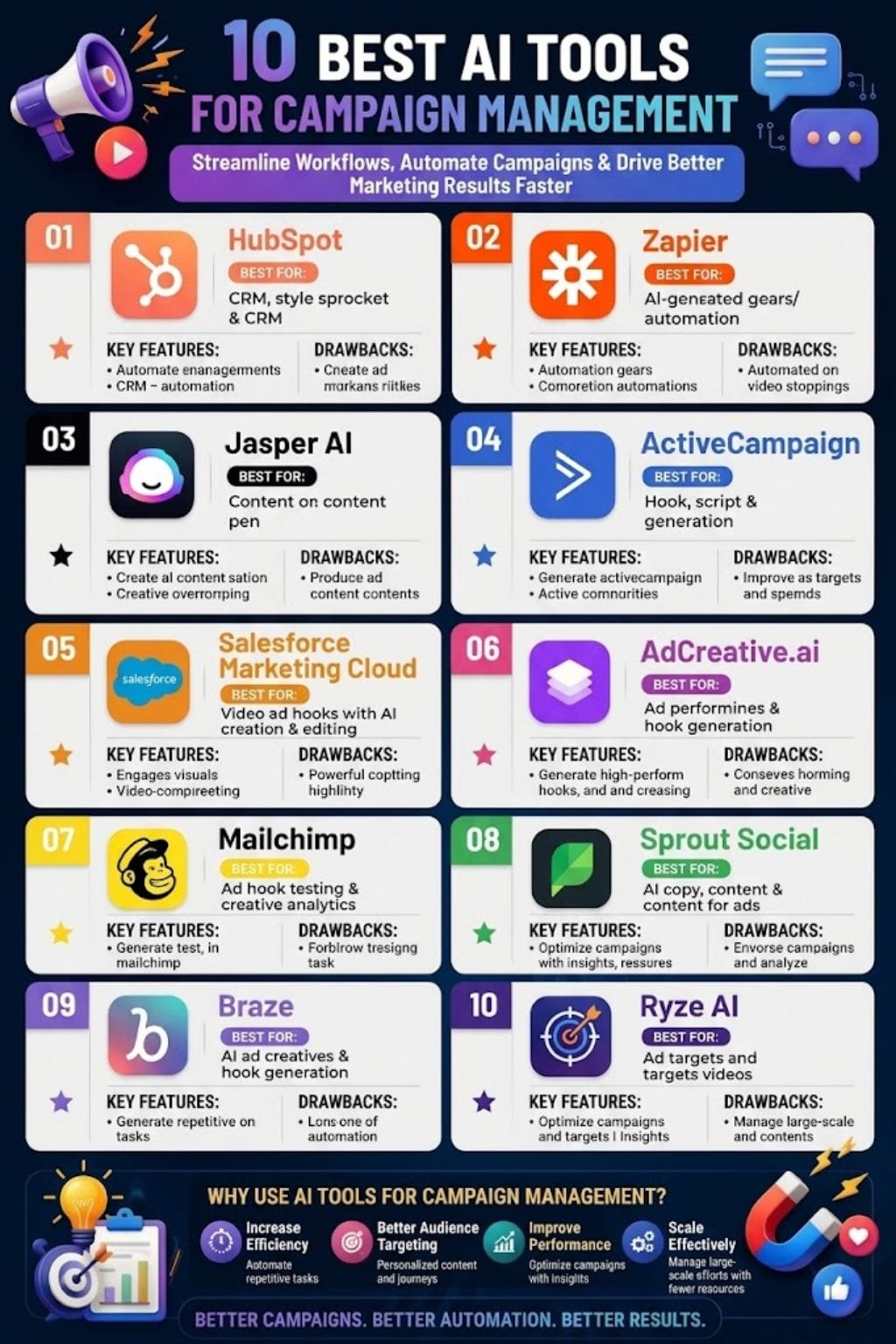
| HubSpot | CRM-based campaign management | Breeze AI, content creation, audience segmentation, automated workflows, lead scoring, intent signals, reporting, attribution | The broad feature set can take time to configure and govern well; AI output still needs human review. |
| Zapier | Connecting marketing tools and automating workflows | Multi-step Zaps, filters, rules, AI content tools, data sorting, summaries, thousands of app integrations | Complex Zaps need careful design and monitoring; broken app connections can stop campaign processes. |
| Jasper AI | Multi-channel marketing content | Campaigns, Brand Voice, reusable knowledge, AI image creation, marketing agents, workflow automation, integrations, analytics | AI copy can sound generic or include errors; it does not replace campaign strategy or media buying. |
| ActiveCampaign | Personalized customer journeys | AI Campaign Builder, segmentation, send-time optimization, email, SMS, WhatsApp, CRM automation, Brand Kit, reporting | The feature set may feel complex for basic newsletters; AI-generated campaigns need human review. |
| Salesforce Marketing Cloud | Enterprise multi-channel campaigns | Agentforce, Journey tools, AI targeting, send-time optimization, customer paths, testing, campaign tracking | May be too complex for small teams; some advanced AI and testing features require higher-priced plans. |
| AdCreative.ai | AI-powered ad creative production | Ad images, videos, copy, creative variations, Creative Scoring AI, templates, bulk creation, A/B testing | Does not replace audience research, bidding, budget control, or media-buying judgment. |
| Mailchimp | Simple email campaign automation | AI writing, subject lines, send-time optimization, automated journeys, audience segments, landing pages, analytics | More of an AI assistant than a fully autonomous campaign manager; transactional email requires a separate Mandrill add-on. |
| Sprout Social | Social media campaign management | Content calendar, scheduling, unified inbox, social listening, reporting, AI copy, replies, alt text, approvals | Essentials and Standard plans limit users to five social profiles; the feature set can take time to configure. |
| Braze | Real-time customer engagement | Canvas journeys, email, push, SMS, WhatsApp, web, in-app messaging, BrazeAI, audience optimization, testing | Best results depend on clean event data and strong audience design; may be excessive for small teams. |
| Ryze AI | Automated paid advertising | Google, Meta, TikTok and LinkedIn integrations, Paid Ads Autopilot, ad copy, bidding, budgets, audience optimization, monitoring | AI cannot replace strong offers, tracking, market knowledge, or creative judgment; users need basic paid-media skills. |
HubSpot
HubSpot is an AI-enabled platform that helps businesses plan, launch, and improve campaigns through one CRM. Its Breeze AI tools use customer data to create content, group audiences, automate tasks, and track campaign results.
Teams can use AI to write emails, blogs, landing pages, and social posts. HubSpot also supports audience segmentation, personalized campaigns, and automated workflows based on actions such as form submissions and page visits.
Lead scoring and intent signals help sales teams focus on valuable prospects. Its reporting tools provide campaign dashboards, attribution, and custom reports. AI agents can also assist with research, outreach.
Pros
- One shared customer record links campaign work to sales and service outcomes
- Strong automation helps teams run multi-step nurture paths with less manual work
- Built-in reporting makes it easier to connect marketing activity with revenue
Cons
- The broad feature set can take time to configure and govern well
- AI output still needs human review for brand voice, accuracy, and campaign strategy
Pricing
| Plan | Pricing |
|---|---|
| Starter | $7/seat/month |
| Professional | $800/month |
| Enterprise | $3600/month |
Zapier
Zapier is an AI-powered automation platform that connects marketing and business tools. It is not a campaign manager itself, but it helps teams automate tasks across email, CRM, ads, and analytics platforms.
Its workflows, called Zaps, can trigger actions when something happens, such as adding a webinar sign-up to an email sequence. Users can build multi-step workflows, apply filters and rules, and route leads based on set conditions.
Zapier also offers AI tools for drafting content, sorting data, creating summaries, and extracting information. With support for thousands of apps, it works as a central automation layer for connected marketing.
Pros
- Lets teams automate across tools they already use instead of replacing them
- Flexible logic can support handoffs between ads, forms, CRM, email, support, and analytics
- A free plan makes it easy to test small workflows before committing
Cons
- Complex Zaps need careful design, testing, and error monitoring
- A broken source-app connection or changed field can stop a campaign process
Pricing
| Plan | Pricing |
|---|---|
| Professional | $29.99/month |
| Team | $103.50/month |
| Enterprise | Contact Sales |
Jasper AI
Jasper AI is an AI marketing platform that helps teams plan, create, and manage campaign content from a single brief. Its Campaigns feature can create different types of content, including blog posts, emails, social media posts, landing pages, and ads, while keeping the brand voice consistent.
It also offers tools such as Brand Voice, reusable knowledge, AI image creation and editing, team collaboration, marketing agents, workflow automation, integrations, and analytics.
Jasper is useful for teams that want to produce marketing content faster across several channels. However, human review is still important to check facts, tone, legal claims, accuracy.
Pros
- Converts one campaign brief into multi-channel content, reducing repeated drafting work
- Brand Voice and knowledge assets help preserve approved messaging across writers and formats
- Combines writing, image tools, campaign workflows, and collaboration in one marketing-focused workspace
Cons
- AI-generated copy can sound generic or include errors without strong briefs and human editing
- It manages content creation and workflows, but does not replace campaign strategy, media buying, audience research, or performance ownership
Pricing
| Plan | Pricing |
|---|---|
| Pro | $69/seat/month |
| Business | Custom Pricing |
 Niku Mandal
ActiveCampaign
ActiveCampaign is an AI-powered marketing platform that helps businesses plan, create, send, and improve marketing campaigns. Its AI Campaign Builder can create campaigns from simple prompts, while AI tools help with writing content and creating images.
The platform can also suggest customer segments based on user behavior and choose better sending times for each contact. Its automation tools support multi-step customer journeys across email, SMS, WhatsApp, and CRM tasks.
Brand Kit features help businesses keep their marketing materials consistent. Detailed reports show campaign performance and customer engagement. Overall, ActiveCampaign helps businesses run personalized marketing campaigns with less manual effort.
Pros
- Uses behavioral data for segmentation and contact-level send-time optimization
- Connects email, SMS, WhatsApp, site messaging, and CRM work in one automation flow
- Includes AI content, image, translation, brand, and campaign-planning tools
Cons
- The large feature set may feel complex for teams that only need basic newsletters
- AI-created copy, segments, and workflows still need human review before launch
Pricing
| Plan | Pricing |
|---|---|
| Request for Pricing(RFP) | Request for Pricing(RFP) |
Salesforce Marketing Cloud
Salesforce Marketing Cloud is an AI-powered platform that helps businesses plan, create, and manage campaigns across email, SMS, WhatsApp, mobile, and web. Its Agentforce tools can assist with campaign planning and content creation, while Journey tools send messages based on customer actions.
The platform also uses AI to improve audience targeting, suggest the best time to send messages, test different customer paths, and track campaign results. This helps marketing teams create more relevant customer experiences and improve campaign performance.
Marketing Cloud is especially useful for companies already using Salesforce CRM and looking to manage customer data.
Pros
- Strong CRM connection: Sales, service, and marketing teams can use shared customer data
- AI-assisted campaign creation can speed up copy, segments, and journey setup
- Multi-channel journeys support coordinated email, SMS, WhatsApp, mobile, forms, and landing pages
Cons
- It may be too complex for a small team that only needs basic email sends
- Some high-value AI and testing features sit in higher-priced plans
Pricing
| Plan | Pricing |
|---|---|
| Request for Pricing(RFP) | Request for Pricing(RFP) |
AdCreative.ai
AdCreative.ai is an AI-powered platform that helps businesses create and improve ad creatives at scale. It can generate ad images, videos, copy, and multiple creative variations for platforms such as Meta, Google, and LinkedIn.
Users can add brand assets, create custom templates, access stock images, and produce campaigns faster. Its Creative Scoring AI helps predict how well a creative may perform before launch, while connected ad accounts provide insights that can support campaign decisions.
The platform also supports bulk creation and A/B testing. However, it is mainly a creative production and optimization tool.
Pros
- Generate many on-brand versions without making each asset from scratch
- Creative scoring helps teams rank concepts before spending media budget
- One workflow can produce assets sized for major ad platforms
Cons
- It does not replace audience research, bidding, budget control, or media-buying judgment
- A strong score cannot ensure sales, leads, or return on ad spend
Pricing
| Plan | Pricing |
|---|---|
| Starter Plans | $20/month |
| Professional Plans | $125/month |
| Ultimate Plans | $500/month |
Rishi Mundra
Mailchimp
Mailchimp is an email marketing platform that helps businesses create, send, and track campaigns with less effort. Its AI tools can help write email content and subject lines, suggest the best time to send campaigns, and build automated customer journeys.
You can also use audience segments to reach specific groups and get simple insights from campaign data. Mailchimp includes landing pages, signup forms, email templates, analytics, and reporting.
It also supports SMS, social ads, and e-commerce campaigns. Overall, it is a useful option for small teams that want an easy, visual platform to manage email marketing.
Pros
- Send-time optimisation can deliver emails when each contact is more likely to engage
- Broad marketing toolkit reduces the need for separate form and landing-page tools
- Strong template options help teams keep a consistent brand style
Cons
- The platform is more of an AI assistant than a fully autonomous campaign manager
- Transactional email requires the separate Mandrill add-on
Pricing
| Plan | Pricing |
|---|---|
| Standard Plans starting @ $20/month | Standard Plans starting @ $20/month |
Sprout Social
Sprout Social is an AI-powered platform that helps teams plan, publish, manage, and measure social media campaigns. It brings key tools into one place, including a shared content calendar, post scheduling, a unified inbox, social listening, reporting, and team workflows.
Its AI features can improve post copy, suggest replies, and create alt text for images. The platform can also recommend the best times to publish posts based on audience activity.
Higher plans include sentiment analysis, message alerts, automation, chatbots, competitor reports, and CRM or helpdesk integrations. It is useful for teams that want simple approvals, better customer support.
Pros
- Strong all-in-one setup for publishing, inbox work, listening, analytics, and approvals
- AI helps refine posts, replies, and image alt text, which can cut routine writing time
- Useful campaign control through tagging, approval paths, automated rules, and scheduled reports
Cons
- The Essentials and Standard plans limit users to five social profiles
- Its wide feature set can take time to configure well
Pricing
| Plan | Pricing |
|---|---|
| Professional | $299/seat/month |
| Advanced | $399/seat/month |
| Enterprise | Contact Sales |
Braze
Braze is a customer engagement platform that helps brands plan, personalize, test, and automate marketing campaigns across email, push notifications, SMS, WhatsApp, web, and in-app messages.
Its Canvas journey builder responds to real-time customer actions, such as leaving items in a cart or uninstalling an app. BrazeAI helps teams create content, predict churn, score customer activity, recommend products, select audiences, and choose the right time and channel to send messages.
Teams can also test different campaign versions, control message frequency, and measure results. Braze is best suited for brands with large, active digital audiences.
Pros
- Real-time, event-based automation lets teams react quickly to customer behavior
- Canvas provides visual, multi-step journey design across many message channels
- AI can optimize timing, channel, content, segments, and next-best actions
Cons
- Best results depend on clean event data, clear consent rules, and strong audience design
- It may be excessive for a small team that only needs simple email newsletters
Pricing
| Plan | Pricing |
|---|---|
| Request for Pricing(RFP) | Request for Pricing(RFP) |
Anish Sharma
Ryze AI
Ryze AI is an AI-powered tool that helps marketers manage paid advertising with less manual work. It connects with Google, Meta, TikTok, and LinkedIn ad accounts to plan, launch, monitor, and improve campaigns.
Its Paid Ads Autopilot can create campaigns, write ad copy, adjust bids and budgets, refine audiences, and track performance. Teams can also ask questions about campaign results in plain language through AI assistant integrations.
Ryze provides ongoing monitoring and reports to help teams stay on top of performance. Beyond paid ads, it also offers tools for SEO, eCommerce automation, and improving visibility across AI search platforms.
Pros
- One tool can support several major ad channels, which may reduce dashboard switching
- It can carry out campaign tasks, not just suggest changes for a marketer to make
- Teams can ask questions about ROAS, spend, and performance rather than pull each report by hand
Cons
- AI can optimise toward chosen goals, but it cannot replace strong offers, clean tracking, market knowledge, or creative judgment
- Users still need basic paid-media skills to check targeting, conversion events, budgets, and campaign goals
Pricing
| Plan | Pricing |
|---|---|
| Request for Pricing(RFP) | Request for Pricing(RFP) |
How to Choose an AI Tool for Automated Campaign Management
The right AI campaign management tool depends on the type of campaigns a team runs, the channels it uses, and how much automation it needs.
Consider Your Marketing Channels
Choose a platform that supports the channels where your customers are most active. Some tools focus on email and customer journeys, while others support social media, paid advertising, CRM workflows, or multiple channels.
Check Automation Features
Look at what the platform can automate. Useful capabilities can include audience segmentation, campaign scheduling, content creation, workflow triggers, send-time optimization, budget adjustments, and performance monitoring.
Look at Data and Integrations
AI campaign management works best when the tool can access the data it needs. Check whether it connects with your CRM, advertising platforms, analytics tools, email system, website, and other marketing software.
Keep Human Review in the Process
AI can automate repetitive campaign tasks, but human review remains important. Teams should check AI-generated content, audience segments, campaign goals, budgets, tracking, and customer communications before campaigns go live.
Measure Campaign Performance
A useful platform should make it easy to understand campaign results. Look for reporting and analytics that help teams track engagement, conversions, spending, customer behavior, and other important campaign metrics.
Final Thoughts
AI-driven campaign management changes how teams plan, launch, and improve marketing work. It cuts manual tasks, speeds up choices, and helps teams act on real customer signals.
Campaigns can adapt faster, reach the right people, and use budgets with more care. Clear data also makes results easier to track and explain. The best outcomes still need human goals, strong ideas, and ethical checks. Used well, these systems do not replace marketers.
They give marketers more time to think, create, and build trust. This makes campaigns smarter, faster, and more useful for both brands and customers.
FAQs
What are AI tools for automated campaign management?
AI tools for automated campaign management help marketers plan, launch, monitor, and optimize campaigns with less manual work. They can automate tasks such as audience segmentation, budget adjustments, creative testing, reporting, and campaign optimization.
What are the best AI tools for automated campaign management?
Popular AI campaign management tools include HubSpot, ActiveCampaign, Zapier, Madgicx, Optmyzr, Revealbot, Smartly.io, and Ryze AI. The right tool depends on your campaign channels, automation needs, and level of control.
How do AI tools automate marketing campaigns?
AI tools can use campaign and customer data to automate tasks such as targeting, content creation, bid or budget adjustments, workflow triggers, testing, and performance monitoring. Some platforms can also make campaign changes automatically based on predefined rules or AI recommendations.
What are the benefits of automated campaign management?
Automated campaign management can reduce repetitive work, speed up campaign execution, improve personalization, support continuous optimization, and help marketers monitor campaigns across multiple channels.
What should you consider when choosing an AI campaign management tool?
Consider supported advertising and marketing channels, automation capabilities, AI features, integrations, reporting, pricing, data controls, approval workflows, and how much control you want over automated changes. Tools vary significantly in whether they only provide recommendations or can directly execute campaign changes.