Kunal Shah's Angel Portfolio, Decoded: 299 Startups, 14 Unicorns, and the Misses Nobody Lists
The man who just took over WhatsApp is also India's most prolific angel investor. Tracxn lists 299 companies in Kunal Shah's portfolio. We pulled the data apart by sector, vintage and outcome. Here is what it reveals about how he wins, where he loses, and what is still unproven.

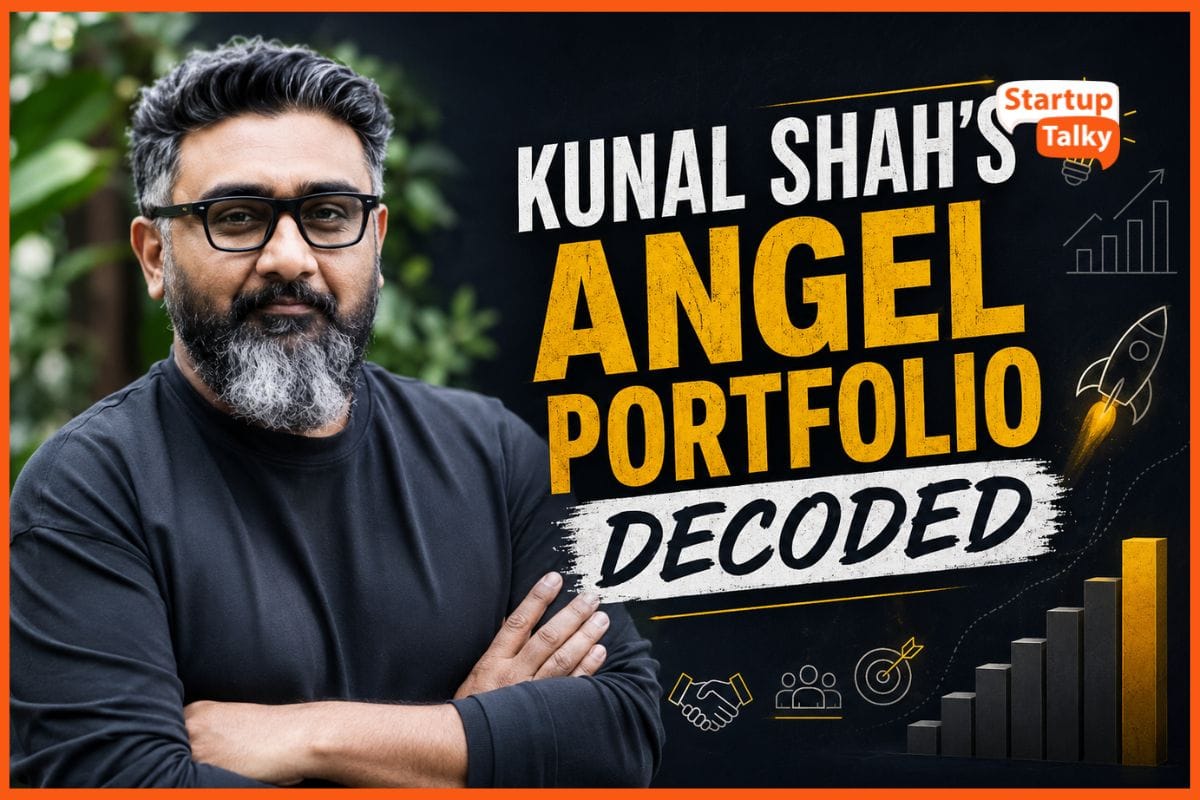
In June 2026, Kunal Shah became the global head of WhatsApp, and Meta committed ₹8,550 crore to his company, CRED. It was the loudest moment of a career built on being early.
Behind the operator sits a second, quieter portfolio. Over the last decade, Shah has become India's most prolific angel investor. According to Tracxn data retrieved on 24 June 2026, his name sits on the cap table of 299 companies, and those companies have collectively raised more than $15 billion.
One caveat up front. That $15.1 billion is the total capital his portfolio companies raised from all investors, not the money Shah put in. Investor databases peg his typical angel cheque at around $100,000, in a range of roughly $10,000 to $500,000. The $15 billion is not his outlay. It is a measure of how much weight the rest of the market eventually placed on companies he spotted first, with small, early money.
The Portfolio at a Glance
| Metric | Value |
|---|---|
| Portfolio companies | 299 |
| Total capital they have raised | ~$15.1 billion |
| Typical angel cheque | ~$100,000 (range $10K to $500K) |
| Unicorns (Tracxn tag) | 14 |
| Soonicorns | 26 |
| Minicorns | 121 |
| Acquired | 36 (Tracxn summary: 34) |
| IPO'd | 0 (none have listed) |
| Shut down (deadpooled) | 23 |
| Top 10 share of all capital raised | 52% |
| Biggest sector | FinTech (74 companies) |
Sources: Tracxn portfolio export for Kunal Naresh Shah (retrieved 24 June 2026); cheque-size range from investor databases.
The Scale, And How Top-Heavy It Is
Most angels make a few dozen investments. Shah has made 299, which is why he is routinely called the most active individual backer in the Indian ecosystem.
But the book is steeply concentrated. The 10 largest companies account for 52% of all the capital his portfolio has raised. The top 20 account for 68%, and the top 50 for 86%. The remaining 249 companies share the last 14%. This is the power law in plain numbers: a handful of names carry almost all the weight, and the long tail is lottery tickets bought cheaply.
How He Actually Invests
The data shows what he backed. His method explains how he reached 299 cap tables.
Three things compound. First, he writes small, early cheques, around $100,000, which lets him say yes far more often than a fund deploying millions per deal. Second, he has unusual access: Shah has been a part-time partner at Y Combinator and an advisor to Sequoia Capital India and AngelList, seats at the front of the queue for the best founders. Third, he is a founder-magnet himself. Having built FreeCharge and then CRED, his name on a cap table is a signal others read, so founders want him in even when the cheque is small.
That combination, early access plus a small cheque, high-volume strategy, is the engine. He was an early backer of Razorpay and BharatPe before they were household names. This is not 299 acts of deep diligence. It is seeing more early-stage founders than almost anyone in India, and betting on a lot of them.
 shifa ali
The Thesis: Delta 4, and a Fintech Tilt
Shah's investing is guided by a framework he made famous, the Delta 4 theory: a product wins only when it is dramatically more efficient than what it replaces, by a gap of at least 4 on a 10-point scale. A delta that large makes the new behaviour irreversible and brag-worthy. Small improvements do not change habits; large ones mint companies.
Read through that lens, and the sector mix is a self-portrait. A quarter of everything he has backed is fintech, the category where a Delta 4 jump is most achievable: paying in seconds, getting credit in a tap.
Where His Bets Paid Off, And Where They Died
This is the most revealing cut, and the one that funding totals hide. Sliced by sector and outcome, his book has clearly different weather in different neighbourhoods.
| Sector | Companies | Unicorns | Soonicorns | Acquired | Shut down | Death rate |
|---|---|---|---|---|---|---|
| FinTech | 74 | 3 | 8 | 7 | 2 | 3% |
| Consumer | 42 | 2 | 6 | 7 | 4 | 10% |
| Enterprise software | 38 | 0 | 1 | 7 | 1 | 3% |
| Retail | 30 | 4 | 3 | 3 | 5 | 17% |
| EdTech | 29 | 1 | 2 | 3 | 6 | 21% |
| HealthTech | 17 | 1 | 1 | 3 | 1 | 6% |
Tracxn primary sector tag; unicorn counts by sector do not sum to the portfolio's 14 because a few sit in smaller categories.
Four patterns jump out:
- FinTech is big and safe. His home turf is his largest sector (74 bets) and his lowest death rate (3%), with the deepest soonicorn pipeline (8). When Shah plays where he knows the game, he rarely loses the cheque.
- EdTech is the graveyard. At 21%, edtech has by far the worst death rate in the book. The 2020 boom he leaned into broke hardest, and six of his shutdowns are here.
- Enterprise software is the exit lane, not the unicorn lane. Thirty-eight bets produced zero unicorns but seven acquisitions. Enterprise rarely mints unicorns in India; it gets bought, and its enterprise book behaves exactly so.
- Retail is the highest variance. Thirty bets produced the most unicorns (4) and the second-most deaths (5). Boom or bust, little in between.
The Winners
The companies that went on to raise the most read like a map of the last decade of Indian startups.
| Company | Capital raised | Sector |
|---|---|---|
| Snapdeal | ~$1,774M | E-commerce |
| BigBasket | ~$943M | Grocery |
| Zetwerk | ~$912M | Manufacturing |
| Unacademy | ~$880M | EdTech |
| Rapido | ~$798M | Mobility |
| Razorpay | ~$742M | FinTech |
| Spinny | ~$698M | Auto |
| Nothing | ~$450M | Consumer hardware |
| Slice | ~$331M | FinTech |
| Shiprocket | ~$322M | Logistics |
| CoinSwitch | ~$302M | FinTech |
| Jupiter | ~$201M | FinTech |
Capital raised is total funding from all investors, per Tracxn.
A caution on labels: Tracxn's unicorn and soonicorn tags reflect a company's peak status, not current health. Hike still carries a unicorn tag despite winding down its messenger, and the once-hyped Zilingo sits in the soonicorn column despite its collapse. A tag is a high-water mark, not a pulse.
The Exits: Three Dozen Acquisitions, Zero IPOs
The detailed Tracxn export flags 36 of his companies as acquired; Tracxn's own summary profile lists 34 portfolio exits. The gap is definitional, a question of whether to count acqui-hires and the like. What is not in dispute, and what today's data confirms, is the second half of the sentence: none of his 299 companies has gone public. Every realised exit has been a trade sale. Even CRED, his own company, remains private and pre-IPO despite Meta's June 2026 investment, which is framed as funding its path to IPO. The zero is real, and it says as much about India's thin listing route for venture-backed startups as about the portfolio.
| Company | Acquirer | Reported value |
|---|---|---|
| BigBasket | Tata | ~$1.31 billion |
| Unacademy | upGrad | ~$218M (about 90% below its $3.5B peak) |
| Tapzo | Amazon | ~$40M |
| Pocket Aces | Saregama | ~$21M |
| Innovist (Bare Anatomy) | L'Oréal | undisclosed (reported $350-450M) |
| axio | Amazon | undisclosed |
| Locus | Ingka (IKEA) | undisclosed |
The exits span the full range of venture outcomes. BigBasket to Tata was a landmark; Innovist to L'Oréal, announced this month, a clean win; Unacademy to upGrad, a rescue in all-stock form, roughly 90% below its 2021 peak. The same book holds the trophy and the down-round. One small tell: Amazon is his only repeat acquirer, having bought both Tapzo and axio.
His misses were cheap. His hits were enormous. That is the whole game in angel investing.
Rishi Mundra
The Misses: Cheap Failures, Big Survivors
This is the part the success stories leave out. Twenty-three of his companies have shut down, and every single one was small. The largest edtech startup, Lido, raised about $32 million. Most of the rest raised under $5 million before folding, including a cluster of pandemic-era edtech bets such as FrontRow, Udayy, and Crejo.Fun and Kafqa.
Hold that against the winners. His failures are a rounding error of the portfolio's capital, while his survivors raised hundreds of millions each. That is the power law working in his favour: when you place 299 bets at $100,000 a time, you cannot avoid being wrong often, only wrong cheaply and right hugely.
A Young Book, still Being Graded
The single most important caveat is maturity. Sorted by founding vintage, most of the portfolio has not been tested yet.
| Founding vintage | Companies | Unicorns | Acquired | Shut down |
|---|---|---|---|---|
| 2012 to 2015 | 56 | 6 | 17 | 6 |
| 2016 to 2018 | 40 | 3 | 3 | 1 |
| 2019 to 2022 | 167 | 2 | 10 | 14 |
| 2023 to 2025 | 25 | 0 | 2 | 1 |
A handful of companies lack a founding-year tag, so rows do not sum to 299.
The story is stark. His 2012 to 2015 vintage is golden and resolved: 56 companies that have already produced 6 unicorns and 17 acquisitions. But the 2019 to 2022 cohort is 167 companies, 56% of the entire book, and so far it has yielded just 2 unicorns, while 14 have already shut down. The deaths are arriving before the unicorns, which is normal, and exactly why his real hit rate on the boom-era bets will not be knowable for years. The legend rests on a resolved past; the bulk of the portfolio is an open question.
The Other Side: Even The Master's Flagship Burns Cash
It is worth resisting the halo. The investor who preaches efficiency runs a flagship that is not yet a clean profit story. CRED, valued at roughly $4 to $4.5 billion, posted a loss of about ₹298 crore in FY25 on heavy marketing. And a 299-company book is not forensic diligence on each name; it is access plus pattern-matching plus the math of the power law. That is a legitimate strategy, arguably the only one that works at this volume, but it is closer to indexing the best founders you can reach than picking the right company.
Shubham Kumar
What It Says, And What To Watch
Decoded, the data says three things. He wins where he knows the game (fintech: biggest sector, lowest death rate) and loses where he chased the hype (edtech: 21% dead). He wins big and loses small, the only sustainable shape for a high-volume angel. And most of his book is still unproven, concentrated in a 2019 to 2022 cohort that has barely begun to resolve.
The thing to watch now is the collision between his two portfolios. With Shah running WhatsApp and CRED drawing a large Meta investment, both his influence and his potential conflicts rise. An angel who sits on 299 cap tables, several of them in payments, while helping steer the world's largest messaging platform, is a genuinely new kind of figure in Indian tech. The portfolio that made his name may now be the smaller of his two jobs.
FAQs
How many companies are in Kunal Shah’s angel portfolio?
He has invested in around 299 startups as per Tracxn data.
What makes Kunal Shah a successful angel investor?
His focus on strong founders, product-led growth, and early-stage conviction bets.
Does Kunal Shah only invest in successful startups?
No, his portfolio includes both successful exits and failed or unproven startups.
What does his portfolio analysis reveal?
It shows patterns in sector choices, investment timing, and mixed outcomes across startups.