Inside Panasonic’s Smart Home Strategy: Manish Misra on Powering India’s Next Residential Revolution
Manish Misra explains how Panasonic is shaping India’s smart home future through innovation, sustainability, and startup collaboration, moving from standalone devices to integrated living solutions.
India’s smart home and residential technology market is entering a high-growth phase, driven by rising urbanization, increasing disposable incomes, and demand for connected, energy-efficient living solutions. The Indian smart home market is expected to grow at a CAGR of over 20%, while segments like home security, energy management, and air quality solutions are witnessing rapid adoption.
At the same time, the focus is shifting from standalone gadgets to integrated, ecosystem-driven solutions, combining safety, wellness, and sustainability. This transformation is creating opportunities for both global corporations and startups to co-create solutions tailored to India’s unique residential challenges.
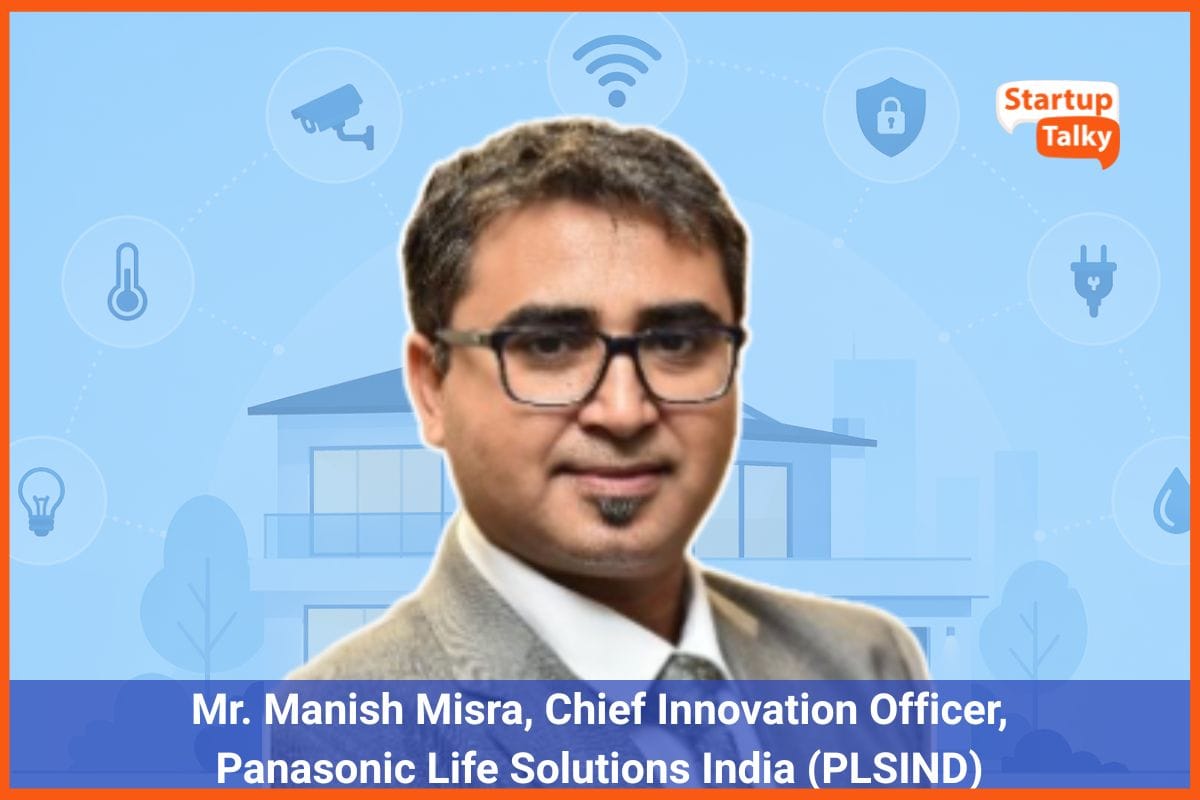
In this conversation, Mr. Manish Misra, Chief Innovation Officer, Panasonic Life Solutions India (PLSIND), shares how Panasonic is leveraging initiatives like Panasonic Ignition to build scalable, innovation-led solutions and strengthen startup, corporate collaboration in India.
India’s Residential Tech Shift: From Gadgets to Integrated Living
StartupTalky: India has become a pivotal market for Panasonic’s long-term transformation. How do you view the shifts happening in India’s residential and consumer technology landscape today?
Manish Misra: India is undergoing a fundamental residential transformation. We are seeing rapid growth in smart-home adoption, with premium residential technologies, especially safety, security, energy systems, and wellness, becoming mainstream rather than niche.
Safety and security already account for a significant share of smart-home spending, while air quality, elder care, and energy resilience have emerged as household priorities. These shifts signal a move from fragmented, gadget-led adoption to demand for integrated, community-scale living solutions, which aligns closely with Panasonic’s long-term vision for smarter, healthier, and more connected homes in India.
Panasonic’s Core Innovation Focus Areas in India
StartupTalky: Within Panasonic’s innovation priorities, which two or three areas are currently receiving the strongest internal focus or investment, particularly from an India market standpoint?
Manish Misra: In India, our focus areas are residential safety and security, energy optimisation, smart home ecosystem, and health & wellness. These priorities reflect real gaps in India’s residential ecosystem, including unreliable power and rising energy costs, concerns around indoor air quality, and emergency preparedness.
Through Panasonic Ignition and our India Innovation Centre (IIC), we are actively building solutions that integrate these domains into a unified, interoperable residential platform rather than treating them as standalone technologies.
From Accelerator to Co-Creation Platform: Evolution of Panasonic Ignition
StartupTalky: Between Edition 1 and Edition 3 of Panasonic Ignition, what structural or evaluation changes were introduced to strengthen startup–corporate collaboration?
Manish Misra: The most significant change is that Panasonic Ignition has evolved from a traditional accelerator into a co-creation and incubation platform. Edition 1 focused on a single problem area, B2B energy management, while Edition 3 addresses interconnected residential challenges under a B2B2C model.
Evaluation is no longer limited to pilots or proofs of concept; instead, we assess startups on their ability to integrate with Panasonic businesses, scale through real deployments, and progress toward long-term partnerships or investment pathways.
Measurable Outcomes from Panasonic Ignition’s Previous Cohorts
StartupTalky: From the earlier editions of Panasonic Ignition, which specific pilots, integrations, or measurable business outcomes demonstrated the program’s effectiveness?
Manish Misra: We are eyeing a deep, ongoing collaboration. From earlier cohorts, startups such as Enlite, Clairco, Sustlabs, Blaze Automation, Ray IoT, and NeoSapien are already working closely with Panasonic teams on business integration, solution refinement, and go-to-market strategies.
Further, we are simultaneously conducting formal investment due diligence. Cumulatively, Panasonic Ignition has engaged over 700 startups, incubated more than 45 startups, and created a pipeline of commercially viable joint solutions rather than one-off pilots.
What Sets Panasonic Ignition Apart from Other Corporate Accelerators
StartupTalky: Corporate accelerators vary widely in approach. What is one practice that Panasonic Ignition avoids, and one it deliberately prioritises, to ensure stronger commercial and technical outcomes?
Manish Misra: We avoid token accelerators that focus only on visibility or short-term mentoring. Instead, we prioritise joint business creation. That means meaningful business outcomes, deep technical collaboration with Panasonic R&D teams, and post-demo-day engagement that extends well beyond typical 3-6 month programs.
Our intent is to build long-term partnerships with clear pathways to commercialisation which creates business success for both Panasonic and Startup, not just run a showcase program.
Key Problem Statements Driving Panasonic Ignition 3.0
StartupTalky: For the third edition of Panasonic Ignition, which problem statements within residential living, such as air quality, energy optimisation, elderly care, or security, emerged as the most urgent through your research?
Manish Misra: The third edition’s theme centres on our innovation across five key areas, including residential security and safety, indoor air quality and wellness, energy resilience and optimisation, elder care, and scalable community solutions.
These challenges are deeply interconnected and we notice a comprehensive and holistic solution brings higher value to residential consumers. Ignition 3.0 focuses on solving them systemically, at both the home and community level, rather than addressing each in isolation.
Non-Negotiable Criteria for Startup Selection
StartupTalky: During the selection for Panasonic Ignition’s third cohort, what technical or commercial criteria were non-negotiable for startups like Ambiator, Biomoneta, Awiros, and The Energy Company?
Manish Misra: The non-negotiables are clear, real-world use cases, scalability, and strategic alignment with Panasonic’s business roadmap. We look for solutions that could integrate into a unified ecosystem, demonstrate measurable efficiency or performance outcomes, and address genuine challenges. Strong founding teams, deployment readiness, and a clear path to joint business creation are equally critical.
Evaluating Sustainability and ROI in Clean-Tech Partnerships
StartupTalky: Clean-tech and sustainability-led solutions form a major part of this year’s Ignition cohort. What sustainability metrics or ROI indicators does Panasonic apply when evaluating such partnerships?
Manish Misra: We evaluate sustainability through both environmental impact and business viability. Key indicators include measurable energy savings, efficiency gains, reduction in emissions or resource consumption, and long-term cost benefits for households or communities. Importantly, sustainability solutions must also demonstrate scalability and commercial logic, because we believe that financially viable solutions can deliver sustained environmental impact at scale.
What’s Next After Panasonic Ignition Demo Day
StartupTalky: Following Panasonic Ignition Demo Day on 19 December, what concrete next steps should the shortlisted startups expect, particularly regarding pilot timelines, investment considerations, or co-development pathways?
Manish Misra: Demo Day is the starting point, not the finish line. Shortlisted startups will move into structured pilot deployments, proof-of-business engagements, and deeper technical integration with Panasonic teams. Based on performance and strategic fit, select startups may also enter formal co-development discussions and investment evaluation.
 Apoorva Bajj