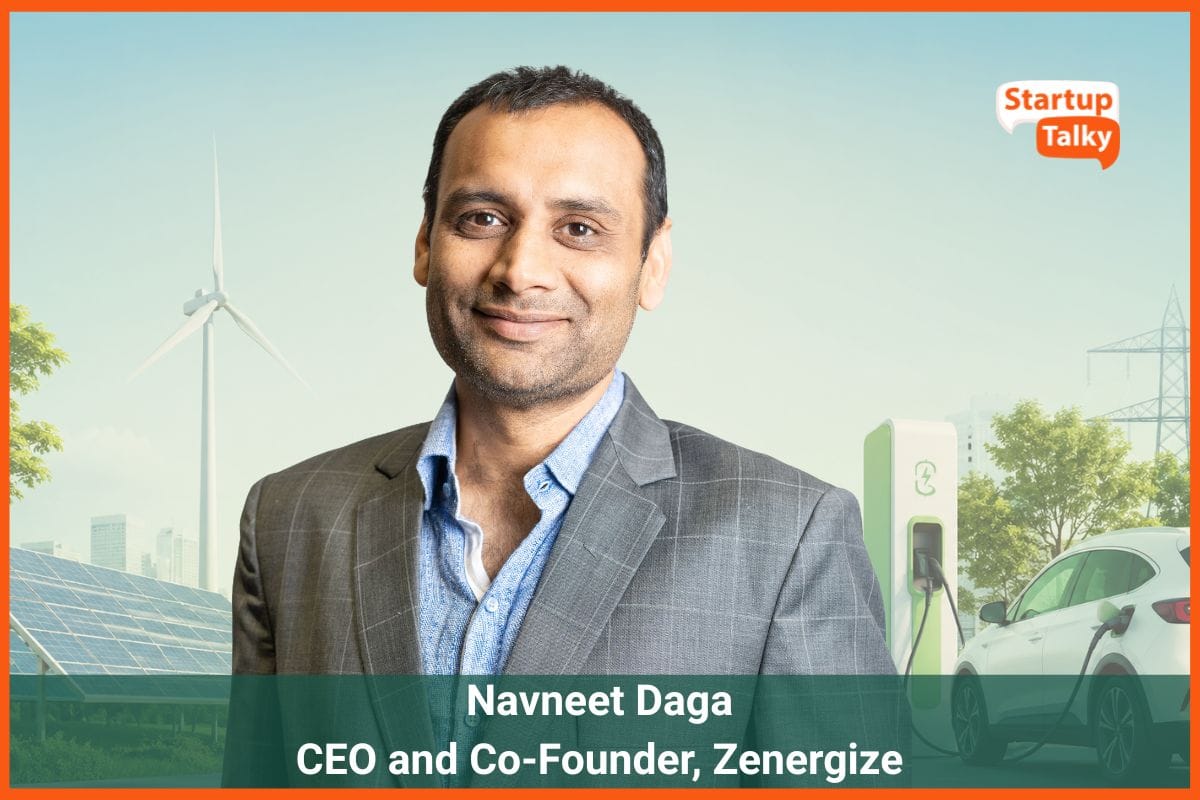
Navneet Daga of Zenergize on EV Charging Reliability, Energy Security, and the Future of Smart Energy in India
India's EV charging and solar markets are growing rapidly. In this exclusive interview, Navneet Daga, CEO and Co-Founder of Zenergize, discusses charger reliability, energy security, grid stability, and the future of smart energy and vehicle-to-grid technologies in India.
India's clean energy and electric mobility sectors are witnessing unprecedented growth, driven by rising EV adoption, rapid solar capacity additions, and increasing investments in energy infrastructure. According to industry estimates, India's EV charging infrastructure market is expected to grow at a CAGR of over 25% between 2025 and 2030, while the country's solar energy market is projected to expand at a CAGR of around 18-20% during the same period.
As the ecosystem matures, technologies such as intelligent charging, integrated solar-plus-storage systems, smart grids, and vehicle-to-grid (V2G) capabilities are expected to redefine how energy is generated, stored, and consumed.
In an exclusive interaction with StartupTalky, Mr. Navneet Daga, CEO and Co-Founder of Zenergize, sheds light on the technical and operational challenges shaping India's evolving energy landscape. He discusses the factors responsible for EV charger downtime, the growing importance of energy security, the impact of high-power charging on grid stability, and how Zenergize is differentiating itself in the highly competitive solar inverter market.
Daga also shares his perspective on scaling deep-tech energy infrastructure businesses and explains what India needs to do to accelerate the commercial deployment of vehicle-to-grid technologies.
Addressing EV Charger Downtime and Reliability Challenges
StartupTalky: India's public EV charging network has grown, but reliability and uptime remain persistent complaints. From a hardware and software perspective, what causes EV charger downtime most frequently, and how does Zenergize's approach to product design or service address those failure modes?
Navneet Daga: The most common causes of charger downtime in India come down to three factors: thermal stress, grid instability, and limited diagnostic visibility.
A large share of chargers deployed today were originally designed for operating environments with far more stable grids and milder climatic conditions. In India, high ambient temperatures frequently push systems into thermal derating or shutdown, while voltage fluctuations and power interruptions often cause session drops or system faults.
The second issue is firmware dependency. When operators rely on imported systems where the underlying software stack is externally controlled, even relatively straightforward updates or fault corrections become slow and operationally expensive.
Our approach at Zenergize has been to engineer for these realities from the first schematic. Our systems are designed to operate reliably at full rated performance in high-temperature Indian conditions, with thermal resilience built into the architecture itself.
On the software side, because we own the full firmware and control stack, we can build protection and recovery logic directly into the system. This enables chargers to tolerate short voltage fluctuations without interrupting active sessions, while features like automatic restart after power restoration significantly reduce manual intervention.
Equally important is serviceability. Domestic engineering ownership allows faster diagnostics, quicker iteration, and far more responsive after-sales support compared to imported systems dependent on overseas escalation cycles.
Rising Demand for Solar and Storage Solutions Amid Energy Security Concerns
StartupTalky: The Iran conflict has elevated energy security as a concern across Indian homes and businesses. How does this translate into demand for integrated solar and storage solutions that reduce grid dependence, and what profile of buyer is most motivated by energy security rather than cost savings?
Navneet Daga: Energy security conversations have become increasingly relevant as global geopolitical disruptions continue to expose the vulnerability of centralised energy systems. What this does is shift the conversation around distributed energy from purely economic optimisation to operational resilience. Buyers are increasingly evaluating solar and storage not only as tools for reducing electricity costs, but as infrastructure that provides greater control over energy availability.
The most motivated buyers tend to be commercial and industrial users where power continuity has direct operational consequences, including manufacturing facilities, logistics operators, commercial campuses, and fleet operators with charging-dependent uptime requirements.
For residential users, adoption is still more strongly influenced by long-term savings economics, although awareness around resilience is growing.
Managing Power Quality Challenges Created by EV Charging Infrastructure
StartupTalky: EV charging stations introduce non-linear, high-power loads onto distribution circuits that were not designed for them. What are the power quality challenges this creates for local grids and building electrical systems, and how should this be considered in the design of charging infrastructure?
Navneet Daga: This is one of the most under-discussed technical challenges in scaling EV infrastructure.
High-power charging introduces dynamic and non-linear loads that can create harmonic distortion, voltage fluctuations, power factor degradation, and localised load spikes if not properly managed. These effects can stress building electrical systems and place additional pressure on already constrained distribution networks.
In practical terms, poorly designed charging infrastructure can contribute to voltage instability, inefficient energy utilisation, and accelerated wear across upstream electrical assets.
This is why charging infrastructure design cannot focus solely on charging speed or cost. It must account for power quality performance at the system level. That means designing converters with high efficiency and strong harmonic performance, incorporating intelligent load management, and building software capable of dynamically adjusting charging behaviour based on site conditions.
As EV deployment scales, grid-aware charging intelligence will become essential. Chargers must increasingly behave as intelligent grid assets capable of responding to broader system conditions rather than simply drawing maximum available power.
Differentiating in India's Competitive Solar Inverter Market
StartupTalky: India's solar inverter market has many players at the lower end competing almost entirely on price. How does Zenergize differentiate in an environment where buyers, particularly in the residential segment, may not fully understand the performance specifications they are comparing?
Navneet Daga: Price-led competition is common in rapidly scaling markets, particularly when technical differentiation is not immediately visible to end buyers. We believe that while upfront pricing may influence early purchase decisions, long-term performance ultimately defines value. Efficiency, thermal reliability, grid resilience, serviceability, and software upgradeability all directly impact lifetime system performance.
The challenge is that many of these attributes are not always obvious on a specification sheet. Our differentiation comes from engineering depth and complete ownership of the technology stack. Because our hardware and software are developed entirely in-house, we are able to optimise system performance for Indian operating realities rather than adapting imported architectures.
This translates into higher reliability under thermal stress, stronger tolerance to grid variability, faster support cycles, and greater flexibility for future upgrades.
As the market matures, buyer focus typically shifts from initial cost to total lifecycle performance. That is where genuinely engineered products consistently outperform low-cost alternatives.
Scaling Deep-Tech Energy Infrastructure: Capital and Operational Challenges
StartupTalky: For a startup operating in hardware-intensive energy infrastructure, what are the most significant capital and operational challenges in scaling from product development to commercial deployment, and what has the fundraising and partnership landscape looked like for Zenergize?
Navneet Daga: Scaling deep-tech hardware is fundamentally different from scaling software.The capital intensity and development cycle is significantly higher because product development requires sustained investment across design validation, testing infrastructure, manufacturing capability, supply chain development, and field deployment before commercial scale is reached.
Operationally, the challenge lies in balancing product iteration with manufacturing consistency. In power electronics, even small design refinements require rigorous validation across performance, safety, and reliability parameters.The partnership landscape is equally important because scaling requires close collaboration across manufacturing, deployment, and service ecosystems.
For Zenergize, our focus has been on building genuine technology ownership from the ground up, which requires patient capital aligned with long-term infrastructure value creation rather than short-term commercial milestones. Our recent seed funding has strengthened our ability to scale manufacturing, deepen R&D, and expand deployment capabilities.
What we are increasingly seeing is that investors and ecosystem partners are beginning to recognise that domestic power-electronics capability is strategic infrastructure, not simply another hardware category.
The Road to Commercial Vehicle-to-Grid (V2G) Adoption in India
StartupTalky: Smart grid integration, demand response, and vehicle-to-grid capabilities are discussed as the future of EV charging. From a hardware readiness and standards perspective, how far is India from deploying V2G commercially, and what needs to happen in the next two years to move from pilots to scale?
Navneet Daga: Vehicle-to-grid is undoubtedly a highly promising direction, but commercially scaled deployment in India is still at a relatively early stage. The challenge is not simply one of charger hardware readiness. It requires alignment across multiple layers, including bidirectional charging infrastructure, interoperable communication standards, grid-level regulatory frameworks, utility participation, and commercially viable operating models. While the technology ecosystem is progressing steadily, large-scale deployment will require significantly stronger standardisation and deeper integration between charging systems and grid management platforms.
Over the next two years, the focus must be on three critical areas: establishing clearer national interoperability and communication standards, enabling utility-led pilot programmes that move beyond technical demonstrations into real operating environments, and accelerating investment in intelligent control systems capable of managing bidirectional energy flows safely and dynamically. The larger point is that V2G is not merely a charger feature; it is an ecosystem capability. Real scale will emerge only when hardware, software, regulation, and grid economics evolve in sync.
 Apoorva Bajj