DealShare's $1.7B Unicorn Value Is Basically Its Cash Now
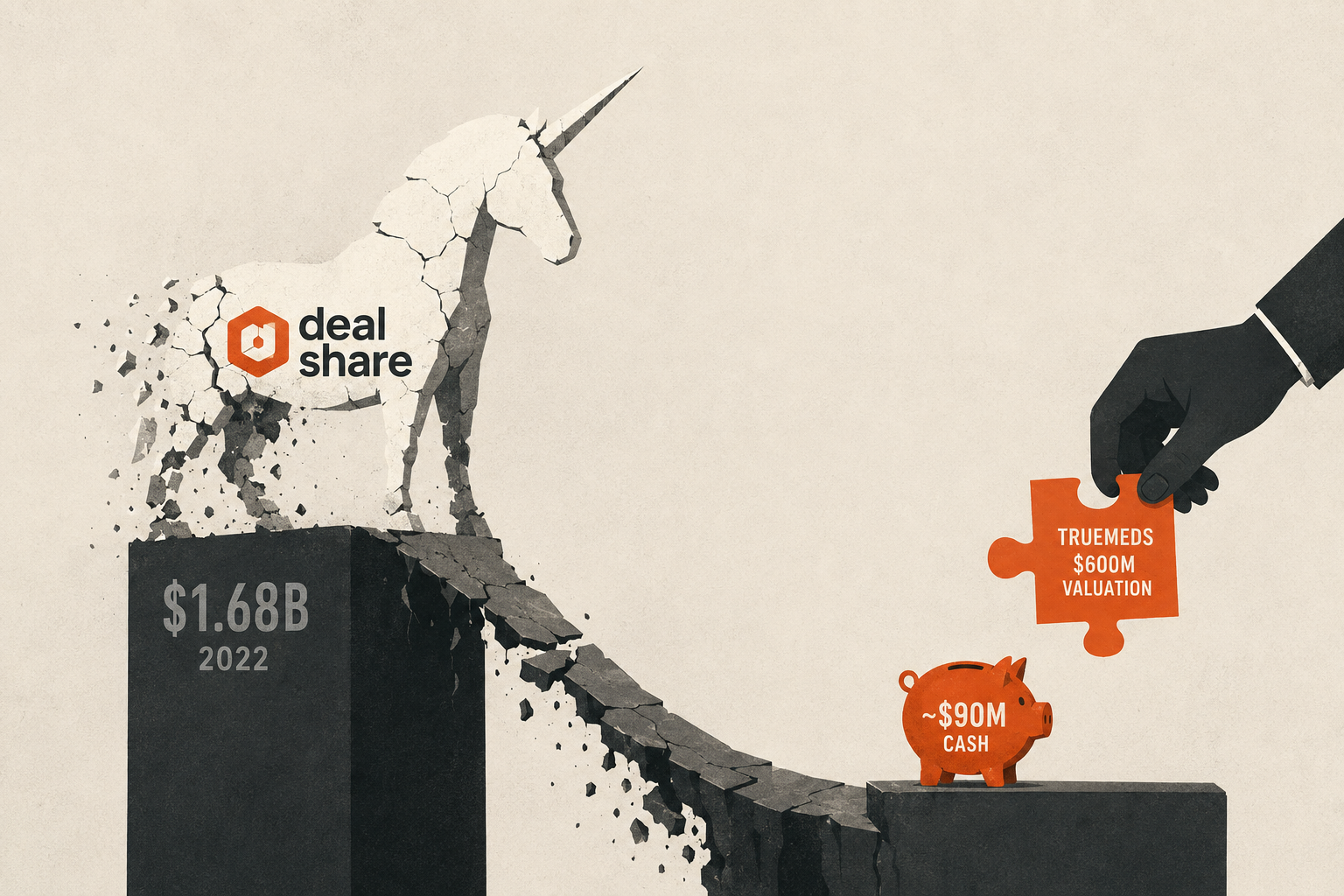
Truemeds is in talks to acquire DealShare for about $90 million in an all-stock deal, 95% below DealShare's 2022 unicorn peak. The real story is how much Truemeds' own valuation had to inflate to make it work.
Every founder who built DealShare is gone.
Vineet Rao (CEO) and Sankar Bora (COO) left in 2023. Sourjyendu Medda stepped down as CEO in January 2024. Rajat Shikhar, the last of the four co-founders still holding a title, departed in December 2025. Eight months later, in August 2026, the company they built is in talks to be acquired for roughly what it has sitting in the bank.
From $1.7 billion to a bank balance
DealShare turned unicorn on January 27, 2022, when Tiger Global and Alpha Wave led a Series E that valued the Bengaluru social-commerce startup at $1.68 billion, one of 118 Indian companies to cross that threshold. It had raised close to $400 million total since founding in 2018, with WestBridge Capital and Tiger Global as its biggest backers alongside Alpha Wave.
The reversal from there was fast and specific, not a slow fade:
- 2023: DealShare shut its B2B business entirely, cut around 230 jobs across two rounds, and lost its CEO and COO within months of each other, while its closest social-commerce rival, Meesho, reached profitability the same year.
- FY24: Revenue collapsed 74%, from ₹1,963 crore in FY23 to ₹499 crore.
- FY25: Revenue fell again to ₹432 crore, though losses narrowed to ₹87.65 crore from ₹167 crore the year before, evidence of a company shrinking toward survival rather than growing toward anything.
What's left is roughly $90 million in cash and a valuation offer that barely clears it. Truemeds is reportedly in talks to acquire DealShare in an all-stock deal at close to that same $90 million figure, a 95% discount to the 2022 peak. Neither company has confirmed the terms publicly.
Why stock, not cash
The structure is the actual story here, more than the number. Truemeds isn't writing DealShare a check. It's issuing its own shares to DealShare's investors, at an implied valuation of roughly $600 million, and picking up DealShare's cash reserves without spending a rupee of its own treasury to do it.
That matters because Truemeds priced its own last real funding round, an Accel-led raise with Peak XV Partners in October 2024, at $330 million. Ten months later, it's using paper worth nearly double that to fund an acquisition. Either Truemeds genuinely grew into that number on its own merits, plausible given its business posted 66% revenue growth and now serves 500,000 customers a month, or the $600 million figure was set specifically to make this particular swap dilute cleanly. Both can be true at once, and there's no way to tell from outside which one is doing more of the work.
WestBridge Capital holds a stake in both companies. That doesn't make the deal improper, but it does mean the investor best positioned to write down DealShare's mark to near-zero is the same investor with a say in what Truemeds' shares are worth for the purpose of absorbing it.
The playbook this fits
DealShare isn't the only Indian startup finding an exit through a discounted stock swap instead of a formal shutdown. India's 2025 M&A activity leaned heavily toward distress and consolidation deals: Groww bought Fisdom for $150 million, InCred Money picked up Stocko for $35 million, and Fullerton Financial took LendingKart for $91 million, all priced well under what those companies once told investors they were worth. What sets the Truemeds structure apart is the currency. A cash acquisition prices a company in public. A stock swap lets both sides avoid ever stating a number that has to survive scrutiny, because the real price is buried in a cap table only the two companies and their shared investor can see. I'd guess we see more of this in 2026, not less. It's a cleaner exit for everyone involved than admitting a unicorn is worth 5% of what the last round said.
What actually determines who wins here
If the deal closes near these terms, DealShare's Series E investors take a loss that's already effectively locked in, whatever the final press release says. The open question is what DealShare's earlier investors, the ones who backed the 2021 Series D at $455 million or the rounds before that, actually recover once $90 million in enterprise value gets split against nearly $400 million raised.
The number worth tracking isn't DealShare's. It's whether Truemeds' $600 million marks a real re-rate the company can defend at its next independent raise, or a figure invented to make one acquisition's math close. That's the difference between a genuine recovery story for one of India's few profitable-adjacent generic-drug platforms, and a paper valuation nobody outside two boardrooms will ever be asked to justify.
If you have information related to this story, contact us through StartupTalky's tips line. Anonymity is the default.