HUL's Beauty Buying Spree: Every Deal Since 2022
HUL has bought majority stakes in two D2C brands since 2022, OZiva and Minimalist, and walked away from two others. That mix of buying and selling, not any single deal, is the real strategy.
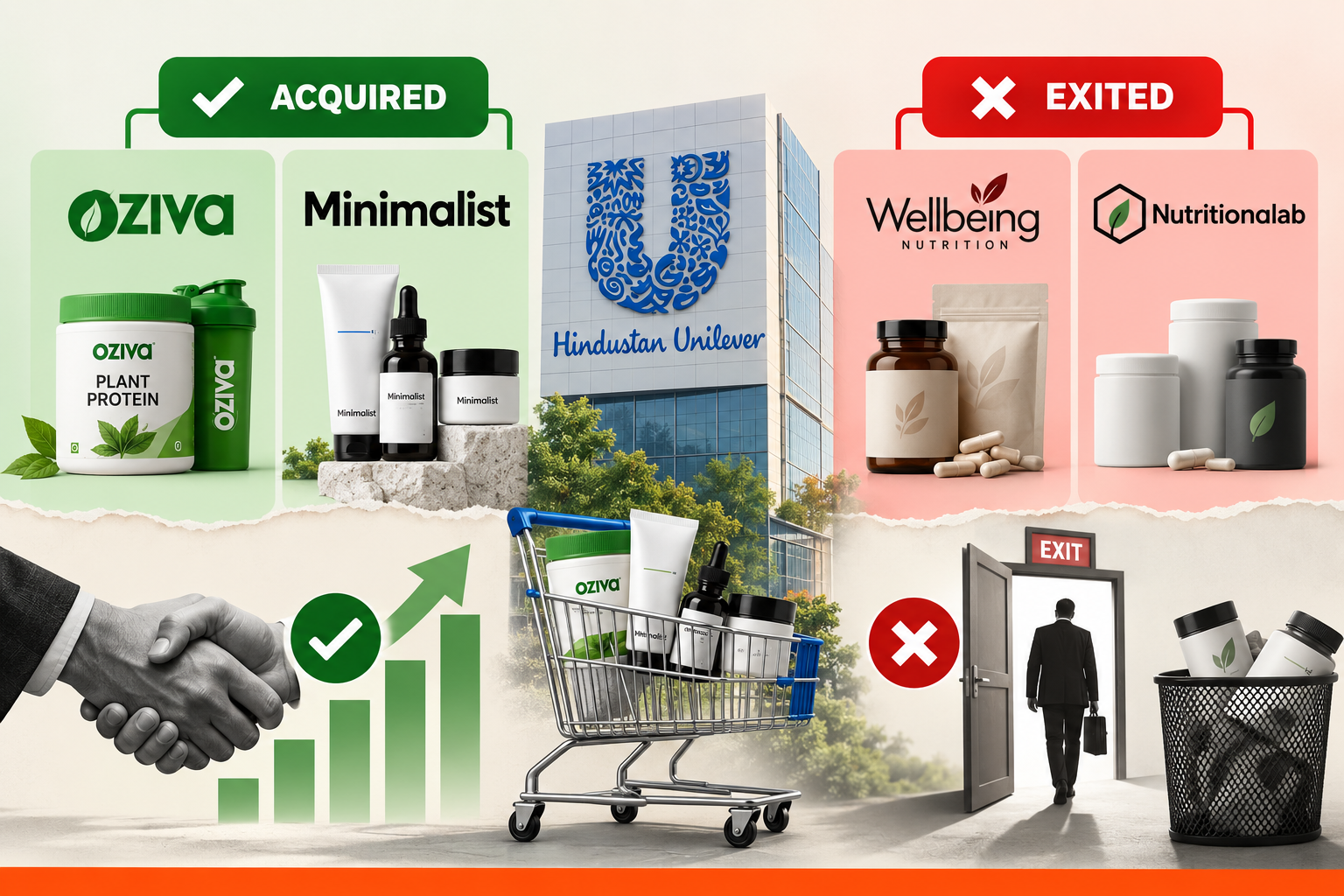
Hindustan Unilever's clearest tell about how it thinks of a young brand isn't which ones it buys. It's how fast it decides whether to own the whole thing or let it go.
Since December 2022, HUL has acquired two D2C brands, OZiva and Minimalist, and walked away from two others, Wellbeing Nutrition and a stake in Nutritionalab. All four moves sit inside the same three-year window, and reading them together says more about HUL's actual M&A discipline than either acquisition does alone. HUL made one other acquisition in this window too, a raw-material supply deal rather than a consumer brand, covered separately below so it doesn't get lost in a table that's otherwise all about D2C.
Every HUL beauty and wellness move since 2022
| Date | Company | Move | Stake | Amount |
|---|---|---|---|---|
| October 2022 | Wellbeing Nutrition | Exit | Full divestment | Undisclosed |
| December 2022 | OZiva (Zywie Ventures) | Acquire | 51% | ₹264.28 crore |
| January-April 2025 | Minimalist (Uprising Science) | Acquire | 90.5% | ₹2,706 crore (₹2,955 crore enterprise value) |
| 2027 (planned) | Minimalist | Buy remaining stake | to 100% | ₹45 crore |
| February-March 2026 | OZiva | Buy remaining stake | to 100% | ₹824 crore |
| March 2026 | Nutritionalab | Divest | 19.8% stake sold | Undisclosed |
Buy majority first, not a toe-hold
HUL's pattern is the opposite of ITC's. Where ITC buys a minority stake and waits years to take control, HUL took 51% of OZiva on day one and 90.5% of Minimalist on day one, in both cases with a pre-agreed, dated path to full ownership rather than an open-ended option.
That structure has already paid out once. HUL bought the remaining 49% of OZiva for ₹824 crore in a deal that values the company at roughly ₹1,682 crore, more than three times what the 2022 stake implied. OZiva's own revenue backs that up: it scaled to around ₹480 crore in 2025, growing at close to 130% a year over two years. Minimalist, still mid-integration, posted its first full year under HUL with revenue up 36% to ₹690.2 crore, EBITDA more than doubling to around ₹40 crore, and a swing to a ₹25.9 crore profit from a loss the year before.
The part ITC's version of this story doesn't have: an exit
HUL didn't just buy in this window. It sold out of Wellbeing Nutrition entirely in October 2022 and divested a 19.8% stake in Nutritionalab in March 2026, both without the fanfare that came with the OZiva and Minimalist announcements. That's a real signal, not a footnote: HUL is treating its D2C bets as a genuine portfolio, with a fast, quiet exit ramp for the ones that don't earn a bigger check, alongside the ones that do.
The one deal that isn't about brands at all
In January 2025, HUL's board approved acquiring the palm oil undertaking of Vishwatej Oil Industries in Telangana, part of a backward-integration push to build its own supply chain for palm derivatives instead of importing them from Indonesia and Malaysia. It's the odd one out on this list: not a brand, not a stake percentage, not aimed at revenue growth at all, but a bet on controlling the raw materials that go into HUL's personal care and home care products. Worth knowing about, even if it doesn't belong in the same sentence as OZiva or Minimalist.
What HUL is buying this with
HUL's most recent quarter, Q1 FY27 (April-June 2026), posted ₹17,341 crore in revenue, up 10.1% and the highest quarterly turnover in 13 quarters, on 5% volume growth. Net profit fell 3% to ₹2,673 crore, but that's a base-effect story: the year-ago quarter carried a one-off tax credit that inflated the comparison, not a sign the core business slowed. EBITDA rose 8% to ₹3,947 crore.
Every one of the four deals above is small change against numbers that size, and that's exactly the point. HUL isn't betting the balance sheet on any single ₹2,000-3,000 crore acquisition the way ITC's ₹3,498 crore Century Pulp deal represents a real swing for that company. For HUL, OZiva and Minimalist are closer to venture-style bets sized against a business doing ₹17,000+ crore a quarter, where the real discipline shows up in which ones it chooses to walk away from just as fast.
What I'd watch next
The 2027 buyout of Minimalist's remaining 9.5% is the next real test of the pattern. If Minimalist's growth holds through that date the way OZiva's did, expect HUL to keep running the exact same playbook on the next premium D2C brand it takes a majority stake in. If it slows, the Wellbeing Nutrition exit says HUL won't hesitate to cut it loose either.
If you have information related to this story, contact us through StartupTalky's tips line. Anonymity is the default.