Best AI Attribution Tools
Explore the best AI attribution tools for 2026 to track customer journeys, measure marketing performance, analyze ROAS, and make better budget decisions.

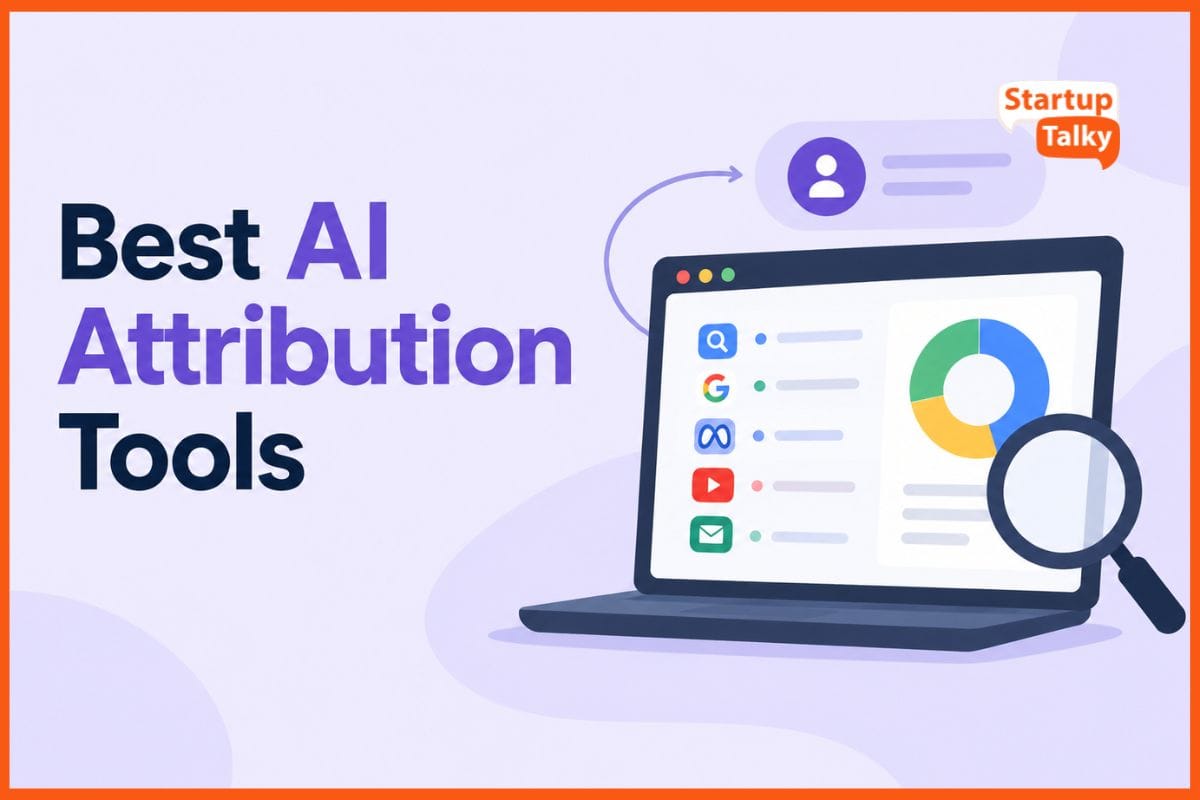
The best AI attribution tools help marketers understand what really drives sales. They track the customer journey across different touchpoints, from the first click to the final purchase.
With machine learning, these tools connect data from multiple channels and find patterns that may be hard to spot manually. This helps teams see which campaigns are bringing in real results and which ones are wasting money.
Marketers can then plan budgets with more confidence, improve their ads, and focus on channels that support growth. By turning complex data into clear insights, AI attribution tools help teams make faster, smarter decisions.
Best AI Attribution Tools: Comparison
| AI Attribution Tool | Best For | Key Features | Drawbacks |
|---|---|---|---|
| Triple Whale | Ecommerce brands running paid campaigns | Multi-touch attribution, marketing mix modeling, incrementality testing, first-party data, cross-device tracking, Moby AI, 60+ integrations | Requires a clean store, ad-platform, and pixel setup; advanced automation may need human review |
| Northbeam | Ecommerce marketing attribution and budget decisions | Multi-touch attribution, media mix modeling, incrementality analysis, first-party data, deterministic view-through measurement, Apex, MMM Plus | Professional and Enterprise plans generally require longer contracts and sales-led quotes; attribution still estimates influence |
| HockeyStack | B2B sales and marketing teams | Buyer journey tracking, CRM and website data, Atlas data layer, Odin natural-language analysis, multi-touch models, lift and incrementality analysis | Depends on sound CRM and identity data; setup can involve several systems and stakeholders |
| Dreamdata | B2B companies with complex buying journeys | Multi-touch attribution, cookieless tracking, company identification, audience building, ad-spend reporting, AI buyer signals, Analytics Agent | Requires clean CRM, ad, and tracking data; may feel complex for small teams |
| Ruler Analytics | Businesses measuring leads, sales, and revenue | First-party attribution, marketing mix modelling, impression data, CRM and offline sales data, AI Analyst, Media Planner, 1,000+ integrations | Setup can be complex; measurement results are models rather than proof |
| Rockerbox | Enterprise brands with complex marketing data | Multi-touch attribution, marketing mix modeling, incrementality testing, offline channels, custom models, ROAS, CAC, CLV reporting | Can require significant implementation and analytical support; may be excessive for small advertisers |
| Measured | Brands with large and diverse media budgets | Geo-based holdout tests, incrementality experiments, media mix modeling, forecasting, cross-channel reporting, budget planning | Requires enough spend, data, and time; does not focus on owning a tracking pixel or server-side event system |
| Wicked Reports | Ecommerce brands and agencies spending heavily on paid media | First-party attribution, verified orders, new vs. repeat customer reporting, LTV, CAC, Analyst, MCP, budget recommendations | Strong results depend on clean ecommerce, CRM, and order data; setup can be more involved |
| Usermaven | B2B SaaS teams, agencies, and growth marketers | Multi-touch attribution, customer journeys, funnels, cohorts, CRM revenue tracking, conversion syncing, Maven AI | Depends on clean campaign tags and CRM setup; may offer more attribution depth than small sites need |
| Windsor.ai | Marketing attribution and data integration | Multi-touch attribution, customer journey tracking, budget analysis, automated data flows, CRM and revenue data, multiple connectors | Depends on clean tracking and CRM data; setup can be difficult for teams without analytics skills |
Triple Whale
Triple Whale is an AI-powered platform that helps ecommerce brands make faster and smarter marketing decisions. Its Compass platform brings together multi-touch attribution, marketing mix modeling, and incrementality testing to show what is really driving sales.
Triple Pixel captures first-party and cross-device data, while Moby AI turns that data into useful actions, such as budget changes, creative ideas, customer segments, reports, and campaign updates.
The platform also combines sales, marketing, and operational data in one place, giving teams a clearer view of their business. It is mainly built for Shopify brands running paid campaigns across Meta, Google, TikTok.
Pros
- Triple Pixel uses first-party signals and identity resolution for stronger cross-device journey tracking
- Moby can act on insights: it can help manage ads, build audience segments
- Supports more than 60 ecommerce and retail integrations, which can reduce reporting gaps
Cons
- Full value requires a clean store, ad-platform, and pixel setup
- Advanced automation can need human review to protect brand voice, budgets, and campaign rules
Pricing
| Plan | Pricing |
|---|---|
| Request for Pricing (RFP) | Request for Pricing |
Northbeam
Northbeam is an AI-assisted marketing attribution platform built for ecommerce brands. It helps teams understand which ads and channels are actually driving revenue, beyond the ROAS numbers reported by ad platforms.
The platform combines multi-touch attribution, media mix modeling, and incrementality analysis to give a clearer view of marketing performance. It uses first-party data, tracks clicks and deterministic views, and supports long lookback periods.
Through Apex, it can also send better performance signals back to ad platforms. Teams can use Northbeam to test budgets, measure creative and channel impact, and identify wasted ad spend.
Pros
- Includes deterministic view-through measurement, not only click-based credit
- Apex can feed Northbeam’s performance data back to ad-platform algorithms
- Supports flexible revenue forecasts and budget scenarios through MMM Plus
Cons
- Professional and Enterprise plans generally require longer contracts and sales-led quotes
- Attribution models still estimate influence; they cannot prove that every credited ad caused a sale
Pricing
| Plan | Pricing |
|---|---|
| Starter | $1500/month |
| Professional | $3500/month |
| Enterprise | Contact Sales |
| Growth | Contact Sales |
HockeyStack
HockeyStack is an AI-powered B2B platform that helps sales and marketing teams understand what drives pipeline and revenue.
It brings together data from websites, CRM systems, products, sales activities, and ads to give teams a clear view of the buyer journey. Its Atlas data layer cleans and connects this data, while Odin allows users to ask questions in plain English without needing SQL.
Teams can also compare different attribution models, such as first-touch, last-touch, linear, time-decay, and custom models. HockeyStack also uses lift and incrementality analysis to measure the real impact of campaigns.
Pros
- Odin provides natural-language analysis, which can reduce reporting work for non-technical users
- Supports flexible, multi-touch models and lets teams switch models without rebuilding the data
- Handles account-level journeys and product-led growth signals, including expansion, churn, and upsell links
Cons
- Useful results depend on sound CRM, campaign, and identity data. Poor tracking can weaken attribution output
- Setup can involve several systems, data rules, and stakeholders, which may slow adoption
Pricing
| Plan | Pricing |
|---|---|
| Request for Pricing (RFP) | Request for Pricing |
 StartupTalky Official
Dreamdata
Dreamdata is a B2B marketing attribution platform that uses AI to show how prospects move from their first website visit to a closed deal. It connects website activity, ad engagement, CRM data, and revenue to give teams a clear view of the buyer journey.
The platform offers multi-touch attribution, cookieless tracking, company identification, audience building, ad-spend reporting, and AI-powered buyer signals. Its Analytics Agent and MCP Server allow teams to explore marketing data using natural language.
Dreamdata is especially useful for B2B companies with long sales cycles, multiple decision-makers, and complex customer journeys.
Pros
- Connects account-level journeys from first visit through closed revenue, which suits complex B2B buying groups
- Offers both cookie-based and cookieless tracking, helping preserve measurement when browser tracking is limited
- Turns insights into action with audience syncs for ad platforms and sales alerts for high-intent accounts
Cons
- Reliable results depend on clean CRM, ad, and tracking data; weak inputs can reduce trust in attribution
- The platform may feel complex for small teams that only need simple source reporting
Pricing
| Plan | Pricing |
|---|---|
| Request for Pricing (RFP) | Request for Pricing |
Ruler Analytics
Ruler Analytics is an AI-powered marketing measurement platform that helps businesses understand how their marketing drives leads, sales, and revenue.
It brings data from multiple sources into one view, including first-party multi-touch attribution, marketing mix modelling, impression data, CRM systems, and offline sales. Its AI Analyst helps teams measure campaign performance, understand return on investment, and identify areas where spending may be less effective.
The Media Planner can also help forecast results and plan future budgets. Ruler Analytics is useful for companies that want a clearer picture of marketing performance and need more insight than basic last-click reporting.
Pros
- Connects web, CRM, call, sales, and offline conversion data to revenue
- Uses first-party data and supports more than 1,000 integrations
- Forecasts ROI and flags spend saturation through budget scenario planning
Cons
- Setup can be complex, since clean CRM, conversion, and campaign data are vital.
- Results are models, not proof; Ruler states that no measurement model is fully accurate
Pricing
| Plan | Pricing |
|---|---|
| Small | $400/month |
| Medium | $668/month |
| Large | $1326/month |
| Advanced | $2000/month |
Rockerbox
Rockerbox is an enterprise marketing measurement platform that helps brands understand which marketing channels drive revenue. It combines multi-touch attribution, marketing mix modeling, and incrementality testing to give teams a clearer view of performance.
The platform tracks digital and offline channels, maps customer journeys, removes duplicate conversions, and supports custom attribution models. It also provides insights into ROAS, CAC, and customer lifetime value.
Rockerbox can measure channels such as paid media, TV, podcasts, direct mail, and ecommerce. It connects with data warehouses like Snowflake, BigQuery, and Redshift. It is best suited for larger brands with complex.
Pros
- Strong offline-channel support, especially for TV, podcasts, direct mail,
- Flexible attribution models and raw event exports help advanced analytics teams build custom views
- Built for complex enterprise data needs, with broad integrations
Cons
- It can require meaningful implementation, clean conversion data, and analytical support to get full value from MMM and incrementality testing
- The enterprise focus may make it excessive for small advertisers or simple, single-channel businesses
Pricing
| Plan | Pricing |
|---|---|
| Request for Pricing (RFP) | Request for Pricing |
Rishi Mundra
Measured
Measured is an enterprise AI platform that helps brands understand what marketing spend actually drives growth. Instead of giving credit to the last ad a customer clicked, it measures the true impact of each channel.
The platform uses geo-based holdout tests, incrementality experiments, media mix modeling, cross-channel reporting, forecasting, and budget planning. Its AI-led approach helps marketing teams estimate incremental sales, ROAS, and CPA across channels such as paid social, search, TV, and display.
Measured is mainly suited for brands with large and diverse media budgets that want clearer insights into which campaigns and channels.
Pros
- Measures true lift with control groups and geo tests, not just click paths
- Links experiment data with media-mix models for stronger budget decisions
- Covers many channels and supports cross-channel spend planning
Cons
- Results need enough spend, data, and time to run sound experiments
- It does not focus on owning a tracking pixel or server-side event system
Pricing
| Plan | Pricing |
|---|---|
| Request for Pricing (RFP) | Request for Pricing |
Wicked Reports
Wicked Reports is an AI-ready, first-party attribution platform built for ecommerce brands and agencies that spend heavily on paid media. It connects real ad clicks with verified orders, helping teams see which channels, campaigns, and creatives drive revenue.
The platform also separates new customers from repeat buyers and tracks key metrics such as customer lifetime value and acquisition cost. Its built-in Analyst and MCP connection work with ChatGPT and Claude, making it easier to query trusted data.
Weekly “Scale, Chill, or Kill” recommendations help guide budget decisions. Wicked Reports also sends verified new-customer signals back to ad platforms.
Pros
- Uses first-party, order-level data rather than relying only on ad-platform reporting
- Separates new and repeat buyers at campaign and creative level
- Includes cohort and LTV reporting, plus lifetime lookback and lookforward views
Cons
- Its strongest value depends on clean, connected ecommerce, CRM, and order data
- Setup can be more involved than simple pixel-based analytics because it joins data across several systems
Pricing
| Plan | Pricing |
|---|---|
| Measure | $499/month |
| Scale | $699/month |
| Maximize | $999/month |
Usermaven
Usermaven is an AI-powered attribution platform built for B2B SaaS teams, agencies, and growth marketers. It connects website, product, advertising, and CRM data to show which channels, campaigns, and content drive pipeline and revenue.
It supports multi-touch attribution models, customer journeys, funnels, cohorts, and retention analysis. Users can track campaigns, landing pages, content, and paid ads while linking them to CRM deals and revenue.
Usermaven also connects with Google, Meta, and LinkedIn Ads for conversion syncing. Its Maven AI feature highlights trends, explains changes, creates reports, and provides automated insights, reducing the need for manual data analysis.
Pros
- It combines web, product, CRM, and ad data in one platform, reducing the need to join data from several tools
- A 365-day attribution lookback can help teams assess B2B deals with long sales cycles
- It can send conversion data back to advertising platforms, not just report on results
Cons
- Attribution quality depends on clean campaign tags, CRM setup, and sound conversion definitions
- Small sites that only need traffic reports may find its attribution depth more than they need
Pricing
| Plan | Pricing |
|---|---|
| Request for Pricing (RFP) | Request for Pricing |
Muskaan Kapoor
Windsor.ai
Windsor.ai is an AI-powered marketing attribution and data integration platform that brings data from ads, websites, CRM systems, and e-commerce into one place. It helps marketing teams understand which channels and customer touchpoints generate leads, sales, and better returns on ad spend.
The platform supports multi-touch attribution, customer journey tracking, budget analysis, and automated data flows.
It can also connect with tools such as Looker Studio, Power BI, Tableau, Google Sheets, and data warehouses. With a wide range of connectors, Windsor.ai reduces the need for manual data collection and reporting.
Pros
- Multi-touch attribution can assign value across a full customer journey, not only the first or last click
- It joins marketing data with CRM, revenue, margin, and customer-lifetime-value data for deeper ROI views
- It offers many connectors and destinations, which can reduce manual CSV work
Cons
- Attribution results depend on clean tracking, sound naming rules, and complete CRM data
- Setup can be hard for teams without data or analytics skills, especially when mapping several sources
Pricing
| Plan | Pricing |
|---|---|
| Basic | $23/month |
| Standard | $118/month |
| Plus | $299/month |
| Professional | $598/month |
| Enterprise | Contact Sales |
How AI Attribution Tools Help Marketers Measure Performance
AI attribution tools help marketers connect customer interactions across different channels and understand how those interactions contribute to sales.
Instead of looking only at the first or last click, many of these platforms use multi-touch attribution, marketing mix modeling, incrementality testing, first-party data, or a combination of these approaches.
This can help marketing teams:
- Understand the customer journey across multiple touchpoints.
- Identify campaigns and channels that contribute to revenue.
- Compare different attribution models.
- Measure ROAS, CAC, CPA, and customer lifetime value.
- Identify potentially wasted ad spend.
- Forecast results and plan future budgets.
- Connect marketing data with CRM and offline sales data.
- Send conversion and performance signals back to advertising platforms.
However, attribution models are still models. They can provide useful estimates of marketing influence, but they cannot always prove that a specific advertisement directly caused a sale.
How to Choose the Right AI Attribution Tool
| Business Type | Recommended Tools | What to Consider |
|---|---|---|
| Ecommerce brands | Triple Whale, Northbeam, Wicked Reports | Choose tools that can track customer journeys, paid campaigns, revenue, and ecommerce data. |
| B2B teams with longer sales cycles | HockeyStack, Dreamdata, Usermaven | Look for CRM integration, buyer journey tracking, multi-touch attribution, and revenue attribution. |
| Enterprise brands with complex marketing programs | Rockerbox, Measured | Consider advanced measurement, cross-channel analysis, offline marketing data, and incrementality testing. |
| Businesses with complex data setups | Compare tools based on your data infrastructure | Check the quality of your CRM, campaign, conversion, and customer data before choosing a platform. |
| Businesses with incomplete or poor tracking | Improve data and tracking before selecting a tool | Poor tracking and incomplete data can weaken attribution results regardless of the tool being used. |
Conclusion
AI attribution tools help creators protect their work in today’s fast-moving digital world. They can track content, detect misuse, check sources, and help make sure creators get proper credit.
However, no tool is perfect, so the results should always be checked by a person. Even with these limits, such tools can make it easier to prove ownership and reduce fraud.
The right tool depends on the type of content, how widely it is used, and how much proof is needed. When used carefully, AI attribution tools can build trust, support original creators.
FAQs
What are AI attribution tools?
AI attribution tools help marketers measure how different marketing channels and touchpoints contribute to conversions, revenue, and customer acquisition.
How do AI attribution tools work?
These tools collect data from advertising platforms, websites, CRM systems, ecommerce stores, and other sources. AI and statistical models then analyze customer journeys and assign credit to different marketing touchpoints.
What are the best AI attribution tools in 2026?
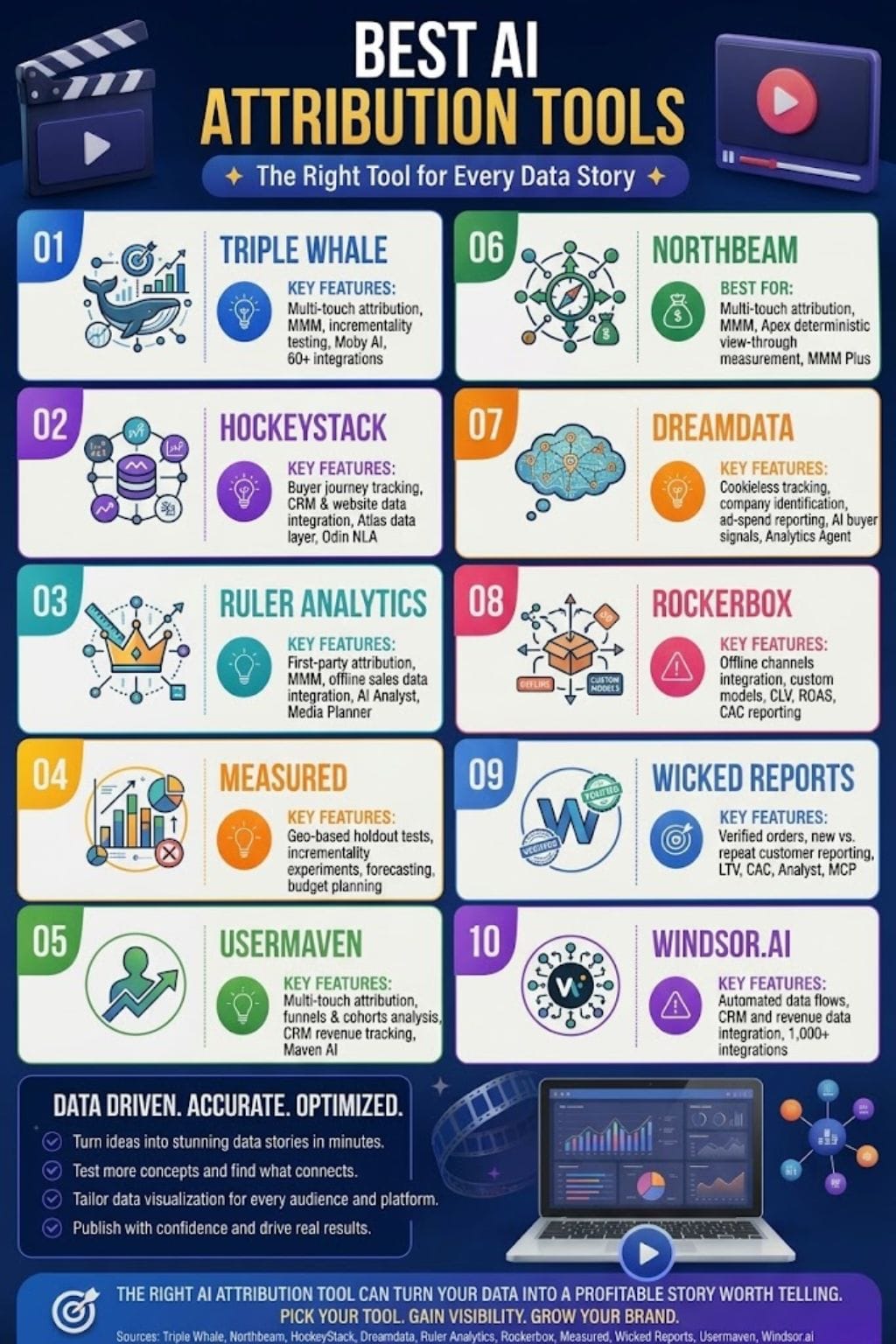
Some of the leading AI attribution tools include Triple Whale, Northbeam, HockeyStack, Dreamdata, Ruler Analytics, Rockerbox, Measured, Wicked Reports, Usermaven, and Windsor.ai.
What is the difference between multi-touch attribution and marketing mix modeling?
Multi-touch attribution analyzes individual customer journeys and assigns credit to specific touchpoints. Marketing mix modeling uses aggregated data to estimate the impact of different marketing channels on overall business results.
Can AI attribution tools improve marketing ROI?
Yes. By showing which channels, campaigns, and touchpoints contribute to conversions and revenue, these tools can help marketers identify better-performing investments and make more informed budget decisions.