I Tested 7 AI Tools to Analyse Competitor Campaigns. Here Is What I Found
Your competitors know what works. These tools help you find out. I tested seven AI tools for competitor campaign analysis across SEO, PPC, email, social, and traffic data to find the right fit for every type of marketing team.

If you have ever wondered why a competitor's ad keeps running for months while yours faded out in two weeks, the answer is probably in their data. They know what works. You do not. Not yet.
AI tools for competitor campaign analysis fix that. They track what competitors are running across search, social, email, and web, how long ads have been live, which keywords they bid on, how messaging shifts over time, and what gets engagement. Manually doing this across even three competitors would take a full-time researcher. These tools do it continuously and automatically.
I tested and researched the tools that consistently come up for this job, verified pricing from official sources, and noted what each one actually does well and where it falls short.
What to Look for in an AI Competitor Campaign Analysis Tool
The category covers several distinct jobs. Knowing which one you need saves money.
- Ad and campaign tracking shows what creative, copy, and offers competitors run across Google and Meta. SpyFu and Semrush specialise here.
- SEO and content intelligence shows which keywords competitors rank for and what content performs. Ahrefs and Semrush are the standard choices.
- Traffic and channel analysis estimates how much traffic a competitor gets and where it comes from. Similarweb leads this category.
- Social listening and sentiment monitors what people say about competitors on social media. Brandwatch and Panoramata cover this.
- Full campaign monitoring tracks competitor emails, landing pages, ad creative, and website changes in one place. Panoramata handles this for e-commerce brands.
Most teams use two or three tools in combination. No single tool covers every job equally well.
Quick Comparison of AI Tools for Competitor Campaign Analysis
| Tool | Best For | Key Feature | Free Plan | Starting Price | Website |
|---|---|---|---|---|---|
| Semrush | All-in-one SEO and PPC analysis | Keyword gap, ad history, traffic analytics, 55+ tools | Yes (10 queries/day) | $139.95/month | semrush.com |
| Ahrefs | SEO and backlink competitor research | Largest backlink index; Content Explorer; keyword gap | Yes (limited) | $129/month (Lite) | ahrefs.com |
| Similarweb | Traffic and channel mix analysis | Panel-based traffic estimates across all channels | Yes (limited) | $125/month (annual) | similarweb.com |
| SpyFu | PPC and ad history on a budget | 18 years of competitor ad history; keyword overlap | No | $39/month (Basic) | spyfu.com |
| Panoramata | Email, ad, and landing page tracking | Tracks competitor emails, ads, and SMS in one dashboard | Yes | $89/month (Startup) | panoramata.co |
| Brandwatch | Social listening at enterprise scale | Social monitoring across 100M+ sources | No | From $800/month | brandwatch.com |
| BuzzSumo | Content engagement and campaign analysis | Top-performing competitor content by shares and backlinks | Yes (limited) | $199/month | buzzsumo.com |
How I Selected These Tools
I assessed each tool on the following criteria:
- Coverage: Which channels and data types does it monitor?
- Accuracy: How reliable is the data compared to real-world signals?
- Ease of use: Can a marketer without a technical background extract useful insights?
- Actionability: Does it surface insights you can act on, not just raw data?
- Pricing value: Is the free tier usable, and does the paid plan deliver fair value?
- Integration: Does it connect to the platforms your team already uses?
What Is an AI Competitor Campaign Analysis Tool?
An AI competitor campaign analysis tool automatically collects, processes, and summarises data about how your competitors market themselves. Instead of manually visiting competitor websites, subscribing to their emails, or checking ad libraries, these tools do it continuously and present findings in a dashboard you can review in minutes.
Without a tool, you might notice a competitor's new ad if you happen to see it. With a tool like Panoramata or Semrush, you know about it within hours, you can see all the variants they tested, how long each ran, and how their messaging has shifted. That is the difference between reactive awareness and proactive intelligence.
How to Analyse Competitor Campaigns With AI Tools
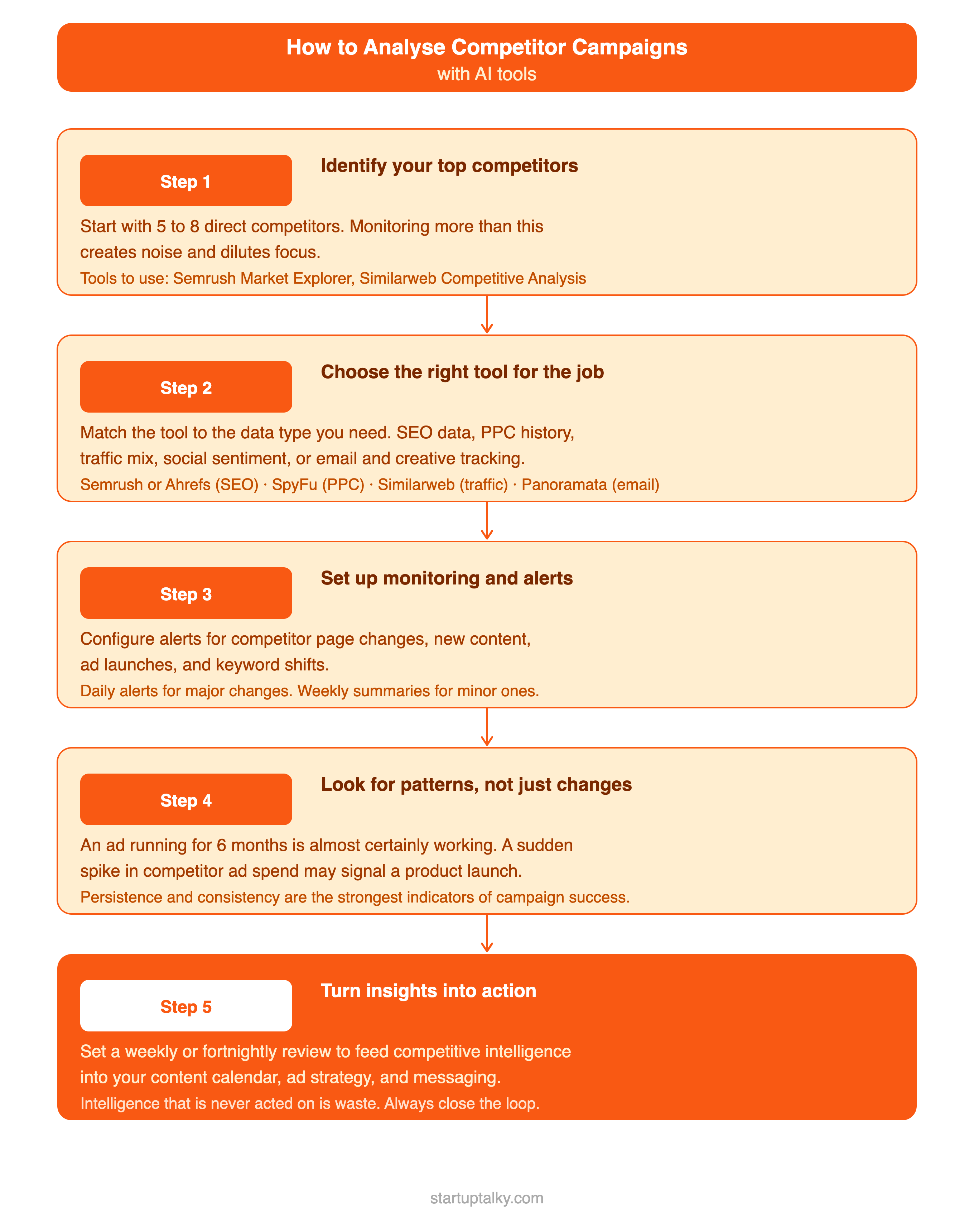
- Identify your top 5 competitors. Start narrow. Monitoring too many creates noise. Most practitioners recommend 5 to 8 direct competitors.
- Choose the right tool for the data type you need. Match the tool to the job: SEO data, PPC history, traffic mix, social sentiment, or email and creative tracking.
- Set up monitoring and alerts. Configure alerts for competitor page changes, new content, ad launches, and keyword shifts.
- Look for patterns, not just changes. An ad that runs for six months is almost certainly working. A sudden spike in ad spend may signal a product launch.
- Turn insights into action on a regular cadence. Set a weekly or fortnightly review to feed competitive intelligence into your content calendar, ad strategy, or messaging.
List of Best AI Tools to Analyse Competitor Campaigns
1. Semrush
Best for: Marketers who want one platform covering SEO, PPC, content, and social competitor research
Semrush is the most comprehensive competitor campaign analysis platform available. Want to know which keywords a competitor ranks for, which Google ads they run, how their traffic has grown, and how their content performs? Semrush covers all of it in one place. It is the most widely used digital marketing intelligence tool globally for exactly this reason.
Key Features
- Keyword Gap: surfaces keywords that competitors rank for that you do not target
- Advertising Research: reveals competitor Google ad copy, keywords, and estimated spend
- Traffic Analytics: estimates total visits, bounce rate, and channel breakdown
- EyeOn: monitors competitor websites and social changes in real time
- Domain Overview: full competitor profile in a single report
Pricing
| Plan | Monthly | Annual | Notes |
|---|---|---|---|
| Pro | $139.95 | $117.33 | 5 projects, 500 keywords, core tools |
| Guru | $249.95 | $208.33 | Historical data, content marketing toolkit |
| Business | $499.95 | $416.66 | API access, Share of Voice, high limits |
Free tier with 10 daily queries. 7-day free trial on paid plans. Trends add-on (traffic analytics) costs ~$289/month extra on Pro.
What Users Like
- Replaces 3 to 4 separate tools; the widest feature set in this list
- Keyword Gap analysis immediately surfaces content and ad opportunities
- EyeOn competitor alerts require no manual checking
Potential Drawbacks
- $139.95/month is the floor; add-ons and extra seats push real costs significantly higher
- Feature breadth creates a steep learning curve for new users
- Traffic estimates for smaller sites are less reliable
Best for: Digital marketing teams and agencies needing a single platform across SEO, PPC, and content competitor research.
 Sushree Sangeeta Behera
2. Ahrefs
Best for: SEO-focused teams who need the deepest backlink and keyword competitor data
Ahrefs is built around the largest commercial backlink index available, with over 35 trillion known links updated continuously. For understanding why a competitor ranks for a keyword and which content drives their organic traffic, Ahrefs is the most accurate tool available. Content Explorer lets you find a competitor's top-performing content by traffic, backlinks, or social shares, directly useful for campaign planning.
Key Features
- Site Explorer: full backlink profile, organic keywords, and top pages for any domain
- Keyword Gap: identifies competitor keywords you do not target
- Content Explorer: finds top-performing competitor content across the web
- Rank Tracker: monitors competitor keyword positions over time
- AI keyword clustering and content gap analysis added in 2025
Pricing
| Plan | Monthly | Annual | Notes |
|---|---|---|---|
| Starter | $29 | $29 | Limited access; exploration only |
| Lite | $129 | $103 | Most popular professional entry point |
| Standard | $249 | $199 | Unlimited searches; best for daily users |
| Advanced | $449 | $359 | Larger limits; additional seats |
| Enterprise | Custom | Custom | API access; maximum limits |
Free Webmaster Tools for verified site owners. No free trial on paid plans.
What Users Like
- Backlink data quality is rated as more accurate than Semrush by most SEO professionals
- Content Explorer finds competitor content opportunities that manual research misses
- Keyword click data (actual clicks, not just search volume) is unique to Ahrefs
Potential Drawbacks
- No PPC ad history or social media analysis; purely SEO and content focused
- Lite at $129/month is expensive relative to alternatives at the entry level
- Credit-based limits on lower tiers frustrate high-volume researchers
Best for: SEO professionals and content teams who need the most accurate backlink and keyword competitor intelligence.
Vivek Dev Jacob
3. Similarweb
Best for: Teams who need to understand total competitor traffic and channel mix
Similarweb answers a question no other tool addresses as well: how much traffic does a competitor actually get, and where does it come from? Using a panel-based measurement approach, it estimates total visits, bounce rates, time on site, and the breakdown between organic, paid, direct, referral, social, and email traffic. Use this when you want to know whether a competitor's campaign is actually driving traffic growth, not just keyword rankings.
Key Features
- Total traffic estimates across all channels for any domain
- Traffic source breakdown: organic, paid, direct, referral, social, and email
- Audience overlap: see how much of your audience also visits competitor sites
- Market Explorer: surfaces competitors you may not have identified
- AI brand visibility monitoring across AI discovery engines
Pricing
| Plan | Price | Notes |
|---|---|---|
| Starter | $125/month (annual) | 1 user; 3 months history |
| Professional | $333/month (annual) | 1 user; 6 months history |
| Team | ~$14,000/year | 5 users; contact sales |
| Business | ~$35,000/year | 5 users; contact sales |
| Enterprise | Custom | 10+ users; API; 37 months history |
7-day free trial. No permanently free plan.
What Users Like
- Only tool showing total traffic across all channels, not just organic or paid
- Audience overlap analysis identifies market positioning gaps
- Essential for benchmarking whether you are growing faster or slower than competitors
Potential Drawbacks
- Team and Business plans are significantly more expensive than alternatives
- Traffic estimates for sites under 50,000 monthly visits are less reliable
- Does not provide keyword-level ad data or creative analysis
Best for: Strategy and marketing teams who need to benchmark traffic growth and channel mix against competitors.
4. SpyFu
Best for: PPC teams who need competitor ad history at an affordable price
SpyFu holds 18 years of competitor Google ad data, making it uniquely useful for understanding long-term advertising strategy. You can see every keyword a competitor has ever bid on, every ad variant they tested, and how spend has shifted seasonally. At $39/month for the Basic plan, it is the most affordable specialist PPC intelligence tool in this list.
Key Features
- 18 years of Google Ad history for any competitor domain
- Kombat tool: visual map of keyword overlap between you and two competitors
- Google Ads copy and headline history for all competitor campaigns
- PPC competitor grouping: see which rivals bid on the same keywords
- Estimated monthly ad spend and keyword count per competitor
Pricing
| Plan | Price | Notes |
|---|---|---|
| Basic | $39/month | Core PPC and SEO data; unlimited searches |
| Professional | $79/month | API access, custom reports |
| Team | $299/month | Multi-client tracking, daily rank updates |
30-day money-back guarantee. No free trial.
What Users Like
- 18-year ad history reveals long-term competitor advertising patterns other tools miss
- Kombat tool makes keyword overlap immediately visual and actionable
- Basic plan gives serious PPC intelligence at a fraction of Semrush's cost
Potential Drawbacks
- Data accuracy is lower than Semrush and Ahrefs for organic search metrics
- Social media and email campaign tracking are not covered
- Interface is less polished than newer tools in the category
Best for: Small teams and agencies that primarily need PPC competitor data at a budget-friendly price.
Ipsita Acharya
5. Panoramata
Best for: E-commerce and DTC marketers tracking competitor email, ad, and landing page campaigns
Panoramata tracks what competitors send to their email subscribers, which ads they run, what their landing pages say, and how all of it changes over time. Unlike most tools in this list that focus on SEO or PPC data, Panoramata is built specifically for campaign creative intelligence. It covers 80,000+ brands across 100+ industries and uses AI to summarise competitor activity into a weekly digest.
Key Features
- Tracks competitor email campaigns, ad creative, landing pages, and SMS
- AI-generated weekly summaries of competitor marketing activity
- Real-time benchmarks comparing your brand to competitors across channels
- AI Assistant: ask questions about competitor strategy and get direct answers
- Covers 80,000+ brands across 100+ industries and 80 countries
Pricing
| Plan | Price | Notes |
|---|---|---|
| Free | $0 | Limited competitor tracking |
| Startup | $89/month | 6 months history; core tracking |
| Professional | $149/month | 3 years history; 10 users |
| Unlimited | $399/month | 20 users; unlimited brand tracking |
What Users Like
- Email campaign tracking fills a gap that Semrush and Ahrefs do not cover
- Weekly AI summaries save time for teams that cannot check dashboards daily
- A startup plan at $89/month is accessible for smaller ecommerce teams
Potential Drawbacks
- Less useful for SEO-focused teams who need keyword or backlink data
- The startup plan's 6-month history limit is restrictive for trend analysis
- Smaller brand database for niche or B2B industries
Best for: E-commerce and DTC marketers who need to track competitor email, ad creative, and landing page campaigns.
6. Brandwatch
Best for: Enterprise teams monitoring competitor social campaigns and brand sentiment at scale
Brandwatch monitors competitor mentions, campaign sentiment, and brand conversations across 100 million+ sources including social networks, forums, news, and review sites. For PR and communications teams that need to track how competitor campaigns land with audiences and whether brand sentiment is shifting, it provides the most comprehensive social intelligence available.
Key Features
- Monitors 100M+ sources: social, news, forums, and review sites
- AI-powered sentiment analysis across competitor brand mentions
- Crisis detection alerts for rapid brand risk monitoring
- Custom dashboards for competitive brand intelligence
- Integrates with Salesforce, HubSpot, and major social platforms
Pricing
| Plan | Price | Notes |
|---|---|---|
| Essentials | From $800/month | 10,000 mentions; contact for exact pricing |
| Enterprise | Custom | Average contract ~$50,000/year |
No free plan or trial. Requires a sales conversation.
What Users Like
- Depth of social listening is unmatched for enterprise brand intelligence
- AI sentiment analysis surfaces shifts in competitor brand perception early
- Historical social data going back years provides genuine trend context
Potential Drawbacks
- Enterprise pricing places it out of reach for most small and mid-size teams
- Requires meaningful onboarding before delivering full value
- Broad listening does not automatically address specific campaign performance metrics
Best for: PR and communications teams at large brands that need deep social monitoring of competitor campaigns at enterprise scale.
7. BuzzSumo
Best for: Content marketers analysing which competitor content drives the most engagement
BuzzSumo answers one question faster than any other tool in this list: what content is working for your competitors right now? Enter a competitor domain, and BuzzSumo returns their top-performing content sorted by social shares, backlinks, or engagement. Set up alerts to be notified when competitor content gains traction. For content teams building editorial calendars, it is the fastest way to identify proven topics before investing in production.
Key Features
- Content analysis by social shares, backlinks, and engagement for any domain
- Trending content alerts when competitor content gains traction
- Influencer identification across competitor campaign topics
- Question Analyser: surfaces audience questions about competitor topics
- Domain comparison: benchmark your content performance against competitors
Pricing
| Plan | Price | Notes |
|---|---|---|
| Content Creation | $199/month | 1 user; 5,000 searches/month |
| PR and Comms | $299/month | 5 users; media database access |
| Suite | $499/month | 10 users; full platform |
| Enterprise | Custom | Unlimited users; API access |
Free tier with limited daily searches.
What Users Like
- Fastest way to find competitor content that actually earns shares and backlinks
- Trending alerts enable quick reaction to competitor content launches
- Question Analyser surfaces content gaps that keyword tools miss
Potential Drawbacks
- $199/month is expensive for what is primarily a content research tool
- Does not cover PPC ads, email campaigns, or traffic analytics
- Social share data accuracy has declined as platforms restrict third-party access
Best for: Content marketers and SEO teams who want to identify competitor content formats and topics that drive the most engagement.
Vivek Dev Jacob
Best AI Competitor Campaign Analysis Tools by Use Case
- Best for PPC and ad research on a budget: SpyFu at $39/month gives 18 years of Google ad history at a price no other tool matches.
- Best for SEO competitor research: Ahrefs for backlinks and content depth. Semrush, if you also need PPC and social data in the same platform.
- Best for traffic and channel intelligence: Similarweb. No other tool provides cross-channel traffic estimates with the same accuracy.
- Best for email and campaign creative tracking: Panoramata. Covers email, ads, and landing pages for e-commerce and DTC brands specifically.
- Best for social listening and sentiment: Brandwatch for enterprise scale. BuzzSumo for content engagement at a lower price point.
- Best all-in-one platform: Semrush. Covers more ground than any single alternative, though individual specialists often outperform it in specific areas.
Final Thoughts
No single tool in this list does everything. The most effective competitive intelligence setups combine tools by data type.
For most marketing teams, the practical starting stack is Semrush or Ahrefs for SEO and keyword data, plus one campaign-specific tool: SpyFu for PPC, Panoramata for email and creative, or Brandwatch for social. Add Similarweb when you need to benchmark total traffic and channel mix.
If your budget allows only one tool, start with Semrush. It covers the most ground and has a free tier that gives you enough to test before committing.
The tools that surface insights you never acted on are a waste. Start with the channels where competitive gaps hurt you most, and build from there.
FAQs
What is the best free AI tool for competitor campaign analysis?
Semrush's free tier allows 10 searches per day at no cost, which covers basic keyword and competitor domain lookups. Ahrefs Webmaster Tools is free for verified site owners but only covers your own domain. For social monitoring, Google Alerts provides free keyword-based competitor mention tracking.
Can AI tools track competitor social media campaigns?
Yes. Brandwatch monitors competitor social campaigns across 100 million+ sources with AI sentiment analysis. BuzzSumo tracks content engagement on social platforms. Panoramata monitors competitor social ads alongside email and landing page campaigns.
How do I know which competitor campaigns are actually working?
Look for patterns over time, not individual data points. An ad that runs for six months is almost certainly performing. SpyFu surfaces ad copy that has run longest. Semrush shows which competitor pages drive the most organic traffic. BuzzSumo identifies which content earns the most shares and backlinks. Persistence is the clearest signal.
How many competitors should I track with these tools?
Start with three to five direct competitors. Most practitioners recommend no more than 5 to 8 direct competitors at once. Tracking more creates noise and makes it harder to act on insights. Establish a weekly review cadence before expanding your monitoring list.