Free vs Paid AI Marketing Tools for Small Businesses (Complete Guide)
Learn when to upgrade to paid AI tools, how to build a smart AI strategy, and the best tool stack for small businesses to scale marketing effectively.

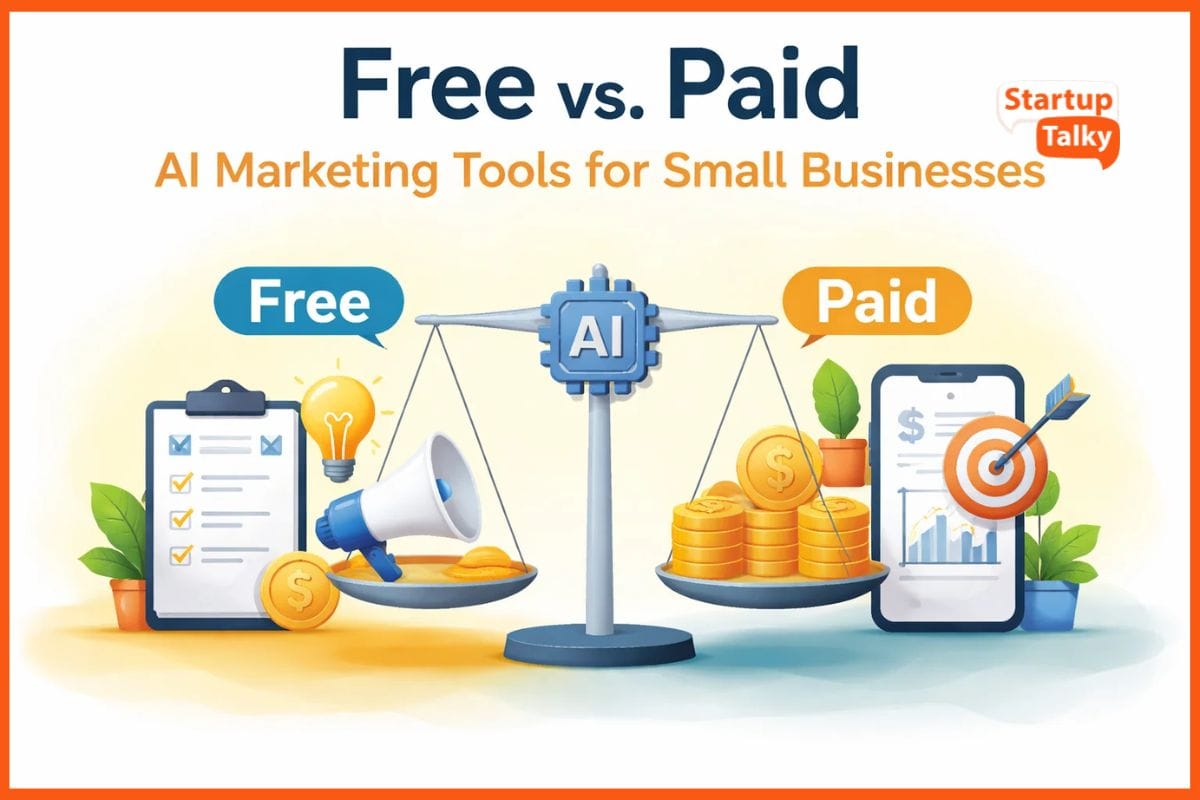
Free AI tools such as website creators, content assistance, social scheduling, basic analytics, and minor automation are available to small businesses at no cost for use in experimentation with marketing ideas with very little risk.
All these tools are ideal for validating small-scale initiatives with small teams.
Paid AI platforms do much more than that: deeper automation; intelligent segmentation; A/B testing; and clear reporting across all channels, as well as better support and reliability. The best way is to stay lean at first with free tools, learn what works, and track results.
AI Marketing Tools Comparison Table
| Tool | Best For | Key Features | Pricing Level | Drawbacks |
|---|---|---|---|---|
| ChatGPT | Content creation & ideas | Blogs, ads, SEO, chatbot replies | Free / Paid | Needs prompt quality |
| Grammarly | Writing improvement | Grammar, tone, clarity suggestions | Free / Paid | Limited AI in free plan |
| Canva AI | Design & visuals | Magic Design, Write, Media | Free / Paid | Limited advanced control |
| Mailchimp | Email marketing | Automation, AI copy, send-time optimization | Free / Paid | Limited automation in free plan |
| Hootsuite | Social scheduling | Post scheduling, hashtags, analytics | Free / Paid | Limited features free |
| Copy.ai | Marketing copy | Templates, workflows, automation | Paid | Subscription cost |
| Surfer SEO | SEO optimization | Content editor, keywords, audits | Paid | Learning curve |
| Canva Magic Studio | Advanced design | Image/video AI, editing tools | Paid | Cost for full features |
| HubSpot AI | CRM + marketing | Automation, chatbots, analytics | Paid | Complex setup |
| AdCreative.ai | Ad generation | Ad creatives, scoring, insights | Paid | Cost + dependency |
ChatGPT
ChatGPT, delivered at no charge by OpenAI, offers remarkable potential for small-business marketing through artificial intelligence. With the inclusion of content, planning, and customer engagement, you could write everything from emails, social posts, blogs, and ad copy that converts.
There is also the ability to generate ideas for keywords, SEO outlines, FAQs, and replies from chatbots. Review customer feedback to carefully refine your message and tone. You can also conceptualize campaign ideas, offers, and angles for the ideal target audiences.
This is saving big time for small teams, cutting costs, hiring fewer staff, and enhancing outreach.
Grammarly
Grammarly is a very useful free AI tool for small business marketing teams. It helps people write clear, clean, and in-brand content across emails, blogs, and social posts. The free version has real-time grammar and spelling checks that quickly correct small mistakes.
It can also give tone suggestions and add some light clarity tips to make messages sound more professional. These would help boost trust and read in every campaign. The free plan also has limited AI text generation.
Marketers may use it to generate a quick idea on how to create email subject lines and social captions.
Canva AI Features
Canva's AI tools enable companies to fast-track their on-brand marketing efforts with no design expertise. Bringing together visuals, copy, and content reuse in one place enhances team efficiency.
Some free features, for instance, Magic Design, provide ready-made layouts, while Magic Write builds captions and ad copy in seconds. From simple prompts, Magic Media generates images and short videos.
Canva also assists with AI-assisted social posts, basic photo editing, and an intuitive drag-and-drop template interface. Altogether, these tools make it simple to maintain brand consistency and create high-impact multi-channel campaigns with relatively low costs and effort.
 Alan Joseph
Mailchimp (Free Plan)
Small businesses can take advantage of using Mailchimp's free plan as an easy way to create an AI-powered marketing hub for email and some light automation.
The team now helps a reader craft better emails using AI-powered copy suggestions to draft or edit content much faster. With the Creative Assistant, you can create beautiful, on-brand designs without having any design skills.
Send-time optimization will select the best day and hour of the week for your subscribers. Ready-made automations welcome new subscribers by sending trigger-based campaigns for neglected carts or win-back campaigns.
Hootsuite AI Scheduler
Hootsuite's AI-based free social media scheduler essentially helps the hinge of any small business to manage its time optimally, along with the organization required to coordinate all social content into a single, simple dashboard.
Users can schedule an infinite number of posts to the network. They can write captions by AI, think about smart hashtag ideas, and post at the best times for the outreach of a broader audience.
Teams coordinate schedules with a shared content calendar: they also design quick, on-brand visuals using built-in access to Canva. An integrated inbox allows for easy replies to comments and messages. Clear analytics let users see what's best at work, allowing businesses to improve results without any additional tools or costs.
Copy.ai
Copy.ai is a tool made for small businesses that want faster marketing output. It is a paid artificial intelligence tool that helps to develop ads, blogs, product descriptions, and emails under ready-made templates.
Teams can now set up workflows to run campaigns end-to-end from lead nurturing to follow-up emails. Time is saved, as well as reducing manual work. The AI keeps writing in line with your brand voice and tone.
It also connects with common sales and marketing tools for smoother execution overall. So basically, it creates speed, clarity, and productivity in small, lean marketing teams.
Surfer SEO
Surfer SEO essentially stands as an artifice, especially for small businesses that seek overt good in organic search results. SEO data meets AI writing assistance to help in guiding the content creation process.
The Content Editor issues live scores, keyword ideas, and structural tips based on the top-ranking pages; this allows writers to meet search intent with ease.
Surfer SEO is also helpful in content audits, internal linking, checking for plagiarism, and rank tracking to the extent that one wants it. Surfer SEO works well within WordPress and Google Docs. Its interface is intuitive and user-friendly.
Canva Magic Studio
Canva Magic Studio is a fee-based AI design toolkit for small business owners. All creation, editing, and automation are brought together under one easy platform.
With Magic Media, users can transform text inputs into images or videos in a matter of minutes. Magic Write helps write coherent marketing copy. Magic Switch helps to instantly change the size and format of designs.
Advanced solutions such as Magic Edit, Magic Erase, and background removal make light work of photo editing. Small teams can fast-track their way through creating ads, social posts, presentations, and website visuals.
HubSpot AI Marketing Hub
HubSpot AI Marketing Hub provides application-based services for managing small businesses' marketing and customer relationship management operations in a single, simple, computer-based interface platform.
It combines campaign planning, customer data, and automation in one platform. Teams can visually design campaigns, send smart emails written and personalized by AI, and target audiences in real-time using live data.
AI chatbots will capture leads while the business is open or not, and behavior will refine how we target them to improve ad results. In-built analytics clarifies what works and what needs to be done next.
AdCreative.ai
AdCreative.ai is an affordable AI tool that supports smaller businesses in developing more effective and faster ads without needing a large team.
The tool generates ad creatives or social media posts or writes copy within seconds just by inputting simple details like product images and brand identification. Users produce ready ads in bulk for each platform.
It evaluates creatives based on possible effective results and indicates those likely to convert. It ensures designs remain strictly within the brand by using prefabricated templates. Built-in analytics display winning ads and competitor insights that semi-supercharge teams into executing faster tests.
Free vs Paid AI Tools: Pros and Cons
Free Tools: Pros and Cons
They are free, leading to being more experimental or used on extremely lean budgets, while once a business scales and requires reliability and deeper insights, paid solutions come in handy. The choice depends on campaign complexity, budgets spent, and growth objective.
| Free tools – Pros | Free tools - Cons |
|---|---|
|
|
Paid Tools: Pros and Cons
| Paid tools- Pros | Paid tools- Cons |
|---|---|
|
|
Final Thoughts
It's an excellent idea to use free AIs for testing ideas, validating channels, and understanding how automation fits without incurring financial loss in the existing workflows.
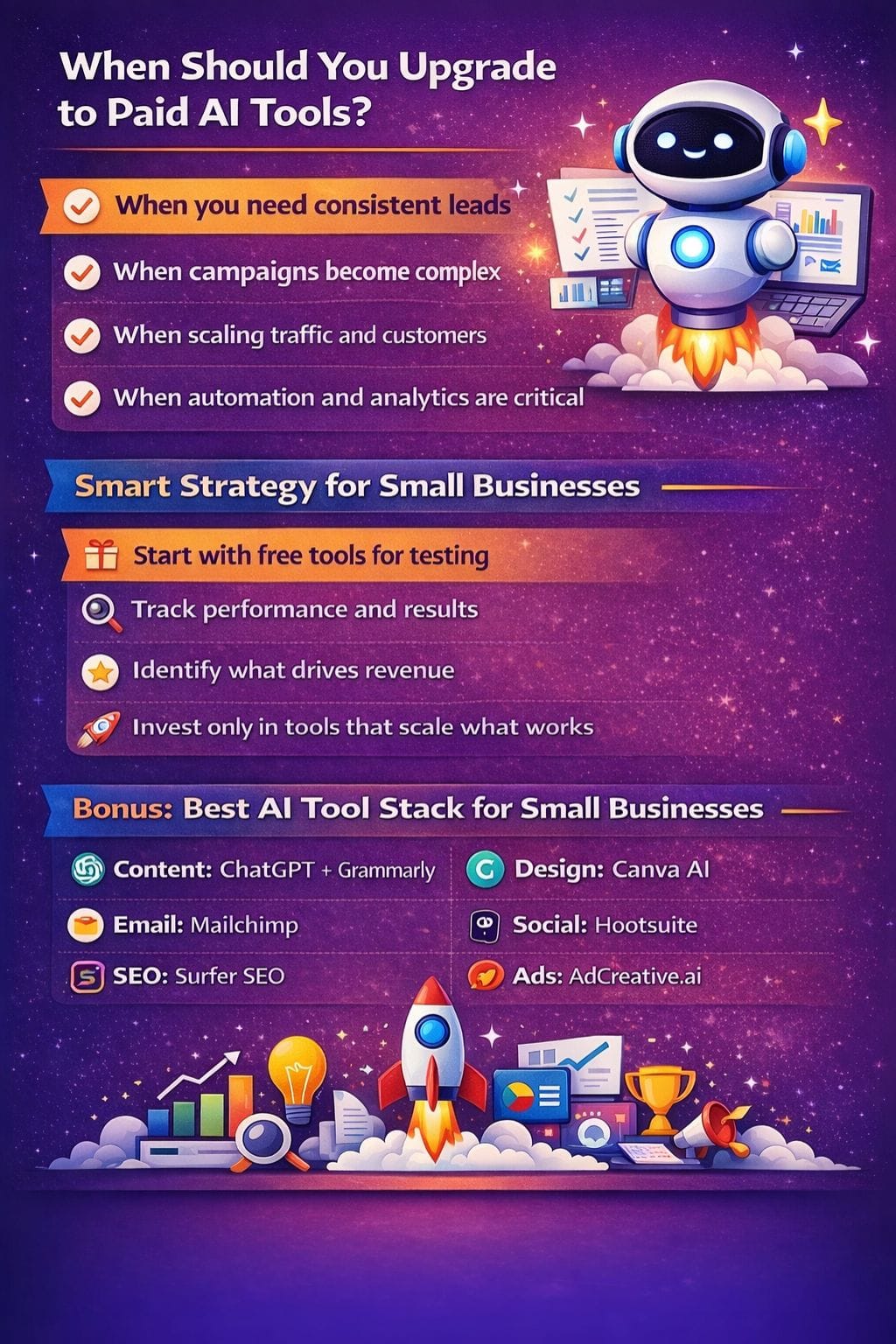
However, the limits concerning volume, integrations, and support become apparent as soon as campaigns are scaled or customer journeys become more complicated. Paid solutions make sense for consistent leads, higher traffic, or growing lists that require more precise targeting and deeper automation with reliable analytics to guide spend.
For a small business, starting with experimentation through free offers, understanding what really drives revenue, and gradually investing in selective paid capabilities, amplifying what has proven to be effective, is the most suitable pathway towards campaign perfection.
The winning formula:
Start lean → validate → scale smartly
FAQs
When should a business upgrade to paid AI tools?
A business should upgrade to paid AI tools when it needs consistent leads, handles complex campaigns, scales traffic and customers, or requires advanced automation and analytics.
Why start with free AI tools first?
Starting with free AI tools allows businesses to test ideas, experiment with marketing strategies, and understand what works without any financial risk.
How can small businesses build an effective AI strategy?
Small businesses should begin with free tools, track performance, identify what drives revenue, and then invest only in tools that help scale successful strategies.
What is the best AI tool stack for small businesses?
A strong AI stack includes ChatGPT and Grammarly for content, Canva AI for design, Mailchimp for email marketing, Hootsuite for social media, Surfer SEO for optimization, and AdCreative.ai for ads.