
10 Best AI Prompt Enhancement Tools to Improve AI Responses (2026)
Looking for the best AI prompt enhancement tools? Compare the top 10 prompt optimization platforms, including PromptPerfect, Braintrust, AIPRM, PromptHub, and more, to create better AI prompts, improve response quality, and streamline prompt engineering workflows.

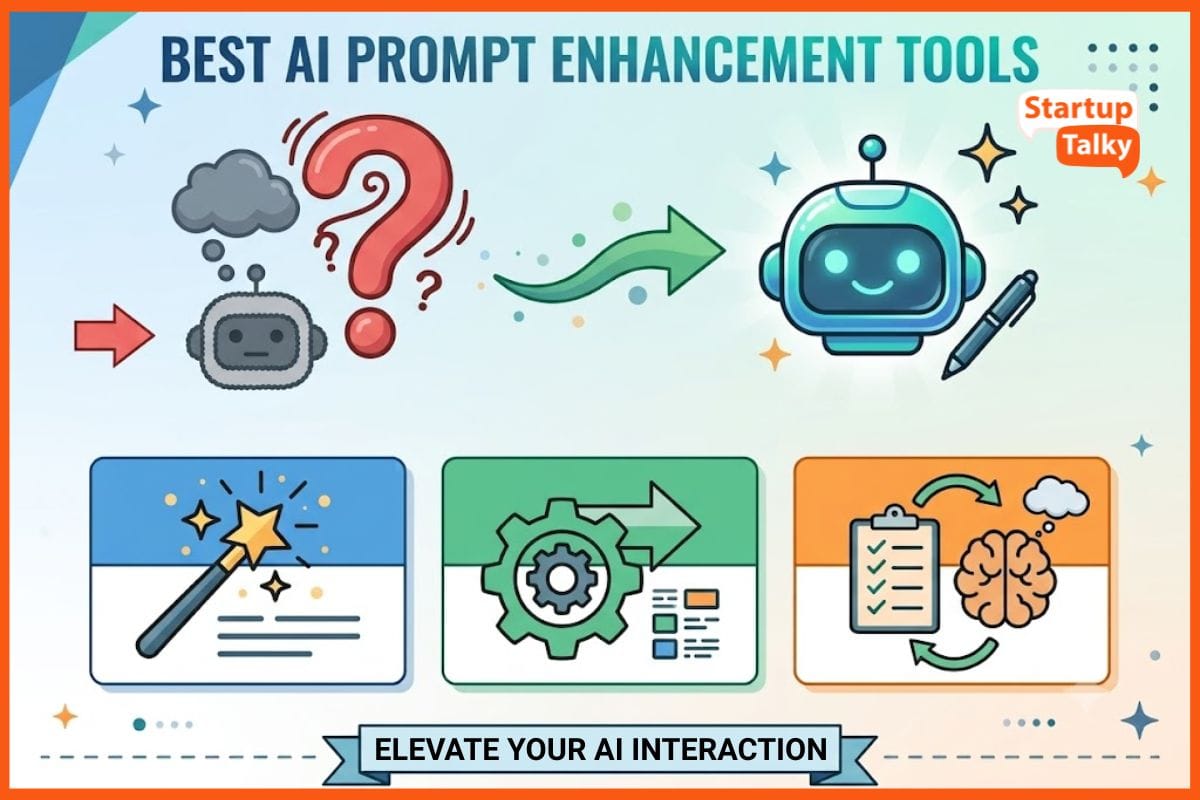
An AI prompt enhancement tool helps you turn simple ideas into clear and detailed prompts that produce better results. Instead of guessing what the AI needs, the tool fills in missing details, improves the structure, and suggests the right tone and instructions.
You only need to enter a basic request, and it rewrites it into a prompt that is easy for any AI model to understand. This saves time, reduces trial and error, and gives you more consistent answers. For businesses and teams, it also creates a standard way to write prompts.
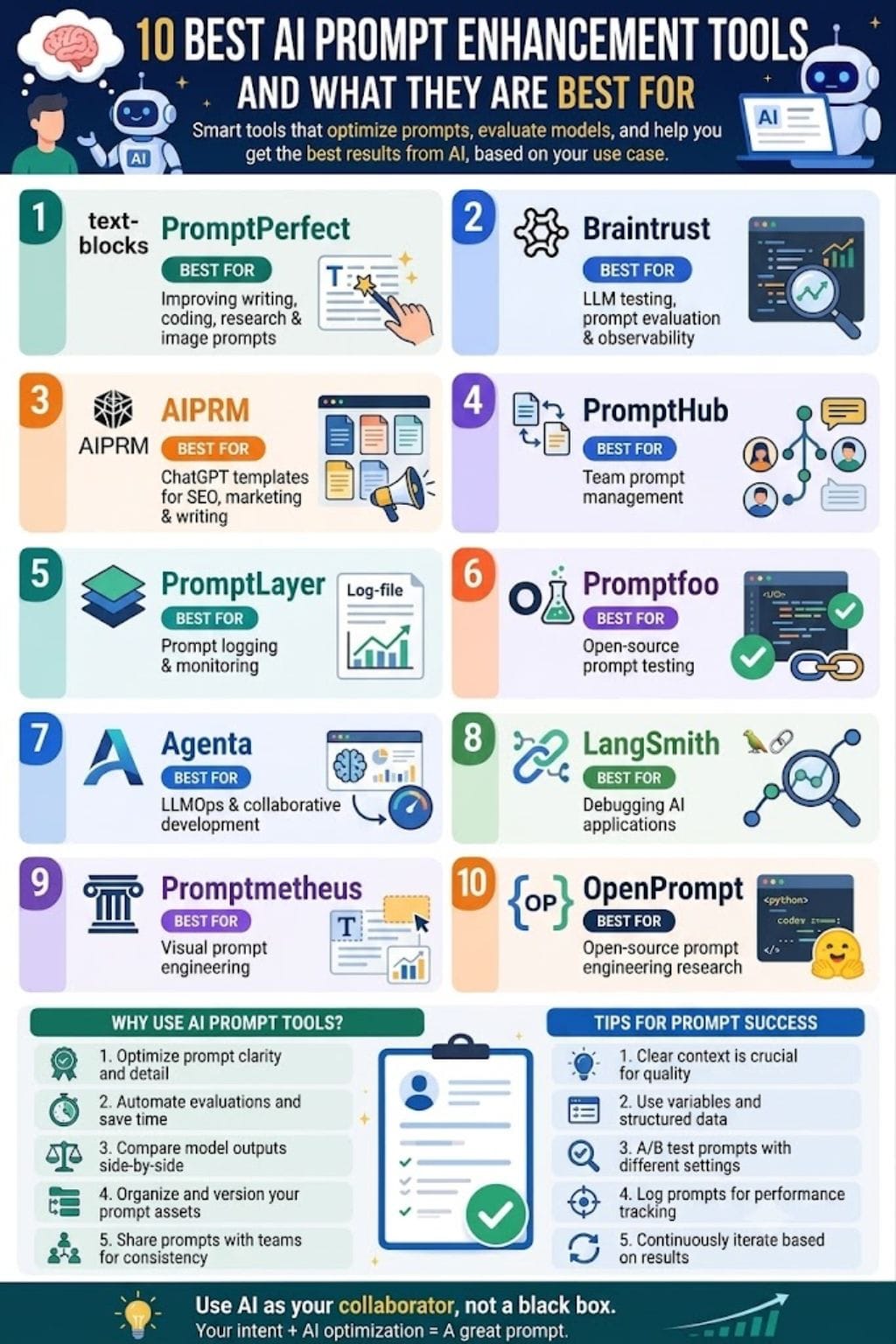
AI Prompt Enhancement Tools Comparison
| Tool | Best For | Key Features | Pricing Level | Drawbacks |
|---|---|---|---|---|
| PromptPerfect | Improving prompts for writing, coding, research & image generation | Prompt optimization, context enhancement, structured prompts | Medium | Best value for frequent AI users |
| Braintrust | LLM testing, prompt evaluation & observability | Tracing, versioning, prompt testing, deployment labels | High | Technical and developer-focused |
| AIPRM | ChatGPT prompt templates for SEO, marketing & writing | Prompt library, private prompts, filters, Chrome extension | Low–Medium | Dependent on community prompt quality |
| PromptHub | Team prompt management | Version control, AI prompt enhancer, collaboration | Low–Medium | Too advanced for solo users |
| PromptLayer | Prompt logging & monitoring | Logging, evaluations, A/B testing, governance | Custom | Requires API integration |
| Promptfoo | Open-source prompt testing | Batch testing, CI/CD integration, red teaming | Custom | CLI-based with learning curve |
| Agenta | LLMOps & collaborative prompt development | Prompt playground, evaluations, production monitoring | Medium–High | Self-hosting requires technical skills |
| LangSmith | Debugging AI applications | Tracing, evaluations, datasets, prompt hub | Custom | Focused mainly on LangChain ecosystem |
| Promptmetheus | Visual prompt engineering | Drag-and-drop builder, analytics, reusable blocks | Medium | Extra platform to manage |
| OpenPrompt | Open-source prompt engineering research | Prompt templates, Hugging Face support, modular framework | Low | Requires Python knowledge |
PromptPerfect
PromptPerfect is an AI tool that helps you write better prompts for language and image models. Instead of using short or unclear requests, it turns your ideas into clear, detailed instructions that are easier for AI to understand. This helps improve accuracy, relevance, and the overall quality of responses.
The tool can identify missing details, suggest useful context, and organize your prompt into a simple, structured format. It works well for tasks like writing, coding, research, brainstorming, and image creation. By reducing guesswork and repeated edits, PromptPerfect saves time and cuts down on wasted tokens.
Pros
- Easy for non-experts to get strong, ready-to-use prompts
- Improves clarity and consistency across many AI use cases
- Helps reduce trial and error, saving tokens and time
Cons
- Best value shows only if you use AI heavily and often
- Extra step in the workflow compared with typing straight into a model
Pricing
| Plan | Pricing |
|---|---|
| Pro | $19.99/month |
| Pro Max | $99.99/month |
Braintrust
Braintrust helps teams build better AI applications by making it easy to test, track, and improve prompts. It stores every model call in one place, so you can compare prompt versions, models, and settings using real or synthetic datasets.
Teams can review outputs side by side, measure quality, monitor cost and latency, and decide what works before deploying changes. Built-in tracing gives clear visibility into every AI request, while prompt versioning supports production, canary, and custom releases.
Braintrust also works with popular LLM frameworks and offers hybrid deployment, allowing sensitive data to remain in your own cloud.
Pros
- Code‑first design fits engineering‑heavy teams that live in Git and SDKs
- Very deep observability with fine‑grained traces and scoring for serious evaluation
- Clean deployment model with labels and caching, so prompt fetches add no extra latency
Cons
- Technical UI and code‑centric workflows can feel heavy for non‑engineers
- Focuses on observability and prompt management rather than full agent lifecycle or guardrails
Pricing
| Plan | Pricing |
|---|---|
| Pro | $249/month |
| Enterprise | Custom Pricing |
AIPRM
AIPRM is a Chrome extension that adds a large prompt library to ChatGPT. It helps you find and use ready-made prompts for tasks like SEO, content writing, marketing, coding, and more. Instead of creating prompts from scratch, you can choose from thousands of templates shared by the community with a single click.
You can also save your own private prompts and organize them for future use. The extension lets you filter prompts by topic, language, tone, or AI model, making it easy to find the right one. It saves time, improves consistency, and helps both beginners and experienced users.
Pros
- Speeds up clip creation from long-form video with automated highlight detection and clipping
- Adds AI subtitles, emojis, and progress bars to boost engagement
- Beginner-friendly interface with templates, branding, and resizing for major social platforms
Cons
- Relies on existing footage and cannot create fully original videos from scratch
- Does not always remove silences and fillers perfectly; may need manual tweaks
Pricing
| Plan | Pricing |
|---|---|
| AIPRM Plus | $20/month |
| AIPRM Pro | $39/month |
| AIPRM Elite One | $79/month |
| AIPRM Titan | $999/month |
 Vivek Dev Jacob
PromptHub
PromptHub helps teams build and manage prompts for AI applications. It keeps all prompts in one place, making them easy to organize, update, and share. Teams can test different prompt versions, compare results, and improve performance before using them in production.
Built-in AI tools help refine wording, logic, and tone to produce more consistent outputs. PromptHub also supports version control, so changes can be tracked like software code. Reusable templates save time and encourage collaboration across product, data, and content teams.
By making prompt engineering more organized and reliable, PromptHub helps teams develop, test, and deploy better AI prompts.
Pros
- Strong version control and history for prompts
- Built-in enhancers for wording, reasoning, and personas
- Team-focused collaboration with shared libraries
Cons
- Overkill for solo or casual users
- Learning curve for non-technical stakeholders
Pricing
| Plan | Pricing |
|---|---|
| Pro | $12/month |
| Team | $20/user/month |
| Enterprise | Custom Quote |
PromptLayer
PromptLayer helps teams manage and improve the prompts they use with AI models. It sits between your app and the LLM API, logging every request along with useful details like cost, latency, and token usage. A simple dashboard lets you search, compare, version, and roll back prompts when needed.
Teams can build reusable prompt templates, run A/B tests, and check prompt quality through evaluation pipelines. It also supports collaboration with roles, audit logs, and governance features.
By making prompt management organized and measurable, PromptLayer helps teams build more reliable AI products and ship new features with greater confidence.
Pros
- Makes prompt changes safe with history, versions, and rollbacks
- Great for teams that need visibility across many prompts and apps
- Reduces debugging time by centralizing logs and evaluations
Cons
- Requires integration effort into existing code and workflows
- Focuses on structured prompt ops, so solo creators may find it heavy
Pricing
Request for Pricing (RFP)
Promptfoo
Promptfoo is an open-source tool that helps teams test and improve AI prompts before they go live. It makes it easy to compare prompts across different AI models, run large batches of tests, and find weak spots in your workflows.
You can create test cases using simple configuration files and score the results based on your goals. Its clear reports show which prompts perform best for each use case.
Promptfoo also works with CI/CD pipelines, so prompt tests run automatically whenever changes are made. This replaces trial and error with a simple, repeatable process.
Pros
- Open source and local‑first, so tests and prompts can stay in your stack
- Developer‑friendly CLI with caching, live reload, and YAML‑based test configs
- Strong red‑teaming tools for jailbreak, injection, and risk scanning
Cons
- CLI focus can be steep for non‑technical teams used to no‑code dashboards
- Setup and test design take time if you lack clear prompt quality metrics
Pricing
Request for Pricing (RFP)
Vivek Dev Jacob
Agenta
Agenta is an open-source LLMOps platform that helps teams design, test, and refine prompts with a shared UI, version control, and built-in evaluation workflows. It offers a unified playground to compare prompts and models side by side, track every change, and log production traces so you can turn failures into test cases.
Teams can run automated and human evals, integrate custom evaluators, and monitor performance to spot regressions. Non-technical stakeholders get a safe interface to edit prompts without touching code, while developers plug it into existing stacks via popular LLM frameworks
Pros
- Open-source and MIT-licensed, so you can self-host and adapt it to your stack
- Unified prompt playground for side-by-side model and prompt experiments
- Integrates with LangChain, LlamaIndex, OpenAI, and other major frameworks
Cons
- Setup and self-hosting can be harder for small teams without DevOps support
- Best suited to teams building ongoing LLM products rather than casual users
Pricing
| Plan | Pricing |
|---|---|
| Pro | $49/month |
| Business | $399/month |
| Enterprise | Custom Pricing |
LangSmith
LangSmith is a platform built for developers who work with AI models and prompts. It helps you create, test, and improve prompts in one place. You can edit prompts, view model traces, and track token usage with an easy visual interface. It also lets you turn real user interactions into datasets for testing.
You can compare different prompts or models, run evaluations, and see which version performs better. Built-in version history and a shared prompt hub make it easy for teams to work together and reuse successful prompts. This reduces trial and error and helps developers improve.
Pros
- Strong for debugging complex agent and app flows
- Great visibility into real-world performance over time
- Encourages test-driven, data-driven prompt changes
Cons
- Geared toward developers; non-technical users may feel lost
- Tied closely to one ecosystem, which may limit flexibility
Pricing
Request for Pricing (RFP)
Promptmetheus
Promptmetheus is a visual prompt IDE that helps you design, test, and refine complex prompts for large language models in one place. It acts like a control room for your AI instructions, with drag-and-drop building blocks, reusable components, and real-time feedback on how each version performs.
You can compose prompts as modular blocks, run side-by-side tests across models, and track results with clear analytics. This makes it easier to ship reliable AI flows, keep prompts organized as your use cases grow, and collaborate with teammates on the same canvas without losing context or version history.
Pros
- Visual drag-and-drop prompt builder that suits non-coders and technical teams.upgrad+1
- Modular blocks let you reuse parts of prompts across projects and flows
- Built-in testing and analytics to benchmark prompts and models in one view
Cons
- Best value shows up for teams; solo users might not use all the advanced features
- Extra tool to manage alongside your existing AI platforms and dev stack
Pricing
| Plan | Pricing |
|---|---|
| Single | $29/month |
| Team | $99/month |
Rishi Mundra
OpenPrompt
OpenPrompt is an open-source tool that helps developers build, test, and improve prompt-based applications for large language models. It provides a simple way to create prompt templates, add dynamic inputs, and compare results across different AI models. Since it works with multiple pretrained models, you can switch between them without rewriting your prompts.
It also connects with Hugging Face Transformers, making it easy to use popular language models. Its modular design lets teams create reusable prompt components and customize workflows for different projects.
This makes OpenPrompt a practical choice for testing ideas, running experiments, and building reliable AI applications.
Pros
- Open‑source and highly customizable for research and production
- Encourages clean, modular prompt engineering practices
- Eases experimentation with many models from one codebase
Cons
- Geared to developers; not ideal for non‑technical users
- Requires Python and ML tooling knowledge to use well
Pricing
| Plan | Pricing |
|---|---|
| Pro | $5/month |
| Pro+ | $10/month |
| Pro++ | $20/month |
How to Choose the Right AI Prompt Enhancement Tool
Choosing the right AI prompt enhancement tool depends on how you use AI and the features you need. Some tools are designed for individuals who want better prompts, while others focus on prompt management, testing, and collaboration for development teams. Understanding your workflow will help you select the most suitable platform.
Here are a few factors to consider before making your decision:
- Ease of Use: Look for an intuitive interface if you're new to prompt engineering. Tools with ready-made templates and prompt suggestions are ideal for beginners.
- Prompt Optimization: The best tools automatically improve prompt clarity, add missing context, and organize instructions to generate more accurate AI responses.
- Testing and Evaluation: If you're developing AI applications, choose software that supports prompt comparisons, A/B testing, automated evaluations, and performance tracking.
- Collaboration Features: Businesses and teams should look for shared prompt libraries, version control, access management, and collaboration tools that make prompt development more organized.
- AI Model Compatibility: Ensure the platform supports the language models you use, such as OpenAI, Anthropic, Google Gemini, Meta Llama, or other popular LLMs.
- Pricing: Compare pricing plans based on your usage. Individual users may only need affordable plans, while enterprises often benefit from premium collaboration and monitoring features.
- Integrations: Consider whether the tool integrates with your existing workflow, including APIs, GitHub, LangChain, LlamaIndex, IDEs, or CI/CD pipelines.
By evaluating these factors, you can choose an AI prompt enhancement tool that fits your workflow, improves the quality of AI-generated responses, and helps you create effective prompts more efficiently.
Final Thoughts
An AI prompt enhancement tool has one clear goal: to turn rough ideas into results you can trust. It acts like a smart editor for your thoughts, cutting noise and adding the right detail at the right time. With it, you move from guesswork and endless retries to a steady flow of sharp, on-brief outputs.
This means better work, done faster, with less mental drag. For anyone who depends on AI each day, it becomes less of a nice extra and more of a quiet, constant edge that compounds with every prompt you write.
FAQs
What is an AI prompt enhancement tool?
An AI prompt enhancement tool improves simple or incomplete prompts by adding context, structure, and clear instructions. This helps AI models generate more accurate, relevant, and consistent responses while reducing the need for repeated prompt editing.
Who should use AI prompt enhancement tools?
AI prompt enhancement tools are useful for content creators, marketers, developers, researchers, educators, designers, and businesses that use AI regularly. They help both beginners and experienced users write better prompts with less effort.
What features should I look for in an AI prompt enhancement tool?
Key features include prompt optimization, reusable templates, prompt version control, AI model compatibility, collaboration tools, testing and evaluation capabilities, analytics, and integrations with popular AI platforms and development frameworks.
Which is the best AI prompt enhancement tool?
The best tool depends on your needs. PromptPerfect is ideal for improving individual prompts, AIPRM is great for ready-made ChatGPT templates, Braintrust and PromptLayer are suited for AI development teams, while Promptfoo and OpenPrompt are excellent choices for developers who prefer open-source solutions.