Best AI Tools for ROAS Tracking
AI ROAS tracking tools help marketers measure ad performance, identify wasted spend, and understand which campaigns drive real revenue. Here are 10 AI tools to track ROAS and optimize advertising performance.

The best AI tools for ROAS tracking help marketers turn scattered ad data into clear, useful insights. They bring together spending, sales, and customer journeys across different channels, making it easier to see which campaigns drive real revenue.
AI can spot weak campaigns, detect sudden changes, and show where budgets may be better used. These tools can also account for delayed purchases and privacy limits, giving teams a more complete view of ad performance.
With real-time data and simple reports, marketers can reduce wasted spend, improve campaign results, and make faster budget decisions.
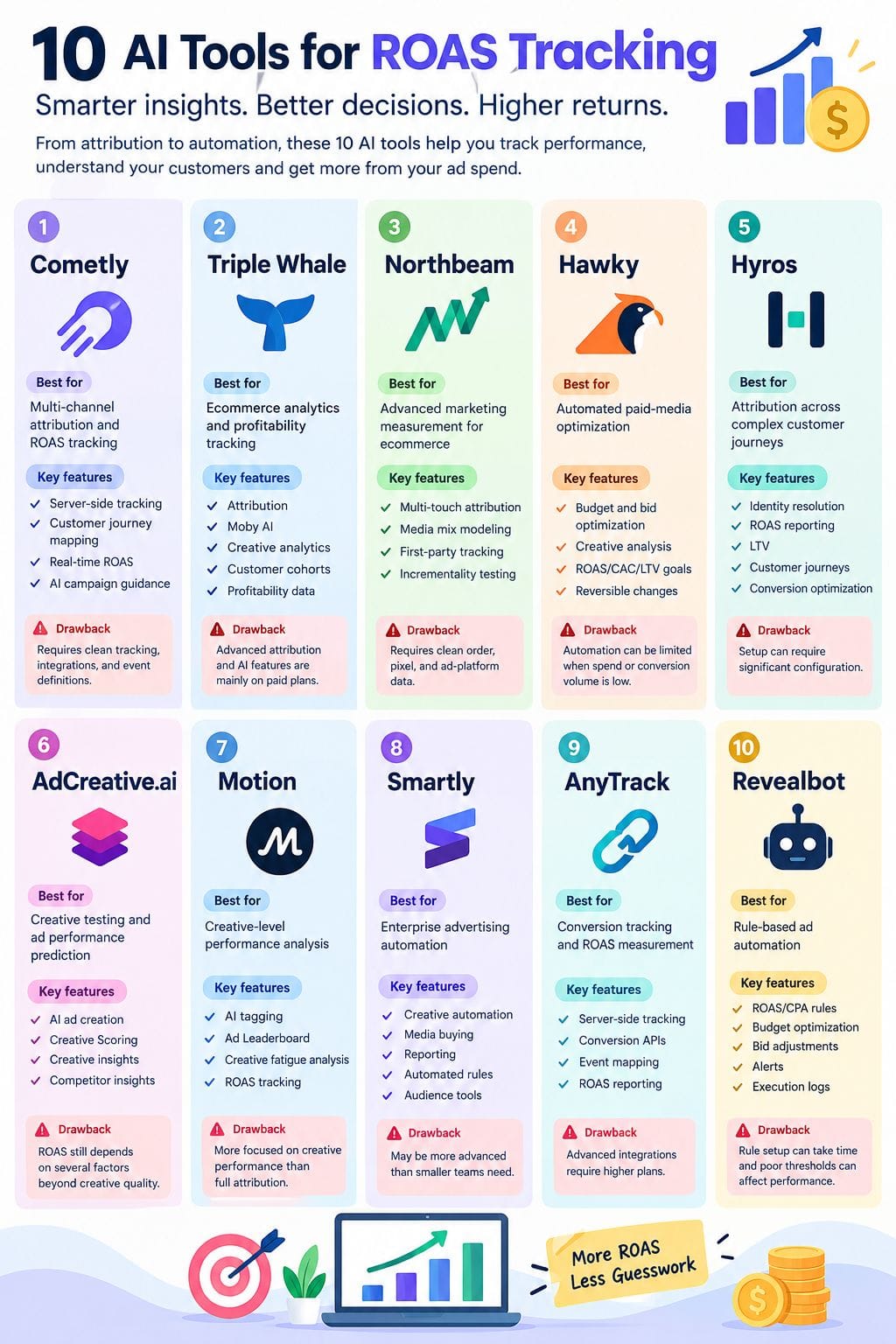
Best AI Tools for ROAS Tracking: Comparison
The following tools offer different approaches to ROAS tracking, attribution, creative analysis, campaign optimization, and ad automation.
| AI Tool | Best For | Key Features | Drawbacks |
|---|---|---|---|
| Cometly | Multi-channel attribution and ROAS tracking | Server-side tracking, customer journey mapping, real-time ROAS, AI campaign guidance | Requires clean tracking, integrations, and event definitions |
| Triple Whale | Ecommerce analytics and profitability tracking | Attribution, Moby AI, creative analytics, customer cohorts, profitability data | Advanced attribution and AI features are mainly on paid plans |
| Northbeam | Advanced marketing measurement for ecommerce | Multi-touch attribution, media mix modeling, first-party tracking, incrementality testing | Requires clean order, pixel, and ad-platform data |
| Hawky | Automated paid-media optimization | Budget and bid optimization, creative analysis, ROAS/CAC/LTV goals, reversible changes | Automation can be limited when spend or conversion volume is low |
| Hyros | Attribution across complex customer journeys | Identity resolution, ROAS reporting, LTV, customer journeys, conversion optimization | Setup can require significant configuration |
| AdCreative.ai | Creative testing and ad performance prediction | AI ad creation, Creative Scoring, creative insights, competitor insights | ROAS still depends on several factors beyond creative quality |
| Motion | Creative-level performance analysis | AI tagging, Ad Leaderboard, creative fatigue analysis, ROAS tracking | More focused on creative performance than full attribution |
| Smartly | Enterprise advertising automation | Creative automation, media buying, reporting, automated rules, audience tools | May be more advanced than smaller teams need |
| AnyTrack | Conversion tracking and ROAS measurement | Server-side tracking, conversion APIs, event mapping, ROAS reporting | Advanced integrations require higher plans |
| Revealbot | Rule-based ad automation | ROAS/CPA rules, budget optimization, bid adjustments, alerts, execution logs | Rule setup can take time and poor thresholds can affect performance |
Cometly
Cometly is an AI-powered marketing attribution platform that helps businesses track ROAS and understand which campaigns drive real revenue. It connects ad spend with customer purchases, maps the full customer journey, and provides clear insights across channels such as Meta, Google, TikTok, and LinkedIn.
Its server-side tracking helps reduce data loss caused by browser limits, iOS privacy changes, and ad blockers. Cometly also sends enriched conversion data back to ad platforms to improve targeting and bidding.
Its AI Ads Manager can suggest when to scale, pause, or adjust campaigns. The platform provides real-time views of ROAS.
Pros
- Links ad clicks to downstream revenue, not only platform-reported conversions
- Helps reduce gaps caused by browser pixels and privacy changes
- Combines attribution reporting and AI-led campaign guidance in one tool
Cons
- Setup requires clean tracking, integrations, and event definitions
- Attribution models still estimate credit; they do not prove causation
Pricing
| Plan | Pricing |
|---|---|
| Request for Pricing (RFP) | Request for Pricing |
Triple Whale
Triple Whale is an AI-powered ecommerce analytics platform that gives brands one clear view of ad spend, revenue, CAC, profit, and attribution.
Its Triple Pixel and survey data help link purchases to the channels that influenced them, even when tracking signals are limited. Moby AI allows teams to ask questions in plain English, spot changes in performance, and automate analysis.
The platform also tracks creative performance, products, customer groups, and buying journeys. This helps marketers shift budgets toward ads that generate real sales rather than relying only on platform-reported results.
Pros
- Links ads, creative concepts, and copy to Shopify orders, not merely clicks or platform conversions.apps
- Moby supports natural-language analysis, automated workflows, specialists, and autonomous actions on higher plans
- Pulls advertising, Shopify, email/SMS, Amazon, customer cohorts, subscriptions, and profitability data into one workspace
Cons
- Multi-touch attribution, richer analytics, and Moby features are primarily paid-plan capabilities
- Weak source data, inconsistent UTM rules, or poor survey design can still distort ROAS decisions
Pricing
| Plan | Pricing |
|---|---|
| Request for Pricing (RFP) | Request for Pricing |
Northbeam
Northbeam is an AI-powered marketing measurement platform built for eCommerce brands. It helps companies get a clearer view of their advertising performance across different channels.
Instead of relying only on data from platforms like Google or Meta, Northbeam uses first-party data, machine learning, and media mix modeling to connect ad spending with actual revenue.
It offers tools for multi-touch attribution, view-through conversions, creative performance, and cross-channel ROAS tracking. Teams can also test incrementality and adjust attribution windows based on their needs. With Northbeam Apex, brands can send conversion data back to ad platforms to improve campaign targeting and delivery.
Pros
- Blends multi-touch attribution with media mix modeling, so it can support both day-to-day channel decisions and broader budget planning
- Uses first-party tracking and deterministic view data, which can reduce reliance on platform-reported ROAS
- Connects revenue to individual ads and creatives, not only campaigns or channels
Cons
- Attribution models estimate contribution; they cannot prove that every credited ad caused every sale
- Proper setup depends on clean order, pixel, and ad-platform data
Pricing
| Plan | Pricing |
|---|---|
| Starter | $1,500/month |
| Professional | $3,500/month |
| Enterprise | Contact Sales |
| Growth | Contact Sales |
 Vivek Dev Jacob
Hawky
Hawky is an AI platform built for paid-media teams to improve ROAS across Meta, Google, TikTok, and YouTube. It brings campaign tracking and optimization into one place.
Hawky reads campaign data, moves budgets and bids toward ads that are driving results, and flags creatives that are underperforming or losing impact. It can also help create new ad variations based on proven winners.
Teams can set goals around ROAS, CAC, LTV, or contribution margin, while adding spend limits for better control. Every change is logged, reviewed, and can be reversed. Hawky also brings key metrics and creative performance.
Pros
- It tags ad elements, such as hooks and CTAs, to show why an ad wins or loses
- It seeks to detect declining creative performance before ROAS falls sharply
- Users can set budget, creative, and geography limits; changes are logged and reversible
Cons
- Poor tracking, weak conversion signals, or wrong attribution can lead to poor AI choices
- Automation has less room to learn when spend, conversions, or creative volume are low
Pricing
| Plan | Pricing |
|---|---|
| Request for Pricing (RFP) | Request for Pricing |
Hyros
Hyros is an AI-powered ad attribution platform that helps marketers understand how ads drive revenue across complex customer journeys. It tracks users across paid ads, email, organic traffic, calls, and other touchpoints to connect sales with the campaigns that influenced them.
Its identity resolution tools help link customer activity across devices and over time. Hyros also provides reports on ROAS, creative performance, funnels, customer journeys, LTV, subscriptions, repeat purchases, and forecasts.
It integrates with major advertising platforms and offers API access and custom attribution options. The platform also provides AI-driven optimization insights, along with implementation support.
Pros
- Uses several identity signals, so it can retain more attribution detail than a browser-pixel-only setup
- Includes analyst-led support and setup, which helps teams with complex funnels
- Sends better conversion signals back to ad networks, which may improve optimization
Cons
- Setup can take effort because data sources, checkout flows, and attribution rules must be configured well
- Attribution is modeled, not absolute truth; platform reports may still differ from Hyros results
Pricing
| Plan | Pricing |
|---|---|
| Monthly Plan | $230/month |
AdCreative.ai
AdCreative.ai is an AI-powered ad creation platform that helps teams make better ads and improve ROAS. It can create image, video, product photo, and copy variations while keeping brand colors, fonts, logos, and templates consistent.
Its Creative Scoring feature predicts how an ad may perform before money is spent. Creative Insights also show which colors, layouts, and messages perform well based on campaign data.
Teams can track where assets are used and how they contribute to results. The platform also offers competitor insights and connects with Meta, Google, and LinkedIn.
Pros
- Scores ads before launch, which can reduce low-value tests
- Can compare performance by design traits, such as color or layout
- Creates many size-ready variants fast for cross-channel tests
Cons
- Score accuracy is a vendor claim, so validate it against your own results
- ROAS still depends on offer, audience, bid, landing page, and tracking setup
Pricing
| Plan | Pricing |
|---|---|
| Starter Plans | $20/month |
| Professional Plans | $125/month |
| Ultimate Plans | $500/month |
Motion
Motion is an AI-powered creative analytics platform built for paid social teams. It helps marketers track ROAS and other key metrics at the ad and creative level.
The platform groups results by hooks, formats, offers, messages, and concepts, making it easier to see what is working. Its AI tagging also reduces the need for manual labeling.
The Ad Leaderboard ranks ads based on the metric a team selects, while reports highlight creative fatigue, winning patterns, and weaker versions. These insights help teams create better briefs, test new ads faster, and scale ideas that have proven results.
Pros
- Connects ROAS to distinct creative elements, not only campaigns or ad sets
- AI automatically tags Meta creatives across eight descriptive categories
- The Ad Leaderboard makes it easy to rank ads against a chosen goal, such as ROAS, CPA, or CPL
Cons
- It is a creative-performance tool, not a replacement for a full attribution platform
- Its best-known automation centers on paid-social creative, especially Meta, so it may offer less value to teams with little creative testing
Pricing
| Plan | Pricing |
|---|---|
| Starter | $750/month |
| Pro | $1,200/month |
| Growth | Contact Sales |
Smartly
Smartly is an enterprise AI advertising platform that helps brands and agencies improve return on ad spend (ROAS) across paid social channels. It brings creative, media buying, and reporting into one place, making it easier to track campaigns and find areas for improvement.
Teams can use real-time AI insights to monitor performance, adjust budgets, and scale ads that work well. Smartly also offers automated rules, creative automation, dynamic ads, audience tools, and campaign management across platforms such as Meta, TikTok, Pinterest, Snapchat, Reddit, and YouTube.
It also supports cross-channel measurement, custom reporting, conversion tracking.
Pros
- It joins ad creation, delivery, and results, making it easier to see which creative drives returns
- Automated rules can limit waste by stopping weak ads and scaling strong ones
- Teams avoid checking each ad network in isolation
Cons
- Its broad creative, media, and reporting toolset may require training and process changes
- Smaller teams may not need its advanced automation or enterprise workflow depth
Pricing
| Plan | Pricing |
|---|---|
| Request for Pricing (RFP) | Request for Pricing |
Rinky Moolchandani
AnyTrack
AnyTrack is an AI-assisted conversion tracking platform that helps businesses measure the real return on their ad spend. It connects advertising platforms such as Google, Meta, and TikTok with sales, leads, CRM deals, and affiliate revenue.
The platform then sends accurate conversion data back to ad networks, helping them improve ad targeting and bidding. AnyTrack supports server-side and cookieless tracking, automatic link tagging, event mapping, conversion deduplication, and first- and last-click attribution.
It also provides reports on campaign, landing page, and ad-level ROAS. The platform is useful for ecommerce brands, lead-generation businesses, affiliate marketers.
Pros
- Sends conversion and revenue events back to ad platforms in real time through Conversion APIs
- Combines ad spend with revenue from stores, CRMs, and affiliate networks
- Includes a free tier with 5,000 sessions, one website, one ad platform, one conversion source, and ROAS reporting
Cons
- Advanced needs, such as cross-domain tracking, GA4 integration, custom integrations, and outgoing webhooks, require higher plans
- Attribution still depends on correct setup, event mapping, consent practices, and source data
Pricing
| Plan | Pricing |
|---|---|
| Starter | $100/month |
| Personal | $150/month |
| Advance | $300/month |
Vivek Dev Jacob
Revealbot
Revealbot is an ad automation platform that helps teams manage and improve ROAS across Meta, Google Ads, TikTok, and Snapchat. It tracks key metrics such as ROAS, CPA, ad spend, CTR, frequency, and other custom measures.
Based on rules set by the user, it can pause ads that perform poorly, increase budgets for strong performers, adjust bids, or send alerts when action is needed.
The platform focuses on controlled automation rather than acting as a fully autonomous AI ad buyer. Users decide the goals and rules, while Revealbot handles the actions. Rules can run every 15 minutes.
Pros
- Highly flexible rule builder with multi-condition AND/OR logic for ROAS, CPA, spend, and fatigue signals
- Frequent rule checks can catch poor spend early and scale proven ad sets faster
- Clear execution logs create an audit trail for each automated budget, bid, or pause action
Cons
- Setup can take time for teams with many accounts, campaigns, metrics, or exceptions
- Poor thresholds can pause ads too early or scale ads before results are stable
Pricing
| Plan | Pricing |
|---|---|
| Essential | $49/month |
| Pro | $99/month |
| Enterprise | Contact Sales |
How to Choose an AI Tool for ROAS Tracking
Choosing an AI ROAS tracking tool depends on how your team measures advertising performance and how much automation you need.
| Use Case | Recommended Tools | Why Choose Them |
|---|---|---|
| Attribution and customer journeys | Cometly, Northbeam, Hyros | Useful for understanding how different touchpoints contribute to revenue and tracking complex customer journeys. |
| Ecommerce analytics | Triple Whale | Brings advertising, revenue, customer, and profitability data into one workspace. |
| Creative performance | AdCreative.ai, Motion | Helps teams understand which creative elements contribute to better ad performance. |
| Automated campaign optimization | Hawky, Smartly, Revealbot | Helps automate budget, bid, and campaign decisions based on performance signals and predefined goals. |
| Conversion tracking | AnyTrack | Connects ad platforms with sales, leads, CRM deals, and affiliate revenue while sending conversion data back to advertising platforms. |
Final Thoughts
AI-driven ROAS tracking helps marketers understand where their ad money is going and what it brings back. It turns campaign data into simple, useful insights, showing which ads, audiences, and channels drive real sales.
This helps teams spot wasted spend early, move budgets quickly, and invest more in campaigns that perform well. It also reduces the time spent on manual reports and spreadsheets, giving marketers more time to focus on strategy and growth.
As ad costs increase and customer journeys become harder to track, having fast and accurate data is more important than ever.
FAQs
What are AI tools for ROAS tracking?
AI tools for ROAS tracking help marketers measure how much revenue their advertising campaigns generate compared with their ad spend. They can combine data from multiple channels and provide insights into campaign and creative performance.
How do AI tools help improve ROAS?
AI tools can identify underperforming campaigns, detect changes in performance, analyze creative results, and suggest where budgets may be better used. Some tools can also automate campaign and bid adjustments.
Which AI tools are best for ROAS tracking?
The best tool depends on the team's needs. Cometly, Northbeam, and Hyros focus on attribution and customer journeys, while Triple Whale focuses on ecommerce analytics. Motion and AdCreative.ai focus more on creative performance.
Can AI ROAS tracking tools work across multiple advertising platforms?
Yes. Several tools in the list support multiple advertising platforms, including Meta, Google, TikTok, LinkedIn, YouTube, Snapchat, and others. The platforms supported vary by tool.
What should marketers consider when choosing an AI ROAS tracking tool?
Marketers should consider attribution capabilities, supported advertising platforms, tracking requirements, automation features, reporting, integrations, pricing, and the level of control they want over automated decisions.