Best Labor Law Compliance Tools for Businesses in 2026
Explore the best labor law compliance tools for businesses in 2026 that help automate regulatory tracking, reduce legal risks, and simplify HR compliance processes. Discover how modern platforms ensure audit-ready documentation and seamless workforce law adherence.

Labor law compliance tools make it easier for businesses to follow employment rules without getting buried in paperwork. They keep track of changing regulations, identify potential risks, and organize compliance tasks in one place. HR teams can monitor wages, work hours, employee benefits, and workplace safety without relying on multiple spreadsheets or files. Automated reminders help prevent missed deadlines, reducing the risk of fines and legal issues. Clear dashboards give managers a quick view of compliance across teams and locations. Instead of reacting to problems at the last minute, businesses can build a simple and consistent process.
Why Businesses Need Labor Law Compliance Tools
Labor law compliance software helps organizations:
- Reduce the risk of penalties and legal disputes.
- Automate payroll and statutory calculations.
- Track attendance, overtime, and employee benefits.
- Maintain audit-ready records.
- Stay updated with changing regulations.
- Improve transparency through employee self-service portals.
- Simplify HR and compliance workflows.
Best Labor Law Compliance Tools Compared
| Tool | Best For | Key Features | Pricing Level | Drawbacks |
|---|---|---|---|---|
| ZingHR | Indian businesses | Payroll, statutory compliance, AI alerts | Custom Pricing | Limited global support |
| greytHR | SMBs and enterprises | Payroll, leave, attendance, labor code support | Custom Pricing | Complex setup for small teams |
| Keka HR | Growing businesses | Payroll, attendance, hiring, checklists | Custom Pricing | May be excessive for small teams |
| Darwinbox | Large and multinational firms | Localization, payroll, mobile-first HR | Custom Pricing | Advanced features cost more |
| Qandle | SMBs | Modular HRMS and payroll | Low-Medium | Needs setup time |
| Workday HCM | Large enterprises | Workforce management, audit trails | Premium | Complex implementation |
| LogicGate Risk Cloud | GRC-heavy organizations | No-code workflows, AI gap analysis | Premium | Requires workflow design |
| Thomson Reuters Compliance Management | Global organizations | Policy templates, legal updates | Premium | Steep learning curve |
| VComply | Multi-location companies | Task tracking, dashboards | Medium-Premium | Time-consuming setup |
| Workiva | Large enterprises | Collaboration, audit trails, ESG reporting | Premium | Not labor-law focused |
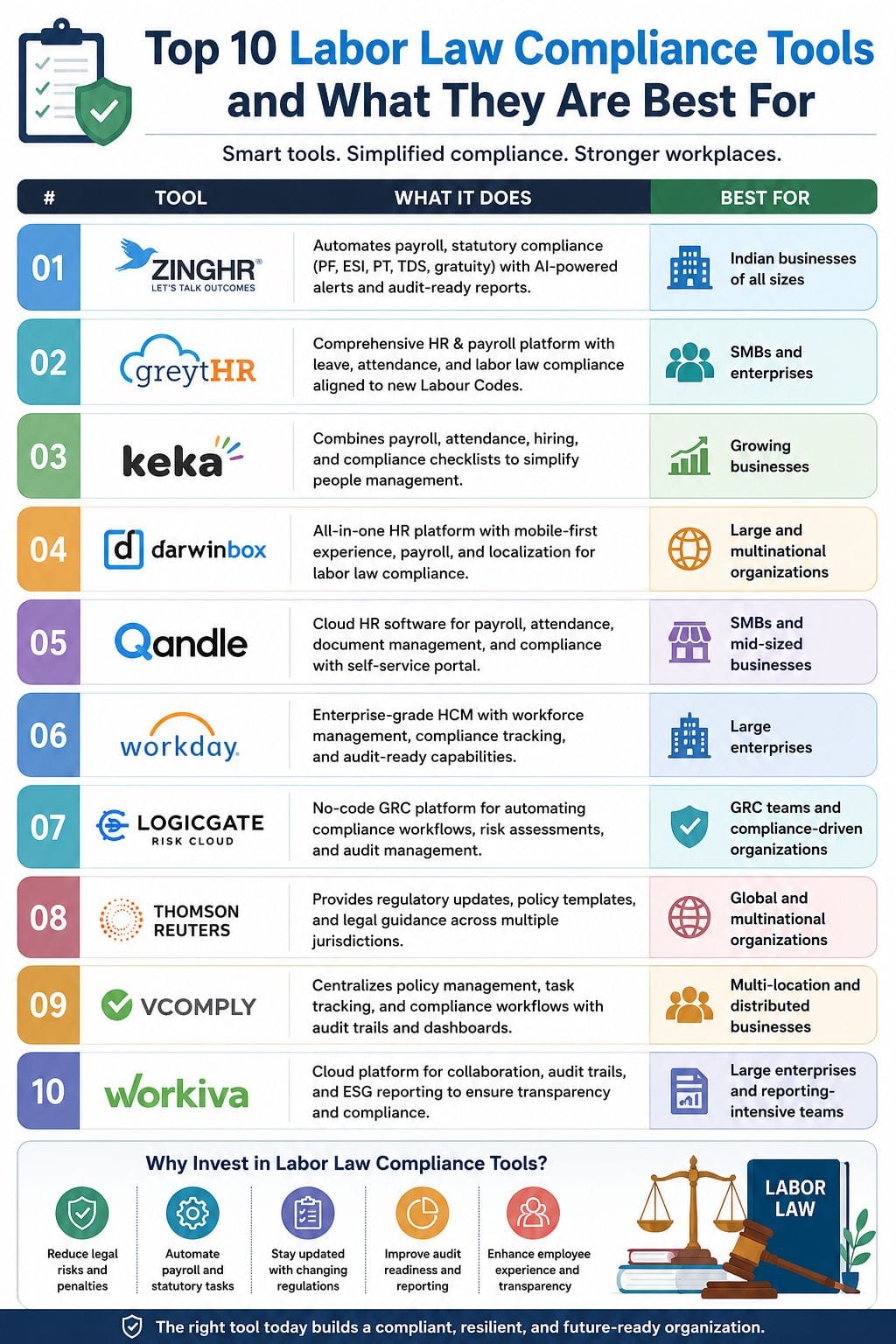
1. ZingHR
ZingHR is a cloud-based HR and payroll platform that helps businesses manage employees and stay compliant with Indian labor laws. It automates payroll processing, including PF, ESI, TDS, gratuity, and professional tax calculations.
The system also handles filings, challans, and updates to tax and wage regulations. Attendance, shift schedules, and overtime are tracked in real time to ensure accurate payroll.
AI-powered alerts help HR teams spot compliance risks and stay ahead of deadlines. The platform provides audit-ready reports and records, making reviews and inspections easier. It also connects with onboarding, performance management, and workforce analytics tools.
Pros
- Indian payroll and statutory compliance (PF, ESI, PT, TDS, gratuity) in one system.
- Automated updates for changing labor and tax rules reduce manual tracking effort.
- AI‑based compliance alerts help catch configuration gaps and filing errors early.
Cons
- India‑centric design may not fit complex multi‑country labor law needs.
- A feature-rich interface can feel heavy for small teams needing only basic compliance.
Pricing
Request for pricing (RFP)
2. greytHR
greytHR is a cloud-based HR and payroll platform built for Indian businesses. It helps companies manage payroll, PF, ESI, PT, TDS, and other statutory requirements while staying compliant with changing labor laws and the new Labour Codes. The platform automates salary calculations, generates challans, forms, and registers, and reduces manual work.
It also combines attendance, leave, shifts, and overtime data for accurate wage processing. HR teams get access to compliance checklists and updated guidance, while employees can view payslips, apply for leave, and manage records through a self-service portal and mobile app.
Pros
- Reduces manual compliance effort with ready checklists, workflows, and registers.
- Scales from small firms to large enterprises with a mature HRMS plus payroll stack.
- Good onboarding support and documentation for HR compliance teams
Cons
- Interface and workflows can feel heavy for very small businesses
- Advanced configuration for complex wage and shift rules may need expert setup time.
Pricing
Request for pricing (RFP)
3. Keka HR
Keka HR helps companies manage people and stay compliant with labor laws without extra manual work. It brings payroll, attendance, leave, hiring, and employee records into one platform. The system automatically handles statutory calculations such as PF, ESI, and taxes, helping businesses reduce payroll errors. HR teams can track shifts, attendance, and overtime in a single place, making it easier to avoid disputes and stay compliant.
Keka also provides policy documents, reminders, and checklists to keep records updated and audit-ready. As a result, compliance becomes part of everyday HR operations instead of a stressful task before inspections or audits.
Pros
- Strong link between payroll, time, and compliance data, which cuts manual updates.
- Embedded checklists, guides, and alerts that support non‑expert HR teams.
- Cloud delivery with web and mobile access for distributed workforces.
Cons
- Best value realized by teams with enough call volume
- Focus on roleplay and coaching means it is not a full CRM or sales engagement suite
Pricing
Request for pricing (RFP)
 Vivek Dev Jacob
4. Darwinbox
Darwinbox is an all-in-one HR platform that helps companies follow local labor laws with less effort. It manages key HR tasks such as hiring, attendance, leave, payroll, and employee exits in one place.
The platform automatically tracks work hours, overtime, and leave, then connects this data to payroll to ensure accurate salary, tax, and social security calculations. It also offers approval workflows, clear audit trails, and quick policy updates when regulations change.
Managers can handle tasks through a mobile app, while built-in reports help identify compliance risks. Its localization features make it useful for businesses operating across borders.
Pros
- Strong localization for India’s new labor codes and GCC compliance needs.
- Deep integration of time, attendance, and payroll to reduce wage law errors.
- Mobile‑first experience that makes policy updates and approvals faster.
Cons
- Compliance depth may vary by smaller or less common geographies.
- Advanced analytics and customization often need enterprise‑level budgets.
Pricing
Request for pricing (RFP)
5. Qandle
Qandle is a cloud-based HR platform that helps businesses in India manage payroll, compliance, and daily HR tasks from one place. It automates salary calculations, tax deductions, and statutory requirements, which reduces manual work and errors.
The platform also tracks attendance, leave, and employee records, making HR processes more organized and efficient. Digital document storage and task management help teams stay prepared for audits and compliance checks. Employees can access their payslips, apply for leave, and view leave balances through a self-service portal. This reduces routine HR queries and creates a more transparent and reliable workplace experience for everyone.
Pros
- Unified HRMS: attendance, leave, payroll, and records in one place.
- Mobile‑first access and self‑service for employees and managers.
- Scales from small teams to large enterprises with a modular setup.
Cons
- Advanced configuration may need an expert onboarding and time from HR and finance.
- Limited use if a company only wants a light compliance tracker, not a full HR suite.
Pricing
| Plan | Pricing |
|---|---|
| Foundation | ₹2,950/month |
| Regular | ₹4,950/month |
| Plus | ₹6,200/month |
| Premium | ₹8,000/month |
| Enterprise | Contact Sales |
6. Workday Human Capital Management
Workday Human Capital Management helps companies manage their workforce while staying compliant with labor laws. It brings HR, payroll, and time tracking into one cloud-based system, making employee data easier to manage. Businesses can set rules for work schedules, overtime, leave, and benefits based on local regulations.
Automated approvals and clear audit trails reduce manual work and help lower compliance risks. Real-time reporting gives HR teams a clear view of working hours, staffing levels, and policy violations across locations. Employees can also access their records, track time, and view benefits through self-service tools, improving transparency and reducing workplace disputes.
Pros
- Highly configurable rules for schedules, overtime, and leave to match local labor codes.
- Robust audit trails and reporting that support inspections and internal audits.
- Modern UI and self-service reduce HR admin load and errors in timesheets.
Cons
- Configuration complexity often requires specialist partners or in‑house experts.
- Can feel heavy if you only need basic labor compliance rather than full HCM.
Pricing
Request for Pricing (RFP)
StartupTalky Official
7. LogicGate Risk Cloud
LogicGate Risk Cloud helps companies manage labor law compliance in one place. It brings together regulations, policies, controls, and evidence so teams can stay organized and reduce compliance risks. The platform uses no-code workflows to automate tasks such as audits, approvals, employee attestations, investigations, and remediation activities.
It also tracks regulatory changes and helps teams respond quickly when labor laws are updated. Real-time dashboards provide a clear view of compliance status, deadlines, and gaps. AI-powered features support control mapping and gap analysis, making it easier for HR and legal teams to maintain compliance and prepare for audits.
Pros
- Highly flexible no-code builder fits diverse labor and HR compliance workflows
- Strong automation and reminders reduce manual tracking of deadlines and evidence.
- Scales from single-use cases to enterprise-wide GRC with many integrations.
Cons
- HR teams must design domain-specific workflows and mappings.
- Pricing and advanced AI features may exceed the budget of small HR departments.
Pricing
Request for Pricing (RFP)
8. Thomson Reuters Compliance Management
Thomson Reuters Compliance Management helps HR and legal teams stay up to date with labor and employment laws across different regions. It brings key information into one place, making it easier to track rule changes and reduce compliance risks.
The platform includes expert guidance, policy templates, checklists, and comparison charts that help teams create compliant workplace policies faster. Users can search by topic, state, or country and access tools for areas such as wages, leave, discrimination, and workplace conduct. Side-by-side comparisons show legal differences across regions, helping organizations keep policies accurate, consistent, and ready for audits.
Pros
- Deep, regularly updated expertise on labor and employment topics.
- Strong global and multi‑jurisdiction coverage for enterprises with cross‑border workforces.
- Rich templates and automated documents cut drafting time for policies and agreements.
Cons
- Best suited to mid‑market and large enterprises
- Implementation and adoption may require training due to the breadth of content and features
Pricing
Request for Pricing (RFP)
9. VComply
VComply is a cloud-based compliance and GRC platform that helps organizations manage labor laws, workplace policies, and regulatory requirements from one central system. Instead of relying on spreadsheets and emails, teams can assign responsibilities, track deadlines, and monitor progress through simple dashboards.
Automated reminders help ensure important tasks and filings are not missed. The platform also supports policy management, document storage, risk assessments, and corrective action tracking. With clear audit trails and reporting, businesses can stay compliant across multiple locations. Its flexible workflows and integrations make it easier to manage compliance in a consistent and organized way.
Pros
- Simple, visual interface that makes complex compliance programs easier to run
- Strong task ownership and reminders reduce the chance of missing labor or HR deadlines.
- Cloud architecture supports distributed workforces and multi‑location compliance.
Cons
- The setup of obligations, workflows, and mappings can take time and expert input for complex jurisdictions.
- Overwhelming for very small firms that need only basic labor tracking.
Pricing
| Plan | Pricing |
|---|---|
| Startups & Non-Profits | Custom |
| Pro GRC Suite | $1,000/month |
| Enterprise GRC Suite | Custom |
Vivek Dev Jacob
10. Workiva
Workiva helps large companies manage labor and compliance tasks in one secure platform. It brings together HR, legal, and financial data, making it easier to track requirements, store evidence, and prepare reports. Teams can pull data from HR and ERP systems into live documents and dashboards, reducing manual work and keeping information up to date.
The platform supports real-time collaboration, version control, and clear audit trails, so every change can be tracked. Workiva also automates routine processes and supports ESG reporting, helping organizations manage workforce, governance, and sustainability disclosures while staying ready for audits and regulatory reviews.
Pros
- Strong fit for enterprises that already rely on Workiva for financial reporting
- High transparency and traceability make it easier to handle external audits and cross-functional reviews.
- Scales well across departments and entities, with centralised workspaces and data connections.
Cons
- Not a labor-law–first system, so some HR and statutory workflows may need customisation
- Performance issues reported by some users.
Pricing
Request for pricing (RFP)
Benefits of Using Labor Law Compliance Software
1. Reduced Legal Risk
Automated systems help organizations avoid missing important deadlines and filings.
2. Improved Payroll Accuracy
Integrated payroll systems minimize errors in wages, taxes, and benefits.
3. Better Audit Readiness
Digital records and reports make audits faster and easier.
4. Higher Productivity
HR teams spend less time on repetitive administrative tasks.
5. Enhanced Employee Experience
Self-service portals improve transparency and reduce HR queries.
How to Choose the Right Labor Law Compliance Tool
When selecting software, businesses should consider:
- Company size
- Number of employees
- Multi-location requirements
- Payroll complexity
- Integration capabilities
- Scalability
- Budget
- Industry-specific needs
Feature Comparison Table
| Tool | Payroll | Attendance | Compliance Alerts | Audit Trails | Mobile App | Best For |
|---|---|---|---|---|---|---|
| ZingHR | ✔ | ✔ | ✔ | ✔ | ✔ | Indian Enterprises |
| greytHR | ✔ | ✔ | ✔ | ✔ | ✔ | SMBs and Enterprises |
| Keka HR | ✔ | ✔ | ✔ | ✔ | ✔ | Growing Businesses |
| Darwinbox | ✔ | ✔ | ✔ | ✔ | ✔ | Large Organizations |
| Qandle | ✔ | ✔ | ✖ | ✔ | ✔ | SMBs |
| Workday HCM | ✔ | ✔ | ✔ | ✔ | ✔ | Large Enterprises |
| LogicGate Risk Cloud | ✖ | ✖ | ✔ | ✔ | ✖ | GRC Teams |
| Thomson Reuters | ✖ | ✖ | ✔ | ✔ | ✖ | Global Enterprises |
| VComply | ✖ | ✖ | ✔ | ✔ | ✔ | Multi-location Firms |
| Workiva | ✖ | ✖ | ✔ | ✔ | ✖ | Large Enterprises |
Future of Labor Law Compliance Software
The labor law compliance software market is expected to evolve significantly as regulations become more complex and organizations increasingly embrace digital transformation.
Some key trends shaping the future include:
AI-Powered Compliance Monitoring
Artificial intelligence will automatically detect risks, identify policy gaps, and provide recommendations before violations occur.
Predictive Analytics
Advanced analytics will help HR teams anticipate compliance issues rather than reacting to them after they happen.
Increased Automation
Payroll calculations, statutory filings, employee onboarding, and audit preparation will become increasingly automated.
Cloud-Based Platforms
Cloud deployment will continue to dominate due to scalability, accessibility, and lower infrastructure costs.
Integration With ESG Reporting
Labor compliance will become closely linked with ESG reporting, diversity initiatives, and corporate governance strategies.
Mobile-First Experiences
Employees and managers will increasingly manage attendance, approvals, and compliance tasks through mobile applications.
Conclusion
Labor law compliance tools are no longer a nice-to-have add‑on; they sit at the core of a safe and fair workplace. They turn dense rules into clear steps, cut human error, and guard you from rising fines and legal risk. With them, HR teams gain time for people, not paperwork. Leaders get real insight into risk, cost, and culture. As rules grow stricter and audits get sharper, firms that rely on guesswork will fall behind. Those that invest in smart, simple compliance systems will protect workers, build trust, and move faster than the rest.
FAQs
What is labor law compliance software?
Labor law compliance software helps organizations manage payroll, attendance, employee benefits, and statutory requirements while ensuring compliance with labor regulations.
Which labor law compliance software is best for Indian businesses?
ZingHR, greytHR, Keka HR, Darwinbox, and Qandle are among the most popular choices for Indian organizations.
Which software is best for large enterprises?
Workday HCM, Workiva, and Thomson Reuters Compliance Management are better suited for large and multinational organizations.
Can labor law compliance software reduce legal risks?
Yes. Automated workflows, reminders, and audit trails help businesses minimize compliance errors and penalties.