LemonSqueezy Alternative for Indian SaaS Accepting Global Payments: Complete Guide for Your AI SaaS Business (2026)
In July 2024, Stripe acquired LemonSqueezy. By May 2024, Stripe had already moved to invite-only access for new Indian merchant accounts. By early 2025, Indian founders on LemonSqueezy were receiving notices of account restrictions, payout limitations, and migration requirements toward Stripe Managed Payments, a service that supports merchants in 35+ countries, with India not listed among supported merchant locations. Indian founders who had built their entire billing stack on LemonSqueezy's Merchant of Record model found themselves with live MRR, no clear migration path, and a compliance structure that had been creating unreported risks from day one.
This guide is for Indian AI SaaS founders in exactly that position: evaluating what comes after LemonSqueezy, understanding why the MoR model creates specific compliance problems for Indian-incorporated businesses, and choosing the right platform for a global billing stack built from an Indian entity.
Why Indian Founders Are Leaving LemonSqueezy
LemonSqueezy built its reputation on a simple premise: one platform, one fee, global tax handled. For Indian indie hackers launching AI tools, writing assistants, and API products in 2021-2023, it was the path of least resistance to global revenue.
Stripe's July 2024 acquisition changed the product trajectory. LemonSqueezy is being migrated to Stripe Managed Payments. The feature velocity slowed. Some merchants reported account freezes and payout delays in 2025. And critically, Stripe's India policy, invite-only since May 2024 and increasingly restrictive for Indian-entity merchants, has carried through to the LemonSqueezy product.
The practical effect: Indian founders who set up LemonSqueezy accounts without a US or UK entity are now in a product that is being sunset, managed by a company that restricts Indian merchant access, with no guaranteed path to Stripe Managed Payments from an Indian entity.
Before You Choose a Replacement: Why the MoR Model May Have Been Creating Compliance Risks All Along
Most guides covering LemonSqueezy alternatives assume the Merchant of Record model is the right starting point and compare MoR platforms against each other. For Indian-incorporated businesses, this assumption is worth examining before the replacement is chosen.
What a Merchant of Record Does Not Do for Indian Businesses
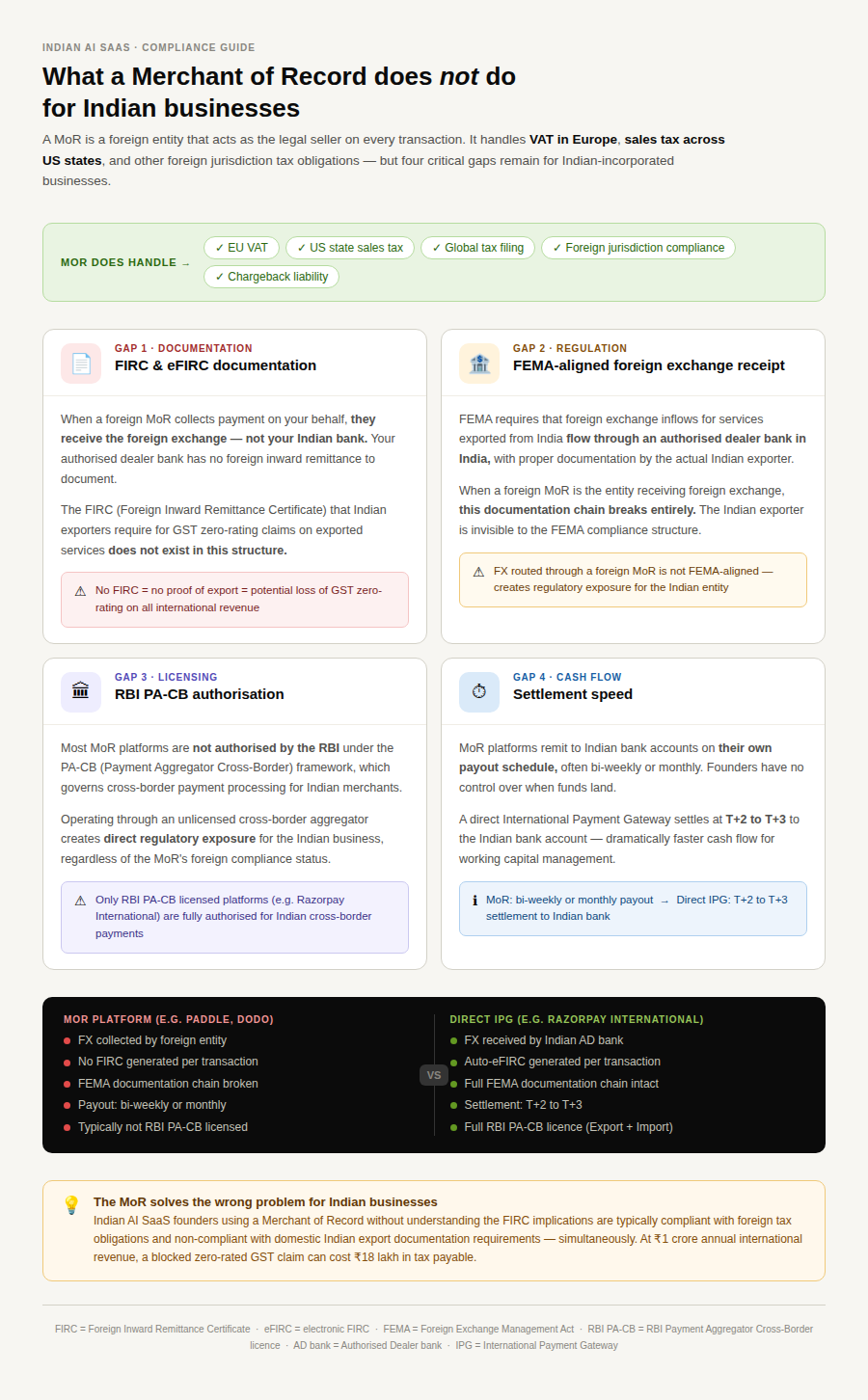
A Merchant of Record (MoR) is a foreign entity that acts as the legal seller on every transaction. It handles VAT in Europe, sales tax across US states, and other foreign jurisdiction tax obligations. What it does not handle, and cannot provide, for Indian-incorporated businesses:
- FIRC and eFIRC documentation.
- When a foreign MoR collects payment on your behalf, they receive the foreign exchange, not your Indian bank. Your authorised dealer bank has no foreign inward remittance to document. The FIRC (Foreign Inward Remittance Certificate) that Indian exporters require for GST zero-rating claims on exported services does not exist in this structure.
- FEMA-aligned foreign exchange receipt.
- FEMA requires that foreign exchange inflows for services exported from India flow through an authorised dealer bank in India, with proper documentation by the actual Indian exporter. When a foreign MoR is the entity receiving foreign exchange, this documentation chain breaks.
- RBI PA-CB authorisation.
- Most MoR platforms are not authorised by the RBI under the PA-CB (Payment Aggregator Cross-Border) framework. Operating through an unlicensed cross-border aggregator creates regulatory exposure.
- Settlement speed.
- MoR platforms remit to Indian bank accounts on their own payout schedule, often bi-weekly or monthly. A direct International Payment Gateway settles at T+2 to T+3 to the Indian bank account.
The Real Cost of MoR for Indian AI SaaS
The MoR service fee is 4-6% on top of standard processing costs. This is not the same as the headline transaction percentage. On $5,000 MRR, a 5% MoR fee is $250 per month, $3,000 per year, before any processing fee is applied. With Paddle's 5% plus $0.50 all-in, the full cost on $5,000 MRR with 50 monthly transactions is approximately $275 per month. Razorpay's International Payment Gateway at 3% handles the same $5,000 MRR for $150 per month, with cleaner FEMA compliance and auto-eFIRC per transaction.
When an MoR Actually Makes Sense for Indian AI SaaS
The MoR model is worth choosing in a genuinely narrow set of scenarios: selling in 10 or more international jurisdictions simultaneously, with no in-house tax compliance resource, willing to accept FIRC documentation gaps and the associated GST compliance risk. If those three conditions are not simultaneously true, an International Payment Gateway paired with a tax automation tool (TaxJar or Avalara) is both cheaper and more compliant for Indian-incorporated AI SaaS businesses.
Quote-ready: Indian AI SaaS founders using a Merchant of Record without understanding the FIRC implications are typically compliant with foreign tax obligations and non-compliant with domestic Indian export documentation requirements, simultaneously. The MoR solves the wrong problem for Indian businesses.
Did You Know? India's Software-as-a-Service export revenue crossed USD 13 billion in FY2025-26, driven in large part by Indian founders building AI tools for global markets. Every rupee of this revenue received through a foreign Merchant of Record that does not generate FIRC documentation is potentially at risk of losing its GST zero-rated export status, converting a 0% GST obligation into an 18% one. The FIRC gap is not a technicality; at Rs. 1 crore annual international revenue, a blocked zero-rated GST claim can cost Rs. 18 lakh in tax payable.
LemonSqueezy Alternatives International Payments Ranked For India
Rank 1. Razorpay International
Rating: 4.8/5 | Best overall for Indian-entity AI SaaS founders
Why is Razorpay the top LemonSqueezy alternative for Indian AI SaaS?
Razorpay International addresses the two most critical gaps LemonSqueezy left for Indian founders: cost and FEMA compliance. At 3% plus GST, it is the cheapest option in this comparison for international card acceptance. It holds a full RBI PA-CB licence (Export and Import, December 2025), auto-generates eFIRC per transaction, and is the first Indian payment aggregator with Apple Pay support for international customers.
The honest distinction from LemonSqueezy: Razorpay International is not a Merchant of Record. Foreign tax compliance (EU VAT, US sales tax) remains the merchant's responsibility. For AI SaaS founders selling to US businesses (B2B, where reverse charge applies) or at early revenue stages below the EU VAT threshold, this is not a practical limitation. For founders selling B2C to European consumers in volume, layering TaxJar or Avalara on top of Razorpay closes the tax compliance gap at significantly lower total cost than a MoR platform.
What does Razorpay charge for global payments from an Indian AI SaaS?
At $5,000 MRR (60% subscriptions, 40% usage), the monthly platform cost is approximately $150 (3% of $5,000). Adding TaxJar for US sales tax compliance runs $19-99 per month, depending on state filing volume. Total: approximately $169-249 per month versus Paddle's $275 or Dodo's estimated $300 for international subscriptions at the same MRR.
Does Razorpay support usage-based and credits billing for AI SaaS?
Razorpay's subscription product supports recurring billing, autopays, and even Shopify payment gateway integrations. For AI SaaS-specific models (per-token, per-API-call, credits replenishment), the integration requires additional configuration via the Razorpay API. One-time payments for credits top-ups work through standard payment links or hosted checkout without additional setup. Pure usage-based metered billing (where the amount varies each cycle based on consumption) requires custom API integration rather than a no-code setup.
For AI SaaS founders with a primarily subscription-based model (fixed monthly plan with optional credits add-ons), Razorpay covers the use case well. For founders whose entire revenue model is metered usage with no fixed component, Dodo or Paddle's native usage billing support is more immediately practical.
Pros:
- Lowest effective cost in this comparison at 3% plus GST with mid-market FX
- Full RBI PA-CB licence, auto-eFIRC per transaction, FEMA-compliant documentation structure
- Apple Pay and Google Pay for international customers (US, UK)
- 95%+ cross-border payment success rate via smart routing
- Domestic + international on the same dashboard
- Rs. 0 setup and annual fees
- India-based 24x7 support team
Cons:
- Native usage-based metered billing requires custom API integration
- Not the right choice for founders who need zero-config global tax compliance out of the box
Best for: Indian AI SaaS founders who want the lowest total cost, FEMA-compliant documentation, and Apple Pay support, and are willing to handle foreign tax via a separate tool or whose customer base is primarily B2B (reverse charge).
 Ashwini
Rank 2. Dodo Payments
Rating: 4.0/5 | Most direct LemonSqueezy replacement for Indian AI SaaS
Why is Dodo Payments the best MoR alternative to LemonSqueezy for Indian founders?
Dodo Payments was built specifically with Indian indie hackers and AI SaaS founders in mind. It is an India-first Merchant of Record platform (founded in 2023 by Rishabh Goel and Ayush Agarwal), with a product designed around the billing models that AI SaaS businesses actually use: subscriptions, one-time payments, usage-based billing, and credits replenishment. It covers 220+ countries, supports 40+ payment methods, and handles global tax compliance in the same MoR model that LemonSqueezy provided.
The settlement structure is important for Indian founders: Dodo acts as the foreign seller on each transaction and remits settlement to your Indian bank account as an export service payment (inward remittance under FEMA). The FIRC is generated by your Indian AD bank when the settlement arrives, not by Dodo per transaction. This is different from Razorpay's auto-eFIRC but still produces FEMA-compliant documentation at the point of settlement.
What does Dodo Payments actually cost for Indian AI SaaS?
At $5,000 MRR with international subscription payments, the effective rate of approximately 6-7% costs $300-350 per month, roughly double Razorpay's $150. The trade-off: Dodo handles EU VAT, US sales tax, and other foreign-jurisdiction tax obligations automatically, which Razorpay does not.
How does Dodo compare to LemonSqueezy's functionality for AI tools?
Dodo specifically targets AI SaaS use cases. It supports credits-based billing (buy 100 credits, consume them as API calls), usage-based metered billing, subscription plans, and one-time payments. The product has a particular focus on AI companies that need flexible billing without per-feature custom development. LemonSqueezy supported subscriptions and one-time payments but was weaker on native usage-based billing; Dodo improves on this for AI SaaS.
The platform is three years old in 2026. Documentation and integration depth continue to develop. For mission-critical billing infrastructure at significant MRR, the platform's youth relative to Paddle is a risk factor to weigh.
Pros:
- Most direct LemonSqueezy replacement with India-first design and support
- MoR covers EU VAT, US sales tax, and global tax compliance automatically
- Usage-based billing, credits, and subscriptions all natively supported
- 220+ countries and 40+ payment methods
- No Indian entity required
- India-accessible: payouts to Indian bank accounts confirmed
Cons:
- Effective international subscription rate of 6-7% is significantly higher than Razorpay's 3%
- $30 chargeback fee per dispute is a real risk for consumer-facing AI tools with higher dispute rates
- Platform is three years old; documentation and support depth still developing
- No ACH, SEPA Direct Debit, or BACS payment method support
- $5 payout fee for settlements under $1,000 penalises founders at early MRR stages
Rank 3. Paddle
Rating: 3.6/5 | Most mature MoR option; best documentation and support depth
Is Paddle a good LemonSqueezy alternative for Indian AI SaaS founders?
Paddle is the most established Merchant of Record platform in this comparison, founded in 2012 with a significantly larger merchant base, more comprehensive documentation, and deeper integrations than newer alternatives. It handles global VAT, US sales tax, GST in Australia and Canada, and subscription management in a model functionally similar to what LemonSqueezy provided.
The cost is higher than Dodo and significantly higher than Razorpay. Paddle's 5% plus $0.50 headline rate, combined with a currency conversion margin of 2-3% above mid-market for non-USD settlements, brings the effective all-in cost to 7-10% for international transactions. At $5,000 MRR with 50 monthly transactions, total cost is approximately $275-325 per month.
Paddle's primary advantage over Dodo is product maturity: the integration documentation is comprehensive, the support infrastructure is larger (though slower on smaller plans), and the migration path for existing LemonSqueezy merchants is well-documented. Paddle's own materials note that the economics shift away from Paddle toward lower-fee alternatives around $50,000-100,000 MRR.
What does Paddle charge and what does it cover?
Pros:
- Most mature MoR platform in this comparison with 14 years of operation
- Full subscription management, dunning, proration, and usage-based metered billing
- Chargeback liability transfers to Paddle, reducing risk for consumer-facing AI tools
- Well-documented migration path from LemonSqueezy
- Apple Pay, Google Pay, and PayPal acceptance included
- No Indian entity required
Cons:
- Effective all-in cost of 7-10% is the highest fee structure in this comparison
- Currency conversion margin of 2-3% above mid-market is not prominently disclosed
- Support for smaller plans is slow; response times of multiple days reported
- Paddle is the legal merchant of record, meaning the customer's card statement shows Paddle, not your product name
- No ACH, SEPA Direct Debit, or BACS support
Best for: Indian AI SaaS founders who prioritise platform maturity, comprehensive documentation, and established support over cost, and whose MRR stage (below $20,000) makes the MoR fee premium acceptable relative to the saved tax compliance overhead.
Rank 4. Creem
Rating: 3.2/5 | Lowest MoR headline rate; narrower coverage; very early-stage platform
Is Creem a viable LemonSqueezy alternative for Indian AI SaaS?
Creem is a Merchant of Record platform founded in 2024 by Armitage Labs OU (Estonia), raised EUR 1.8 million in pre-seed funding in July 2025 from Practica Capital and Antler. It markets itself at 3.9% plus $0.40 per transaction, the lowest headline rate of any MoR platform in this comparison, with no monthly fees and a setup process measured in minutes.
The headline rate comparison requires careful reading. Creem's additional fee structure layers on top of the base rate: revenue splits between co-founders or contractors add 2% per transaction, affiliate transactions add another 2%, and the payout fee is $7 or 1% of the payout amount, whichever is higher. For AI SaaS companies with affiliate programs (common for LLM tools and writing assistants), the effective rate on affiliate-driven transactions reaches 5.9% plus $0.40 before the affiliate's own commission.
Creem's tax compliance covers 28+ US states, EU (via Estonia OSS), UK, and South Korea. This is narrower than Paddle's global coverage and Dodo's 220+ country reach. For Indian AI SaaS companies with a US-and-EU-concentrated customer base, the coverage is functional. For those with significant APAC revenue outside South Korea, Creem may not cover all required jurisdictions.
What does Creem actually cost and what are the real limitations?
Creem is two years old in 2026. Its documentation coverage is narrower than Paddle and Dodo. For LemonSqueezy founders who need a production-grade billing replacement with a full support infrastructure, Creem's youth is a genuine operational risk.
Pros:
- Lowest MoR headline rate at 3.9% plus $0.40
- No monthly fees
- India listed among 86 merchant payout countries
- Fast setup: no lengthy onboarding process
- EU tax compliance via Estonia OSS structure
Cons:
- Revenue split, affiliate, and payout fees can push effective cost well above 5% headline
- Tax compliance covers only 28+ US states, EU, UK, and South Korea; narrower than Paddle and Dodo
- Platform is two years old with limited track record and documentation depth
- Payout fee of $7 or 1% (whichever higher) adds meaningful cost at lower payout amounts
- No information on usage-based or credits billing for AI SaaS
Best for: Indian AI SaaS founders with a primarily US and EU customer base, no affiliate program, no revenue split needs, and willingness to accept a newer platform's documentation and support limitations in exchange for a lower headline rate.
Tripti Garg
Rank 5. Foreign Entity (US LLC or Singapore Pvt Ltd) + Stripe US
Rating: 3.0/5 | Most powerful technical option; highest compliance overhead
When does it make sense to incorporate a foreign entity and use Stripe US?
Stripe US provides the full global Stripe product, including Stripe Billing (comprehensive subscription management, metered usage billing, proration), Stripe Tax (global tax calculation and filing automation), Apple Pay, Google Pay, Link, and the widest international card acceptance at 2.9% plus $0.30 per transaction.
For Indian AI SaaS founders above $50,000-100,000 MRR, the fee difference between Stripe US (2.9%) and MoR platforms (5-7%) begins to justify the compliance overhead of maintaining a foreign entity. Below that threshold, the overhead typically does not.
The FEMA Overseas Direct Investment requirements for an Indian founder incorporating a US LLC or Singapore company: Form FC filed with the AD bank before the investment, Annual Performance Report submitted by December 31 each year, FLA return to the RBI submitted by July 15 each year, and compliance with the 400% net worth cap on overseas investment.
Pros:
- Access to Stripe's full product suite including Stripe Tax, Stripe Billing, Stripe Radar, and complete developer tooling
- 2.9% plus $0.30 is the cheapest fee structure for international card acceptance at scale
- No invite-only restriction (US entity uses Stripe US directly, not Stripe India)
- Native usage-based billing, metered subscriptions, and credits billing fully supported
Cons:
- FEMA ODI compliance (Form FC, APR, FLA) requires CA engagement and creates annual overhead
- Entity setup and maintenance cost ($800-2,000+ per year) changes the economics below $50,000 MRR
- Tax compliance still requires Stripe Tax or a separate tool if selling in multiple VAT jurisdictions
- Not suitable for founders at early MRR stages where entity cost dominates fee savings
AI SaaS Billing Capability Compared of Top International Payments Provider
The specific billing models of AI tools (per-token, per-API-call, credits top-ups, seat-based with usage overlay) require different platform capabilities.
Tax Compliance by Platform
Cost Comparison at $5,000 MRR (60% Subscription, 40% Usage)
Assumes 50 transactions per month, international customer base (primarily US and EU).
Note: Foreign entity cost estimated at Rs. 1,500/month amortised ($18/month) for a US LLC. Tax tool cost for Razorpay assumes basic TaxJar plan sufficient for early-stage US sales tax compliance. Actual costs vary by transaction mix and jurisdiction coverage needed.
How to Migrate from LemonSqueezy
Step 1: Export your data before LemonSqueezy restricts access. Download all subscriber records, subscription plan details, pricing data, and customer emails from the LemonSqueezy dashboard. LemonSqueezy allows CSV export of customer and subscription data. Do this immediately if you have not done so.
Step 2: Choose your replacement platform and complete onboarding. Razorpay International activation via the merchant dashboard takes 2-5 business days. Dodo and Paddle onboarding is typically self-serve and faster. Confirm your chosen platform is fully active before any migration communication to customers.
Step 3: Recreate your subscription plans on the new platform. Set up pricing plans, trial periods, usage tiers, and credits packages on the replacement platform. Test the entire checkout and billing cycle end-to-end before migrating subscribers.
Step 4: Communicate the migration to active subscribers. A simple email explaining that payment details are being updated works for most SaaS subscriber bases. For card-on-file subscriptions, subscribers will need to re-enter payment details on the new platform. Typical re-entry rates within 30 days are 60-80% for active subscribers.
Step 5: Handle pro-rated billing for mid-cycle migrations. For subscribers mid-way through a billing cycle, either issue a partial credit on LemonSqueezy before cancelling, or begin the new subscription at the next natural renewal date to avoid double-charging.
Step 6: Cancel LemonSqueezy after a 60-day transition window. Keep LemonSqueezy active for 60 days post-migration to catch any subscriber who did not receive or act on the migration email. During this period, redirect all new signups to the new platform only.
Frequently Asked Questions
What is the best LemonSqueezy alternative for Indian AI SaaS founders in 2026?
Razorpay International is the best alternative on total cost and Indian regulatory compliance. At 3% plus GST with auto-eFIRC per transaction and full RBI PA-CB licence, it costs approximately $150 per month at $5,000 MRR versus Dodo's $330 or Paddle's $275. The distinction from LemonSqueezy is that Razorpay is not a Merchant of Record: EU VAT and US sales tax remain the merchant's responsibility, solvable with TaxJar or Avalara. For Indian founders where global tax automation is non-negotiable, Dodo Payments is the most India-appropriate MoR replacement.
Does a Merchant of Record solve GST compliance for Indian AI SaaS companies?
Partially, and not in the way most Indian founders expect. A Merchant of Record handles foreign-jurisdiction tax obligations (EU VAT, US sales tax). It does not handle Indian GST zero-rating compliance, which requires FIRC documentation for every inward remittance. When a foreign MoR collects international payments on your behalf, your Indian bank has no foreign inward remittance to document. The FIRC required for zero-rated GST treatment on exported services does not exist. Razorpay's International Payment Gateway auto-generates eFIRC per transaction, satisfying the Indian documentation requirement that MoR platforms cannot provide.
What is the cheapest Merchant of Record for Indian AI SaaS in 2026?
Creem has the lowest headline rate at 3.9% plus $0.40 per transaction. However, the effective rate for Indian AI SaaS founders increases with revenue splits (+2%), affiliate transactions (+2%), and the payout fee ($7 or 1% whichever is higher). Dodo Payments' base rate of 4% plus $0.40 reaches 6-7% for international subscription payments once the international surcharge (+1.5%) and subscription surcharge (+0.5%) are applied. Paddle at 5% plus $0.50 with a 2-3% FX conversion margin reaches 7-10% effective. On a total cost basis including payout fees, Creem and Dodo are comparable at moderate transaction volumes.
Do I need a US or Singapore entity to accept global payments as an Indian AI SaaS company?
No. Razorpay International allows Indian-entity businesses to accept global card payments (Visa, Mastercard, Amex, Apple Pay, Google Pay) from 180+ countries at 3% plus GST, with full RBI PA-CB compliance and auto-eFIRC per transaction. Dodo Payments and Paddle allow Indian-entity (or individual) founders to receive MoR settlement to Indian bank accounts as export service income. A foreign entity is beneficial primarily above $50,000-100,000 MRR, where access to Stripe US's full product suite at 2.9% plus $0.30 begins to justify the FEMA ODI compliance overhead.
Can Dodo Payments be used by Indian founders without any entity?
Yes. Dodo Payments does not require an Indian entity. It acts as the Merchant of Record on every transaction, meaning the legal seller is Dodo, not the founder's business. Settlement is remitted to the founder's Indian bank account as an export service payment (inward remittance under FEMA). Individual founders and pre-incorporation AI SaaS projects can use Dodo without first registering a company. The FIRC generated at settlement by the AD bank documents the inward remittance as required under FEMA, though it reflects a consolidated settlement from Dodo rather than per-transaction documentation.
Is Paddle a good LemonSqueezy replacement for Indian AI SaaS founders?
Paddle is a functionally complete LemonSqueezy replacement with more product maturity, better documentation, and a clearer migration path from LemonSqueezy than newer alternatives. Its limitations for Indian founders: the effective all-in cost of 7-10% (5% headline plus 2-3% FX conversion margin) is 2-3x more expensive than Razorpay's 3% for the same payment acceptance. Like all MoR platforms, it does not provide the per-transaction FIRC that Indian founders need for GST zero-rating compliance. The economics make sense below approximately $15,000-20,000 MRR, where the saved tax compliance overhead outweighs the fee premium, and for founders who need Paddle's mature subscription management without custom development.