Best AI Product Research Tools: Complete Guide (2026 Updated)
A complete 2026 guide to the best AI product research tools for market analysis, user insights, trend discovery, and competitive intelligence. Compare features, use cases, pricing levels, and limitations to choose the right tool for smarter product decisions.

AI tools make product research faster and easier. They scan large amounts of data to find trends, track customer feedback, and spot changes in demand as they happen. They compare prices, features, and reviews across different markets and sales channels, giving teams a clear view of the competition.
These insights help businesses find gaps, understand what customers want, and uncover new opportunities. AI also lets teams test product ideas early, reducing risk before a launch. Instead of relying only on instinct, companies can make smarter decisions based on real data. This helps them build better products and stay ahead.
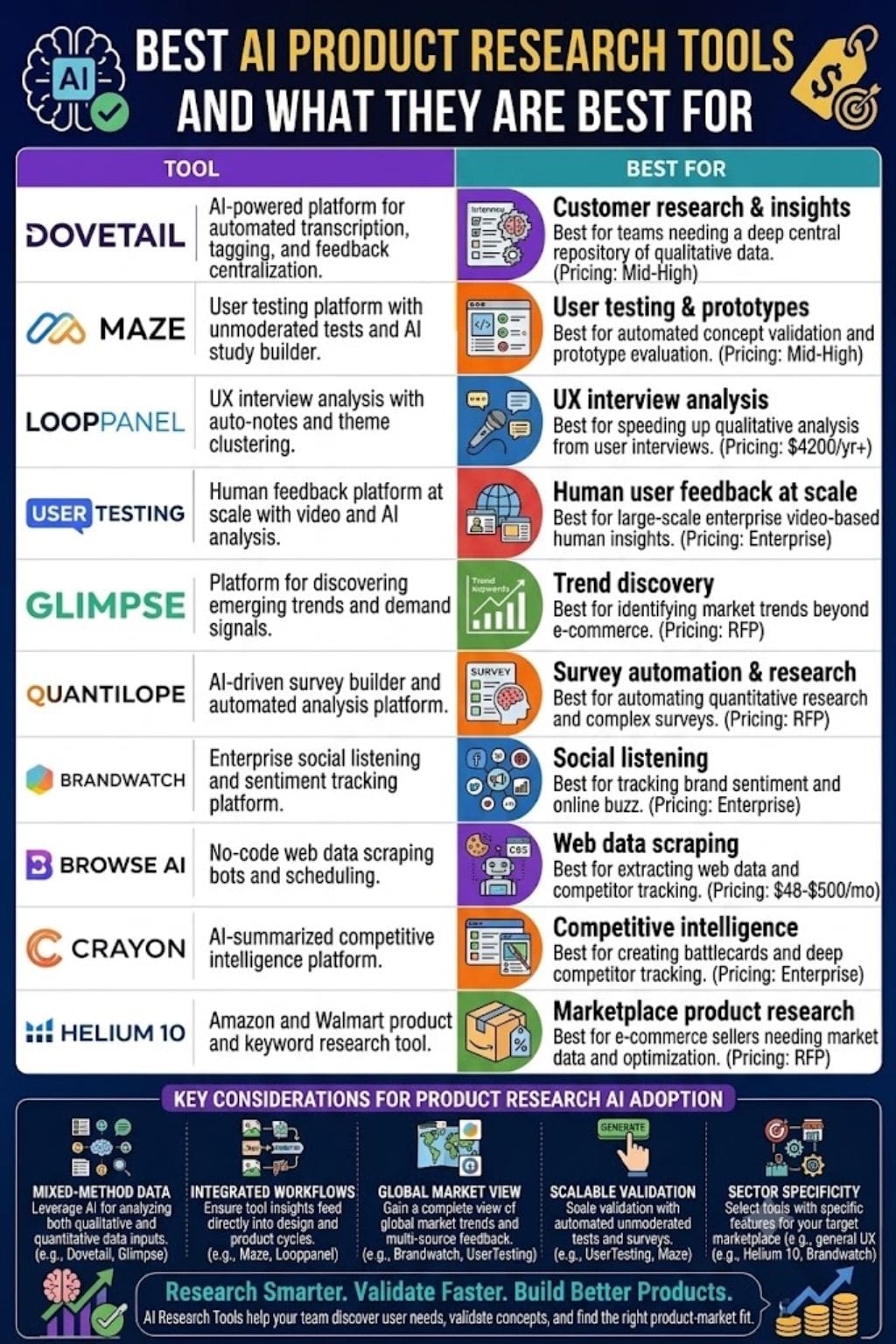
AI Product Research Tools Comparison Table
| Tool | Best For | Key Features | Pricing Level | Drawbacks |
|---|---|---|---|---|
| Dovetail | Customer research & insights | AI transcription, tagging, feedback centralization | Mid–High (RFP) | Per-seat pricing can get expensive |
| Maze | User testing & prototypes | Unmoderated tests, AI study builder, sentiment analysis | Mid–High (RFP) | Complex for non-researchers |
| Looppanel | UX interview analysis | Auto notes, transcription, theme clustering | $4200/year+ | Requires governance for tagging |
| UserTesting | Human user feedback at scale | Video insights, AI analysis, global panel | Enterprise (RFP) | High cost for small teams |
| Glimpse | Trend discovery | Emerging trends, keyword tracking, demand signals | RFP | Limited beyond e-commerce |
| Quantilope | Survey automation & research | Survey builder, AI analysis, dashboards | RFP | Can feel complex for beginners |
| Brandwatch | Social listening | Sentiment tracking, trend detection, dashboards | Enterprise (RFP) | Steep learning curve |
| Browse AI | Web data scraping | No-code bots, scheduling, competitor tracking | $48–$500/month | Struggles with complex sites |
| Crayon | Competitive intelligence | Battlecards, competitor tracking, AI summaries | Enterprise (RFP) | Heavy for small teams |
| Helium 10 | Amazon/Walmart product research | Keyword research, PPC optimization, sales estimates | RFP | Learning curve |
Dovetail
Dovetail is an AI-powered customer insights platform that helps product teams understand what customers need. It brings together interviews, sales calls, surveys, support tickets, and other customer feedback in one place.
The platform automatically transcribes conversations, tags important themes, and makes it easy to search for insights using AI. Teams can quickly find patterns, share key findings, and create clear reports that support product decisions.
By keeping every insight linked to its original source, Dovetail improves trust and makes collaboration easier. This helps companies build better products based on real customer feedback instead of assumptions.
Pros
- Centralizes all qualitative feedback in one place for faster discovery
- Strong AI features for transcription, summarization, and theme detection
- Robust tagging, reels, and reports built for stakeholder‑ready storytelling
Cons
- Per‑seat pricing can scale up quickly for larger research teams
- Free tier is quite limited for serious, ongoing product research
Pricing
Request for pricing (RFP)
Maze
Maze is an AI-powered user research platform that helps teams understand what users want, quickly and easily. It lets you run unmoderated tests, surveys, and interviews in one place. AI helps create research studies, spots biased questions, and turns feedback into clear summaries within minutes.
You can test prototypes, live websites, or even early ideas before building them. The platform highlights user sentiment, common themes, and key problems, making it easier to make product decisions with confidence. With simple integrations and easy sharing, Maze keeps research connected to design and product planning, helping teams build products.
Pros
- AI study builder that turns research goals into ready‑to‑run tests
- Dynamic follow‑up questions for deeper unmoderated insights
- Fast, visual reports and sentiment themes for clear stakeholder buy‑in
Cons
- Light users may under‑utilize AI features
- Advanced capabilities can feel complex for non‑researchers at first
Pricing
Request for pricing (RFP)
Looppanel
Looppanel is an AI-powered UX research platform that helps product teams turn interviews, customer calls, and feedback into clear insights in minutes. It records and transcribes sessions, creates notes automatically, and groups similar themes to reveal patterns quickly.
Teams can search across all research using natural language, making it easy to find important customer signals without digging through endless files. AI-generated summaries, smart tags, and simple dashboards keep everyone aligned and informed.
Instead of scattered recordings and documents, Looppanel gives teams one central place for research, helping them make faster, more confident product decisions.
Pros
- Strong blend of resume screening and video insights
- Can cut time to hire by around 40% in some cases
- Scales well for high-volume hiring
Cons
- Needs careful governance for tagging and themes to keep the repository clean over time
- Adds another platform for teams that already use heavy research ops stacks
Pricing
| Plan | Pricing |
|---|---|
| Pro | $4200/year |
| Enterprise | Contact Sales |
 StartupTalky Official
UserTesting
UserTesting is a human insight platform that helps teams make better product decisions with AI. It turns video, audio, text, and user behavior into clear insights that are easy to act on.
Teams can test ideas, prototypes, and AI features before launch to find issues early and improve the user experience. AI speeds up test creation, participant targeting, and insight analysis, saving time and effort.
The platform also offers a large, verified global panel with fraud checks to ensure reliable feedback. With built-in integrations, UserTesting fits easily into existing product and design workflows.
Pros
- Strong mix of AI speed and real human feedback.usertesting+1
- Great for validating concepts and catching UX issues early
- Transparent AI outputs linked back to raw evidence
Cons
- Enterprise focus can mean higher cost for small teams
- Requires good research practice to design useful tests
Pricing
Request for pricing (RFP)
Glimpse
Glimpse is an AI-powered product research tool that helps businesses find trends before they become popular. It tracks live consumer data to spot fast-growing products, emerging brands, and high-intent search keywords.
Users can explore trends by category, region, or platform to understand where demand is rising. The platform also makes it easy to export insights for product launches, marketing campaigns, and content planning.
Instead of relying on guesswork, Glimpse gives clear data that helps teams validate ideas, discover untapped markets, and stay ahead of competitors. It is a practical tool for marketers, founders, and product teams.
Pros
- Finds early‑stage trends, not just saturated winners
- Simple interface suited to fast validation sprints
- Strong fit for e-commerce and D2C product discovery
Cons
- Focused more on online retail than B2B SaaS
- Signal quality depends on source platforms and regions
Pricing
Request for Pricing (RFP)
Quantilope
Quantilope is an AI-powered consumer research platform that helps companies understand their customers faster. It automates the entire research process, from creating surveys to analyzing results and sharing insights.
Teams can use ready-made templates, build surveys with a simple drag-and-drop interface, and access advanced research methods without needing deep technical skills.
The platform also includes an AI assistant that summarizes findings and highlights key trends in real time. Businesses use Quantilope to test pricing, product ideas, advertising, and packaging before launch. By combining speed, automation, and reliable data, it helps teams make confident decisions in hours.
Pros
- Automation across setup, fielding, analysis, and reporting saves up to half the time per project
- Largest library of fully automated advanced research methods for deep, reliable insights
- Real‑time dashboards and charting support fast, data‑driven decisions
Cons
- Can be expensive for solo or very small businesses
- Advanced options can feel complex for users who only need very simple studies
Pricing
Request for pricing (RFP)
Rishabh Rathi
Brandwatch
Brandwatch is an AI-powered consumer intelligence platform that helps businesses understand what people are saying online. It tracks conversations across social media, review sites, forums, and other digital channels in real time.
The platform groups similar topics, measures customer sentiment, and highlights common pain points, needs, and emerging trends. These insights help product teams improve features, shape product roadmaps, and create stronger marketing messages.
Brandwatch also offers easy-to-read dashboards and real-time alerts, making it simple to spot market changes, understand customer behavior, and stay ahead of competitors with data-driven decisions.
Pros
- Deep social listening and consumer insights from 100M+ sources
- Strong AI for sentiment, trend detection, and topic clustering
- Enterprise‑grade dashboards, alerts, and collaboration features
Cons
- Steep learning curve for new users
- Performance issues reported by some users
Pricing
Request for Pricing (RFP)
Browse AI
Browse AI helps product teams collect and monitor web data without writing code. Using simple point-and-click robots, teams can track prices, gather product details, and keep an eye on competitor websites.
It turns almost any webpage into a live data source that updates on a schedule. The collected information can be sent to spreadsheets, CRMs, or business dashboards, making it easy to organize and use.
This helps teams save time, reduce manual work, and stay informed about market changes. Whether you are researching products, comparing competitors, or tracking pricing trends, Browse AI offers a simple and reliable way.
Pros
- No-code, visual setup fit for non‑technical teams
- Strong scheduling and monitoring for live market tracking
- Wide integrations with thousands of tools
Cons
- Free tier is limited for heavy product research
- Can struggle with some very complex sites
Pricing
| Plan | Pricing |
|---|---|
| Personal | $48/month |
| Professional | $87/month |
| Premium | $500/month |
Crayon
Crayon is an AI-powered platform that helps businesses keep track of their competitors and stay ahead of market changes. It monitors competitor websites, pricing, product launches, marketing campaigns, customer reviews, and social media activity in real time.
Its AI then filters the data, highlights the most important updates, and delivers clear insights through dashboards, battlecards, and sales tools. This helps product, marketing, and sales teams respond faster to changes, improve their messaging, strengthen product positioning, and win more deals.
By turning large amounts of market data into simple, useful insights, Crayon makes competitive intelligence easier and more effective.
Pros
- Centralizes live competitive and product intel in one place
- AI scoring and summaries reduce noise and save research time
- Strong battlecard and CRM integrations for sales and PMM teams
Cons
- Enterprise focus and depth can feel heavy for small teams
- Alerts may include irrelevant changes that need tuning
Pricing
Request for Pricing (RFP)
Vivek Dev Jacob
Helium 10
Helium 10 helps Amazon and Walmart sellers make better decisions with data instead of guesswork. Tools like Adtomic and Xray make it easier to find products with strong demand and lower competition.
Sellers can estimate sales, study trends, and test new ideas before investing money. Adtomic uses AI to manage PPC campaigns, reduce wasted ad spend, and improve returns. The platform also offers keyword research, listing optimization, and review insights to help products rank higher and convert more buyers.
Whether you are launching your first product or growing an established FBA business, Helium 10 provides practical tools.
Pros
- Strong product and keyword database for Amazon and Walmart
- Accurate sales estimates versus key competitors
- Chrome extension for live on‑page validation
Cons
- Feature depth creates a learning curve
- Best value unlocked only on higher‑tier plans
Pricing
Request for Pricing (RFP)
How to Choose the Right AI Product Research Tool
Choosing the right tool depends on your workflow and business stage:
- For startups: Glimpse, Browse AI
- For UX research teams: Maze, Dovetail, Looppanel
- For enterprise insights: Brandwatch, Crayon, Quantilope
- For e-commerce sellers: Helium 10
- For user testing: UserTesting
Key decision factors:
- Budget (startup vs enterprise tools differ heavily)
- Data type (qualitative vs quantitative vs market trends)
- Team size and collaboration needs
- Level of automation required
Conclusion
AI tools make product research faster and more reliable. Instead of spending weeks collecting and sorting data, teams can quickly study customer feedback, market trends, and buying habits. These tools help spot new opportunities, uncover unmet needs, and reveal what customers truly want.
As a result, product teams can test ideas in days rather than months and make decisions based on real evidence instead of guesswork. AI also reduces manual work and removes much of the bias that comes with human judgment. When used well, it becomes a constant source of insight that helps teams build better products.
FAQs
What are AI product research tools?
AI product research tools use machine learning and data analysis to help businesses understand markets, customers, competitors, and trends faster.
Who should use AI product research tools?
They are useful for product managers, startups, e-commerce brands, marketers, and researchers who need data-driven decision-making.
What are the benefits of using AI in product research?
They save time, uncover hidden trends, improve accuracy, and reduce manual research effort.
Which are the most popular AI product research tools?
Tools like Brandwatch, Glimpse, Maze, and Crayon are commonly used for insights, testing, and competitive intelligence.
Are AI product research tools expensive?
Pricing varies widely, some tools start from low monthly plans, while enterprise platforms require custom pricing.