

How Real Madrid Became Football’s First €1 Billion Club | Business Model | Revenue Model
Discover how Real Madrid generates billions through media rights, sponsorships, stadium revenue, merchandising, and digital expansion.


Real Madrid is a global football powerhouse known for both sporting success and savvy business. The club’s revenue model spans many sources. Real earns from media rights, matchday activities, sponsorships, merchandising, digital ventures, and other areas. In recent years, the club has set revenue records.
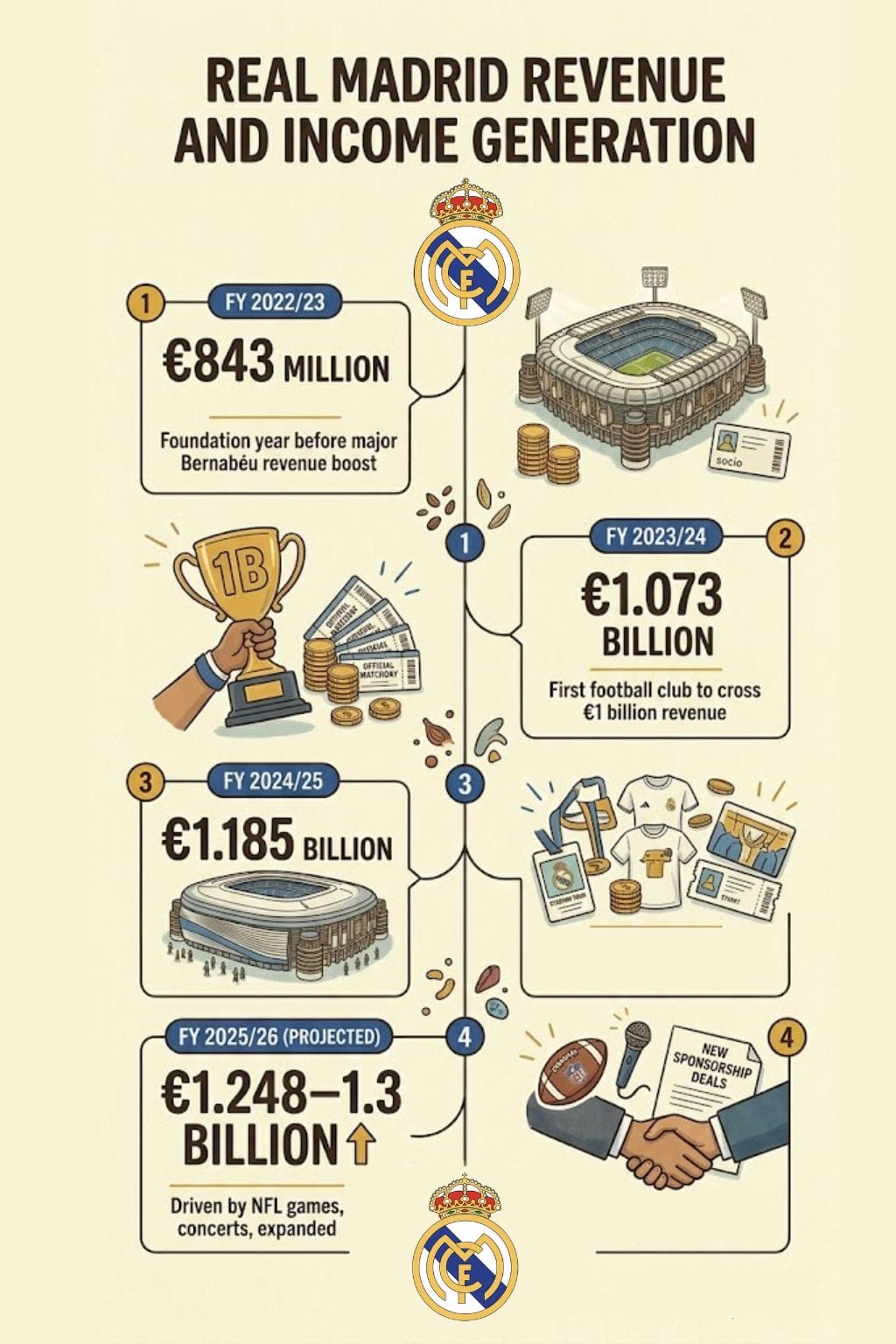
For example, operating income was €1.073 billion in 2023/24 and jumped to €1.185 billion in 2024/25. Deloitte’s Football Money League even noted that Real became the first club ever to break €1 billion in a season. For 2025/26, the club targeted roughly €1.3 billion, underscoring an aggressive growth strategy.
In short, Real Madrid consistently transforms on-field success and a global brand into multi-channel commercial income.
Real Madrid Revenue and Income Generation (Year-wise)
| Financial Year | Total Revenue | Broadcast Revenue | Matchday / Stadium Revenue | Commercial / Sponsorship | Merchandising & Licensing | Net Profit | Key Highlights |
|---|---|---|---|---|---|---|---|
| 2022/23 | €843 million | N/A | Pre-renovation levels | Strong sponsorship portfolio | High global merchandise sales | Positive | Foundation year before major Bernabéu revenue boost |
| 2023/24 | €1.073 billion | €179 million | €248 million | €482 million | Included in commercial category | Positive | First football club to cross €1 billion revenue |
| 2024/25 | €1.185 billion | €162 million | €326.8 million | Largest revenue contributor | €506 million (marketing category) | €24.3 million | Bernabéu fully transformed into major revenue engine |
| 2025/26 (Projected) | €1.248–1.3 billion | Stable | Expected further increase | +7% projected growth | Continued expansion | Projected positive | Driven by NFL games, concerts, expanded sponsorships |
Broadcasting and Media Rights
Broadcasting deals form a major chunk of Real’s income. Real earns from La Liga’s centralized TV contract and from UEFA competitions (Champions League, Club World Cup, etc.). In 2024/25, broadcast revenue was about €162 million (down slightly from €179m the year before under a new UEFA revenue-sharing scheme).
Even so, TV deals still account for roughly a quarter of total revenue. In fact, Deloitte reports that top clubs average about 38% of income from TV, and Real’s share is similar. Champions League appearances help stabilize this stream: as long as Real qualifies, it secures substantial UEFA media money.
However, this category is now largely mature, domestic and European TV incomes are fixed by contracts, so broadcast growth is limited going forward.
Matchday and Stadium Income
Matchday (stadium) revenue has surged thanks to the Bernabéu renovation. This category includes ticket sales, season-ticket (club member) fees, VIP/hospitality packages, and stadium tours/museum admissions. After the expansion work, Real’s matchday income nearly doubled to €248 million in 2023/24.
A key factor was the sale of Personal Seat Licenses (PSLs) and premium seats, which alone contributed roughly €76 million one-time. In addition, stadium tours and events have increased (for example, the “Real Madrid Experience” museum). In 2024/25, combined membership and stadium receipts were €326.8 million.
Real has about 100,000 annual club members (socios) paying dues, and higher ticket prices in big games also help. In short, the modernized Bernabéu has turned matchday into a major profit pillar. For context, before the rebuild, matchday used to contribute only ~15–20% of revenue; now it is far higher.
 Sakshi Jadhav
Sponsorship and Advertising
Sponsorship and advertising represent the largest share of Real’s revenues. The club signs multiyear deals with elite global brands that pay tens of millions per season. For example, Adidas provides Real’s kit in a deal reportedly worth about €110 million per year; Emirates is the main shirt sponsor; Audi and others are premium partners.
Real has also added new sponsors, such as HP, on the jersey sleeve. Each big sponsor contract alone contributes several million euros annually. Beyond headline partners, Real generates income from a wide portfolio: it sells regional sponsorships during its tours (e.g., deals with local banks or airlines) and runs global promotional campaigns.
In 2023/24, sponsorship plus related commercial activities brought in about €482 million, roughly 45% of the club’s total revenue. In other words, nearly half of Real’s income comes from selling brand partnerships and advertising, reflecting the club’s massive appeal to companies.
Merchandising and Licensing
Merchandising is another vital element of Real’s business. The club sells official jerseys, training apparel, souvenirs, and branded products worldwide. It operates hundreds of official stores (flagship shops in major cities and outlets in stadiums) and a robust e-commerce site.
Real’s merchandise revenues are enormous: one analysis estimated €196 million from kit and apparel sales in 2024, the most of any club. The Real Madrid brand is also licensed for use in video games (e.g., the FIFA series), apparel lines, toy and figurine collections, and media.
These licensing deals earn substantial royalties and fees. In fact, Real’s 2025 budget notes that income from its stores (physical and online) was stable year-on-year, indicating strong ongoing demand. Overall, merchandise and licensing (combined into the “marketing” category) were budgeted at around €506 million for 2024/25, showing continued growth beyond the €482m achieved in 2023/24.
Rishi Mundra
Digital Ventures and New Media
Real Madrid has actively expanded its digital footprint to engage fans and open new revenue streams. The club offers a mobile app (RM Play) and its own video streaming service (RMTV) featuring match highlights, documentaries, and player interviews. Real also boasts one of the largest social media followings in sports (over 500 million total followers).
It monetizes this reach with digital advertising and sponsored content. Additionally, Real fields professional eSports teams (such as Real Madrid CF eSports in FIFA competitions) and has explored blockchain fan tokens and NFTs to engage supporters. To facilitate this, Real partnered with IT firm Softtek to modernize its digital infrastructure.
These initiatives allow Real to offer new products (e.g, paid video content, interactive fan events) and digital advertising. While digital revenue is still small relative to core streams, it represents a fast-growing frontier, reaching younger fans and creating incremental income beyond traditional methods.
Other Income Streams
Beyond the main categories above, Real has various other revenue lines that add up to a modest share. “Competition revenue” (prize money and bonuses) is one. For example, reaching the semifinals of the 2025 Club World Cup earned Real about €74 million in prize payouts.
On the other hand, failing to qualify for certain finals (like the UEFA Super Cup) can cut this income; Real’s 2025/26 budget projected a 25% drop in competition revenue for that reason. Real also earns from lucrative friendly matches and tours. Additional sources include arena rentals (concerts, exhibitions), sponsorships of Real’s basketball team, and activities of the Real Madrid Foundation.
These “other” incomes total only a few percent of overall revenue, but they help diversify the club’s balance sheet.
Shubham Kumar
Key Financial Figures and Trends
Real Madrid’s financial results show consistent growth and healthy profits. We have noted revenues rising each year (from €843m in 2022/23 to €1.073bn in 2023/24 to €1.185bn in 2024/25). In those years, almost every revenue line increased.
Profitability has remained positive: Real has recorded an operating profit in every year since 2000, and in 2024/25 the net profit after tax was about €24.3 million. Importantly, Real’s balance sheet is extremely strong. As of June 2025, equity was roughly €598 million and net debt was only about €12 million, essentially debt-free (net debt/EBITDA ≈ 0).
The club’s wage-to-revenue ratio is also well-controlled: about 43% in 2024/25, far below UEFA’s 70% cap. In sum, Real’s business produces strong cash flow and low leverage.
Future Outlook
Real Madrid’s outlook through 2025/26 is optimistic. The club budgeted about €1.248 billion in revenue for 2025/26 (around 5% growth). This plan assumes continued increases across the board: matchday revenue will rise as the renovated stadium is fully operational (more home games, expanded tours, and VIP packages), and sponsorship revenue is forecast to grow by roughly 7%.
TV income is expected to hold steady under new domestic deals. Additional competitions and events could provide windfalls: for example, expanded Champions League formats or the new FIFA Club World Cup offer more prize money.
Off the field, Real is also seeking new avenues; the Bernabéu will host NFL games and major concerts, and the club continues to grow its global academies and women’s football business. Thanks to its diversified model and strong brand, Real appears well-positioned to keep breaking its own revenue records.
FAQs
How does Real Madrid make money?
Real Madrid earns money through multiple streams, including broadcasting rights, sponsorship deals, matchday ticket sales, stadium tours, merchandising, licensing, and digital ventures such as streaming and fan engagement platforms.
What is Real Madrid’s biggest source of revenue?
The club’s largest revenue source is commercial income, particularly sponsorship and advertising partnerships with global brands like Adidas and Emirates. This contributes nearly half of its total annual revenue.
How much revenue does Real Madrid generate annually?
In the 2024/25 season, Real Madrid generated approximately €1.185 billion, making it one of the highest-earning football clubs in the world.
Why is the Santiago Bernabéu renovation important for Real Madrid’s business?
The renovation of Santiago Bernabéu Stadium significantly increased matchday and event revenue through premium seating, concerts, stadium tours, and hosting global events, turning the stadium into a major long-term business asset.


