How Vinay Nair Is Taking KhetiBuddy’s Agritech Innovation Global with Verdnt
From transforming farm data in India to powering global agribusiness, Vinay Nair reveals how KhetiBuddy’s Verdnt is redefining digital agriculture, traceability, and the future of farm technology.
The global agritech market is entering a high-growth phase as agriculture increasingly adopts AI, IoT, data analytics, automation, and digital supply-chain solutions. The global agritech market is projected to grow from $38.56 billion in 2026 to $58.79 billion by 2030, registering a CAGR of 11.1%. In India, the agritech market was approximately $974 million in 2025 and is projected to reach $2.52 billion by 2034, growing at a CAGR of 10.59% during 2026–2034.
The future of agritech is expected to be driven by AI-powered analytics, farm-level traceability, digital agriculture platforms, sustainability reporting, supply-chain transparency, and interoperability with public digital infrastructure. For agribusinesses, the ability to collect, standardize, and use farm-level data is becoming increasingly important as sustainability and traceability requirements grow.
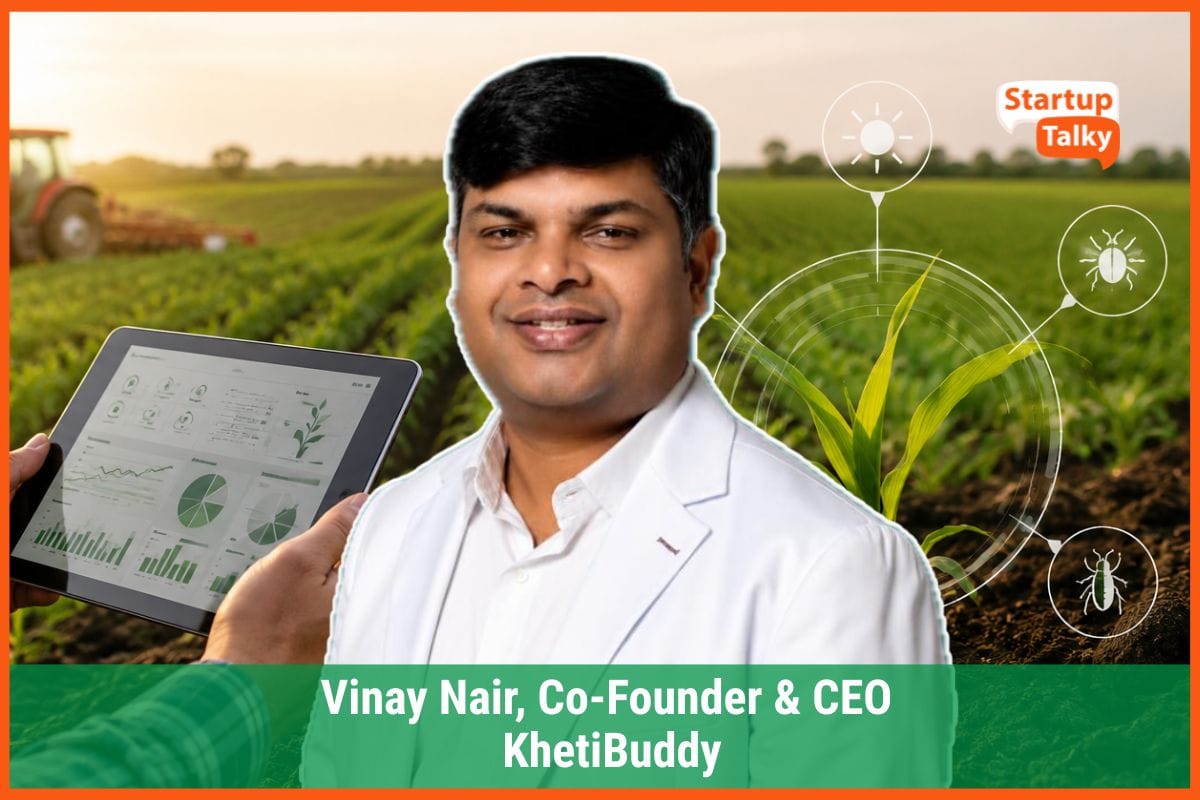
Against this backdrop, Vinay Nair, Co-Founder & CEO, KhetiBuddy, discusses how the company is taking its farm-data technology from India to international markets through its new Verdnt brand. He explains the thinking behind the separate brand, the challenges of farm-data integration, changing technology adoption among smallholder farmers, Bharat-VISTAAR, government partnerships, and the growing importance of food traceability.
KhetiBuddy launched Verdnt to create a distinct identity for international agribusiness clients
StartupTalky: KhetiBuddy launched Verdnt as a separate brand for international agribusiness clients while keeping KhetiBuddy for India. What made you split the product identity rather than use one platform globally?
Vinay Nair: It was not a branding decision. It was an honesty decision. KhetiBuddy carries six years of India-specific context, relationships, and trust. Taking that name into a boardroom in the Netherlands or Canada and asking them to evaluate it as an enterprise SaaS platform would have created unnecessary noise. International buyers are making procurement decisions, not learning about Indian agtech.
Verdnt is the platform name we use internationally because it speaks to what the product does: a data backbone that connects farm operations to enterprise supply chain and sustainability reporting. The underlying technology is the same. The name simply removes the friction of context that the buyer should not have to carry.
Selling farm data software in international markets requires a different approach from India
StartupTalky: You have over 35 enterprise clients in India and are now targeting North America and Europe. What does selling farm data software to an agribusiness in the Netherlands look like compared to selling to one in Maharashtra?
Vinay Nair: The problem is the same. The entry point is completely different. In Maharashtra, you are typically walking into a conversation about operational efficiency: can you help us track what is happening on contracted farms, reduce input wastage, improve yield predictability? The business case is built around cost and control. In the Netherlands or Canada, the conversation usually starts with compliance.
EU deforestation regulations, sustainability disclosures to institutional buyers, carbon traceability requirements from retail chains. The buyer already understands that they need a data layer. They are asking whether you can deliver it at the quality and integration depth they need. The sales cycle is longer internationally but the qualification is faster because the urgency is regulatory, not discretionary.
Inconsistent farm identity remains the biggest challenge in farm-level data integration
StartupTalky: Verdnt consolidates farm-level data directly into enterprise procurement and supply chain systems. What is the single biggest data quality problem that breaks this integration in practice?
Vinay Nair: Inconsistent farm identity. Before you can integrate anything into a procurement system, you need to know that Farm A in your data model is the same Farm A that exists in the contract, in the field agent's records, and in the traceability report. Sounds simple. It is not. Across 35 enterprise customers in India, we have seen the same farm recorded under different names, different land parcel references, different GPS coordinates taken from different corners of the plot.
When you try to push that into an ERP or a supply chain system, it breaks immediately. The fix is not technical, it is foundational: you need a structured farm master with unique identifiers before any integration layer can function. Most agribusinesses have not done that work. We end up doing it with them before the platform can deliver its value.
Smallholder farmers now need technology that works within existing trust networks
StartupTalky: You built KhetiBuddy after discovering that most farmers struggled with hard-to-use apps and incomplete data. How has the bar for what counts as usable technology changed for a smallholder farmer between 2021 and 2026?
Vinay Nair: What we discovered was less about the technology and more about the implementation model. The apps were not failing because farmers could not use smartphones. They were failing because the apps were designed for the farmer to use alone, without support, which is not how adoption actually happens in the field. What has changed between 2021 and 2026 is that the better implementations now sit the technology inside an existing trust relationship: an agronomy team, a field agent, a cooperative.
The farmer interacts with the output, not necessarily the interface. Voice access and regional language support have also moved from nice-to-have to table stakes. We have seen this directly: a large food company we work with saw field data completeness go from below 40 percent to above 85 percent, not because they changed the app, but because they changed who was responsible for data entry and built accountability into the agronomy workflow.
KhetiBuddy sees Bharat-VISTAAR as complementary to its enterprise-focused agriculture platform
StartupTalky: You have noted that Bharat-VISTAAR, launched in early 2026, is reshaping how agtech platforms interact with government data systems. How is KhetiBuddy positioning itself relative to this government-built agricultural AI infrastructure?
Vinay Nair: Bharat-VISTAAR is genuinely significant. It is India's first attempt at building digital public infrastructure for agriculture at a national scale, with a plug-and-play architecture that allows third-party platforms to integrate. Our positioning is complementary, not competitive. Bharat-VISTAAR is built for farmer-facing advisory: weather, scheme access, crop guidance.
KhetiBuddy sits on the enterprise side of that transaction, helping the agribusiness that contracted those farmers make sense of what is happening across their supply base. Where the opportunity is interesting is at the data exchange layer. As Bharat-VISTAAR matures and opens its API stack, platforms like ours can pull verified agronomic and scheme data into enterprise workflows without starting from scratch. We are watching that closely and building toward interoperability.
Government partnerships are shaping KhetiBuddy's approach to product development and distribution
StartupTalky: KhetiBuddy won the Maharashtra Startup Week Agriculture Category and has backing from the Government of Maharashtra. What does a government partnership actually change about how you build or distribute the product?
Vinay Nair: It changes how you think, more than how you operate. Working with government gives you a window into how policy actually gets made, how digitisation decisions get taken at scale, and what the real constraints are when you are trying to move something across hundreds of thousands of farmers and dozens of districts.
That perspective is valuable when you are building an enterprise platform because your buyers, especially large agribusinesses, are themselves navigating government programmes, compliance frameworks, and sustainability mandates shaped by policy. It also aligns our platform direction toward regenerative agriculture outcomes, where the intersection of digital traceability, input efficiency, and soil health data has real policy relevance. We are not building just for operational efficiency. We are building for a future where enterprise agribusiness data and government agricultural policy need to speak the same language.
EU traceability requirements are pushing Indian agribusinesses to strengthen their farm-level data systems
StartupTalky: Food traceability is now a regulatory requirement in the EU for agricultural imports. How are Indian agribusinesses you work with preparing for that compliance burden, and where does the data gap sit today?
Vinay Nair: Honestly, most are not prepared. The ones that are exporting to Europe or working with buyers who have European supply chains are beginning to feel the urgency, but the data foundation needed for meaningful traceability simply does not exist for the majority. What the EU regulation requires is farm-level origin data, input usage records, and supply chain linkage from field to shipment.
Most Indian agribusinesses can tell you which cold storage a consignment came from. Very few can tell you with confidence which contracted acres produced it, what inputs were applied, and by whom. The gap is not in intent. It is in structured data collection at the farm level, which is exactly what we have been building for. The regulation is accelerating the conversation significantly. What used to be a five-meeting sales cycle is becoming a two-meeting one because the compliance deadline is no longer theoretical.
 Vivek Dev Jacob