Best AI Tools for Buyer Persona Generation
AI buyer persona generation tools help businesses turn customer data and research into clear buyer profiles. Explore 10 tools for customer profiling, research, persona creation, and buyer insights.

AI tools for buyer persona generation help businesses understand their customers better. They study data such as website visits, search terms, survey responses, sales notes, and social media activity.
From this information, they find common needs, habits, goals, and pain points. This helps marketing teams create clear and realistic customer profiles. With better personas, businesses can write stronger messages, create useful content, and run more relevant campaigns.
These tools also save time and reduce guesswork. Instead of relying on broad assumptions, teams can use real customer data to guide their decisions.
AI Buyer Persona Generation Tools: Quick Comparison
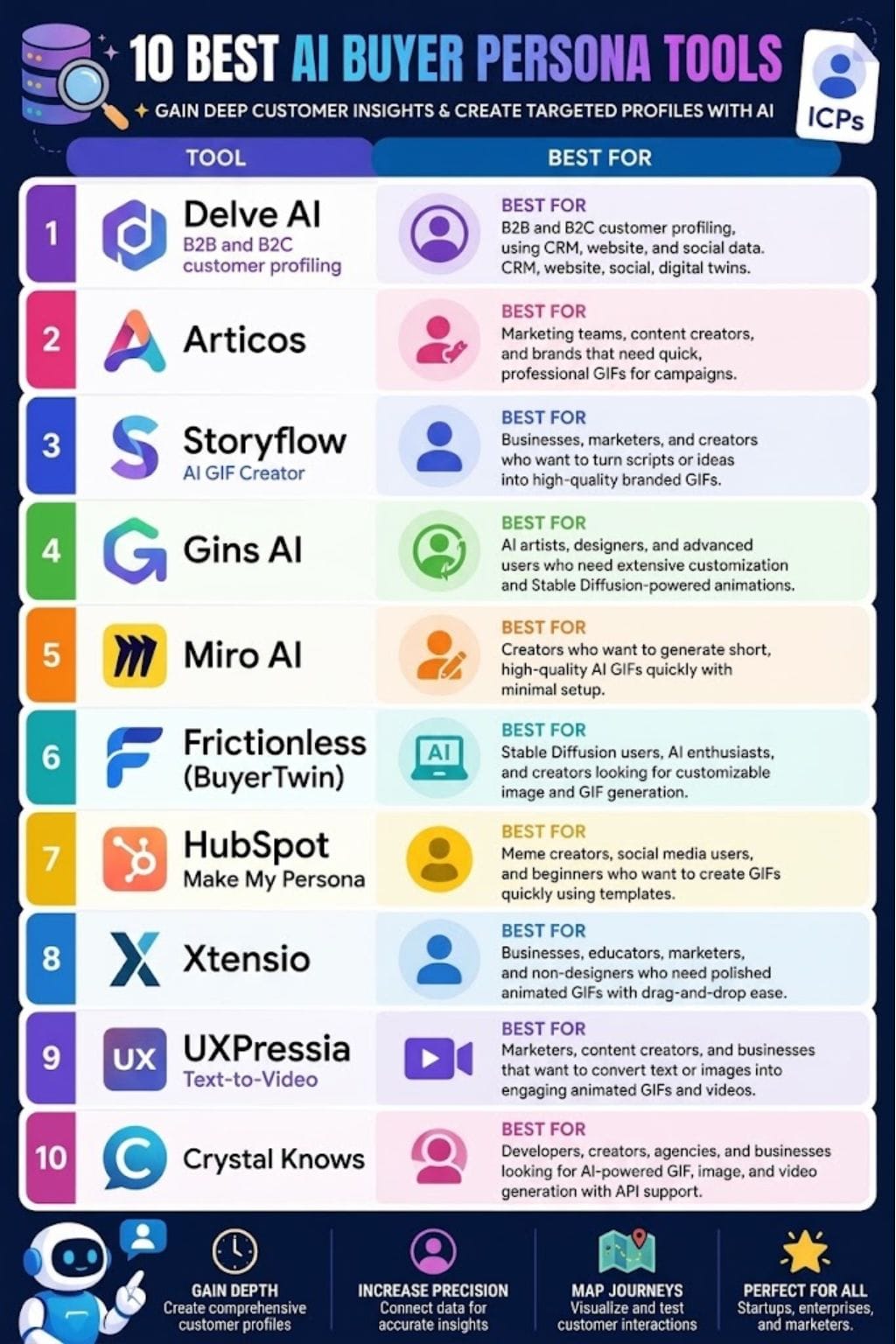
| AI Buyer Persona Tool | Best For | Key Features | Pricing | Drawbacks |
|---|---|---|---|---|
| Delve AI | B2B and B2C customer profiling | CRM, website, social, competitor and public data; buyer personas; ICPs; digital twins; synthetic users | From $317/month | Quality depends on connected data; CRM profiling can be costly |
| Articos | AI-powered customer research | Synthetic personas, AI interviews, ICP discovery, messaging, pricing and concept testing | $47–$119/month | Poor CRM data can reduce recommendations; less useful for non-account-based firms |
| Storyflow | Research-based customer profiles | Research canvas, survey notes, transcripts, files, customer personas, journeys and marketing frameworks | RFP | Not a dedicated CRM or customer-data platform; quality depends on research |
| Gins AI | Simulated customer research | AI personas, interviews, focus groups, surveys, A/B tests, GTM content and reports | From $99/month | Biased ICPs can create biased outputs; reports may appear more conclusive than the evidence |
| Miro AI | Collaborative buyer persona creation | Research uploads, persona generation, customer journeys, product planning and visual collaboration | Included with paid Miro plans | Quality depends on research; AI credits limit use on lower plans |
| Frictionless (BuyerTwin) | Buyer intelligence and B2B testing | Virtual buyers, messaging tests, ads, websites, offers, buyer motivations, objections and competitor views | $29–$249/month | AI responses may not reflect real buyer behavior; important decisions need human review |
| HubSpot Make My Persona | Simple and free buyer personas | AI persona generation, goals, challenges, buying habits, communication preferences, PDF export | Free | Weak inputs can create vague personas; saves only three personas at a time |
| Xtensio | Presentation-ready personas | AI persona generation, drag-and-drop editing, brand styling, collaboration and exports | Free plan | Not a research repository; output depends on audience context |
| UXPressia | Personas and customer journey mapping | Personas, journey maps, AI profiling, simulated chats, AI focus groups and source tracing | $36–$95/user | Advanced AI features require paid AI Boost; free plan has limits |
| Crystal Knows | Sales communication and prospect insights | DISC personality predictions, communication guidance, CRM integrations, meeting briefs and follow-up guidance | RFP | Personality predictions can be wrong; does not provide intent or lead discovery |
Delve AI
Delve AI is an AI-powered customer profiling platform that helps teams build clear buyer personas and ideal customer profiles. It uses data from CRMs, websites, social media, competitors, and public research to group audiences by demographics, firmographics, behavior, and interests.
Each persona can show customer goals, needs, pain points, buying barriers, content preferences, and journey stages. These insights help marketing and sales teams improve targeting, outreach, messaging, and product decisions.
Delve AI also offers digital twins and synthetic users to test ideas and campaigns. It can also create personas directly from HubSpot data.
Pros
- Combines first-party data with social, competitor, and 40+ public sources, so teams can move beyond survey-only personas
- Produces structured, ready-to-use personas quickly, reducing manual analysis time
- Supports both B2B and B2C profiling, including firmographic and transactional signals
Cons
- Persona quality depends heavily on the accuracy, volume, and coverage of connected data
- CRM-based profiling can be costly for smaller teams with limited budgets
Pricing
| Plan | Pricing |
|---|---|
| Research Essential Bundle | $317/month |
| Marketing Essential Bundle | $877/month |
| Complete Bundle | $2499/month |
Articos
Articos is an AI-powered user research tool that helps teams understand their target customers without having to recruit real participants for every study.
It creates a range of synthetic customer personas and conducts structured AI interviews to uncover customer needs, pain points, jobs to be done, objections, buying triggers, and ideal customer profiles.
Teams can also use it to test messaging, product ideas, landing pages, pricing, and new concepts. Results are delivered in under 30 minutes through clear reports that highlight key themes, confidence levels, supporting evidence, and suggested actions. Articos works best for early research and testing ideas.
Pros
- Runs hypothesis-blind interviews, which can limit leading questions and confirmation bias
- Turns raw simulated interviews into practical reports
- ICP discovery, persona creation, messaging, pricing
Cons
- Poor CRM data or weak account rules can reduce the value of AI recommendations
- It may be less useful for firms that do not sell through named accounts
Pricing
| Plan | Pricing |
|---|---|
| Starter | $47/month |
| Pro | $119/month |
Storyflow
Storyflow is an AI-powered visual workspace that helps teams create customer profiles from real research. Users can add survey notes, interview transcripts, links, or files to a shared canvas.
The AI uses this information to build detailed customer personas, including demographics, goals, pain points, habits, motivations, and key messages. Since the personas are linked to the original research, teams can review the information, check assumptions, and make changes when needed.
Storyflow also goes beyond customer profiles. Teams can use the same workspace to plan projects, map customer journeys, and develop marketing ideas. This makes research easier.
Pros
- AI can use the wider canvas as context, which cuts repeat briefings
- Supports files, images, PDFs, links, mind maps, kanbans, and storyboards
- Includes guided marketing and strategy frameworks, such as Customer Persona and AIDA
Cons
- It is a broad creative workspace, not a dedicated CRM or customer-data platform
- Profile quality depends on the truth and depth of the research you add
Pricing
| Plan | Pricing |
|---|---|
| Starter | $47/month |
| Pro | $119/month |
 Revathy Nair
Gins AI
Gins AI is an AI-powered customer research platform that helps teams understand their ideal customers before spending time or money on a campaign or product.
It creates realistic AI personas based on an ideal customer profile (ICP) and uses them to simulate interviews, focus groups, surveys, and A/B tests. Teams can test product ideas, pricing, messaging, features, and creative concepts with these simulated panels.
Gins AI also turns the results into clear reports and useful marketing and sales content. It helps teams spot weak ideas early, improve their go-to-market plans, and make faster decisions.
Pros
- Test many ideas without recruiting a real research panel
- Combines research, validation, and GTM content in one tool
- Unlimited simulated research can help teams iterate often
Cons
- A vague or biased ICP can create vague or biased outputs
- Detailed reports may look more conclusive than the underlying evidence warrants
Pricing
| Plan | Pricing |
|---|---|
| Growth | $99/month |
| Enterprise | Contact Sales |
Miro AI
Miro AI’s Buyer Persona Generator helps teams turn customer research into clear and useful buyer profiles. You can upload interview notes, survey results, customer feedback, or behavior data.
If you do not have much research, you can also describe your target market and let the tool build a starting point. It looks for common patterns and creates personas based on goals, pain points, motivations, buying habits, decision styles, and preferred channels.
Teams can then edit and improve these personas together on a shared board. The personas can also be connected to customer journeys, product plans, marketing ideas.
Pros
- Keeps personas, journeys, backlogs, and prototypes in one visual workspace
- Supports live and async team editing, which helps teams validate assumptions
- Easy for non-research staff to read, change, and present
Cons
- Persona quality still depends on the quality and breadth of the source research
- AI credits limit how often teams can generate or revise profiles on lower plans
Pricing
| Plan | Pricing |
|---|---|
| Paid Miro plans | Included with paid plans of Miro |
Frictionless (BuyerTwin)
BuyerTwin, formerly known as Frictionless, is an AI-powered buyer intelligence tool that helps teams understand their target customers better.
It creates virtual buyer profiles based on real data, allowing teams to ask questions, test ideas, and understand what may drive or stop a purchase. Teams can use BuyerTwin to review marketing messages, ads, websites, offers, product features, and sales pitches before launching them.
It also helps identify buyer motivations, objections, keywords, channels, and views on competitors. By giving teams quick and repeatable buyer feedback, BuyerTwin reduces guesswork and helps businesses improve product-market fit, sharpen their messaging.
Pros
- Shows motivations, objections, priorities, and a committee-level view for complex B2B purchases
- Helps teams share a common buyer view across marketing, sales, and product
- Can surface buyer language, search intent, preferred channels, and competitor perceptions
Cons
- Teams may treat clear AI responses as proof, even when real buyers behave differently
- It can encourage fast testing, but needs human review for high-stakes product and market decisions
Pricing
| Plan | Pricing |
|---|---|
| Core | $29/month |
| Growth | $99/month |
| Scale | $249/month |
Vivek Dev Jacob
HubSpot Make My Persona
HubSpot’s Make My Persona is a free AI tool that helps businesses create buyer personas in a few simple steps.
You only need to describe your ideal customer in plain language, and the tool builds a clear profile covering their job, goals, challenges, buying habits, research sources, and communication preferences.
The persona follows a ready-made professional format, so there is no need to build a template yourself. Teams can edit, share, or export the persona as a PDF. You can save up to three personas at a time. It can help sales, marketing, and product teams.
Pros
- It is free, with no credit card or subscription required
- The layout is easy to use in briefs, decks, and team talks
- It gives sales and marketing one shared view of a target buyer
Cons
- Weak or biased inputs can create a vague or false persona
- The tool saves only three personas at a time
Pricing
| Plan | Pricing |
|---|---|
| Free | Free tool |
Xtensio
Xtensio’s AI Persona Generator helps teams create detailed customer personas from a simple description. It can suggest details such as demographics, company information, goals, motivations, habits, pain points, buying triggers, preferred channels, tools, and messaging ideas.
The tool also lets users edit the persona using drag-and-drop sections, add brand styles and visuals, work with teammates, and share the final version through a live link or export.
It is useful for quickly building a clear starting point for customer research. However, AI-generated details should not be taken as facts. Teams should check them against customer interviews, surveys, and analytics.
Pros
- Produces presentation-ready, interactive documents rather than plain text profiles
- Lets teams edit, co-create, reuse, share by live link, and export to PDF or PNG
- Covers both user insight and communication needs, including messaging notes and decision trigger
Cons
- It is chiefly a persona-document builder, not a direct research repository or interview-analysis platform
- The quality of the result depends heavily on the audience context entered by the user
Pricing
| Plan | Pricing |
|---|---|
| Free Plan | Free |
UXPressia
UXPressia is an AI-powered customer experience platform that helps teams create customer profiles, personas, and journey maps. It turns research into clear persona drafts and connects them with customer journeys.
Teams can map customer goals, pain points, emotions, touchpoints, and channels in one place. Its AI can build profiles, improve content, create journey maps, and highlight useful insights from research.
Advanced features include persona chats, AI focus groups, source tracing, ticket analysis, and journey map summaries. The platform is useful for UX, product, and CX teams that need a shared view of their customers.
Pros
- Supports multi-persona journeys and simulated persona group chats.help.uxpressia+1
- Lets teams use different AI models, including OpenAI, Claude, and Gemini
- Can turn support tickets into stage-level sentiment and issue signals
Cons
- Advanced profiling tools are tied to the paid AI Boost add-on, with pricing available only on request
- The free plan limits users to three personas, three journey maps, and three impact maps
Pricing
| Plan | Pricing |
|---|---|
| Pro | $36/user |
| Business | $95/user |
| Enterprise | Custom Pricing |
Rinky Moolchandani
Crystal Knows
Crystal Knows is an AI-powered tool that helps sales teams understand and engage with prospects. It uses public information, such as LinkedIn data, to predict a person’s DISC personality style and suggest ways to communicate with them.
Sales reps can view buyer profiles, prepare for meetings, and get tips on tone, pace, level of detail, and follow-ups. Crystal can also work with platforms like LinkedIn, HubSpot, and Salesforce.
It offers CRM enrichment and an API that lets businesses add personality insights to other tools. However, its predictions should be treated as guidance.
Pros
- Gives clear do’s and don’ts for emails, calls, and meetings
- Shows insights in LinkedIn, HubSpot, and Salesforce workflows
- Creates meeting briefs and follow-up guidance for each prospect
Cons
- DISC results are predictions from public signals, so they can be wrong
- It helps with communication style, but it does not provide intent data, contact data, or lead discovery
Pricing
| Plan | Pricing |
|---|---|
| Request for Pricing | Contact Sales |
How to Use AI-Generated Buyer Personas Effectively
AI tools can make customer profiling faster, but the quality of the persona still depends on the information used to create it.
Start With Real Customer Data
Use information such as website visits, search terms, survey responses, sales notes, social media activity, customer feedback, and CRM data where available.
This gives AI tools better information to identify customer needs, habits, goals, and pain points.
Check AI-Generated Assumptions
AI-generated details should not automatically be treated as facts. Review personas against customer interviews, surveys, analytics, and sales feedback.
This is especially important when the persona is created from limited information or synthetic research.
Keep Personas Useful for Teams
A buyer persona should help marketing, sales, product, and customer experience teams understand the same target customer.
Use the persona to guide messaging, content, campaigns, product ideas, customer journeys, and sales conversations.
Update Personas Over Time
Customer needs and buying behavior can change. Review personas regularly and update them when new customer data becomes available.
Final Thoughts
AI tools for customer profiling help businesses understand their customers better. They bring scattered data together and show what people want, when they need it, and how they make choices.
This helps companies create better offers, respond faster, and build stronger customer relationships. AI can also find patterns that may be hard for people to spot on their own. But businesses must use these tools with care.
Customer data should be handled fairly, kept safe, and used with clear consent. AI should support human decisions, not replace them. AI can make customer insights more useful, personal, and reliable.
FAQs
What are AI buyer persona generation tools?
AI buyer persona generation tools use customer data, research, and AI to create detailed profiles of target customers. These profiles can include goals, pain points, buying habits, motivations, and communication preferences.
How do AI tools create buyer personas?
AI tools analyze information such as CRM data, website activity, survey responses, interview notes, customer feedback, and other research. They identify patterns and organize them into customer or buyer profiles.
What are the best AI buyer persona generation tools?
Popular AI buyer persona generation tools include Delve AI, Articos, Storyflow, Gins AI, Miro AI, Frictionless (BuyerTwin), HubSpot Make My Persona, Xtensio, UXPressia, and Crystal Knows.
What are the benefits of using AI for buyer persona creation?
AI can help businesses analyze customer information faster, identify patterns, reduce manual research, and create structured buyer profiles. These insights can support better targeting, messaging, content, and customer engagement.
Can AI-generated buyer personas replace real customer research?
No. AI-generated personas should be treated as a support for customer research rather than a replacement for real customer insights. The quality of the persona depends on the data and research used, so businesses should review AI outputs against real customer feedback and other reliable sources.