10 Best AI Conversion Tracking Tools to Optimize Marketing Performance (2026)
AI conversion tracking tools help businesses identify which campaigns, channels, and customer interactions drive real revenue. Compare the best AI-powered platforms by features, pricing, pros, cons, and use cases to improve attribution, optimize marketing performance, and increase ROI.

In today’s digital world, marketing is no longer about guesswork. Every click, view, and interaction can be tracked—but the real challenge is understanding what actually leads to conversions. This is where AI conversion tracking tools are changing the game. They use artificial intelligence to analyze customer journeys across websites, ads, emails, and apps, helping businesses clearly see what drives results and what doesn’t.
With competition increasing in almost every industry, optimizing marketing performance has become more important than ever in 2026. AI-powered tracking tools not only improve attribution accuracy but also predict customer behavior, reduce wasted ad spend, and boost ROI.
In this article, we explore the 10 best AI conversion tracking tools that can help you make smarter, data-driven marketing decisions and grow faster.
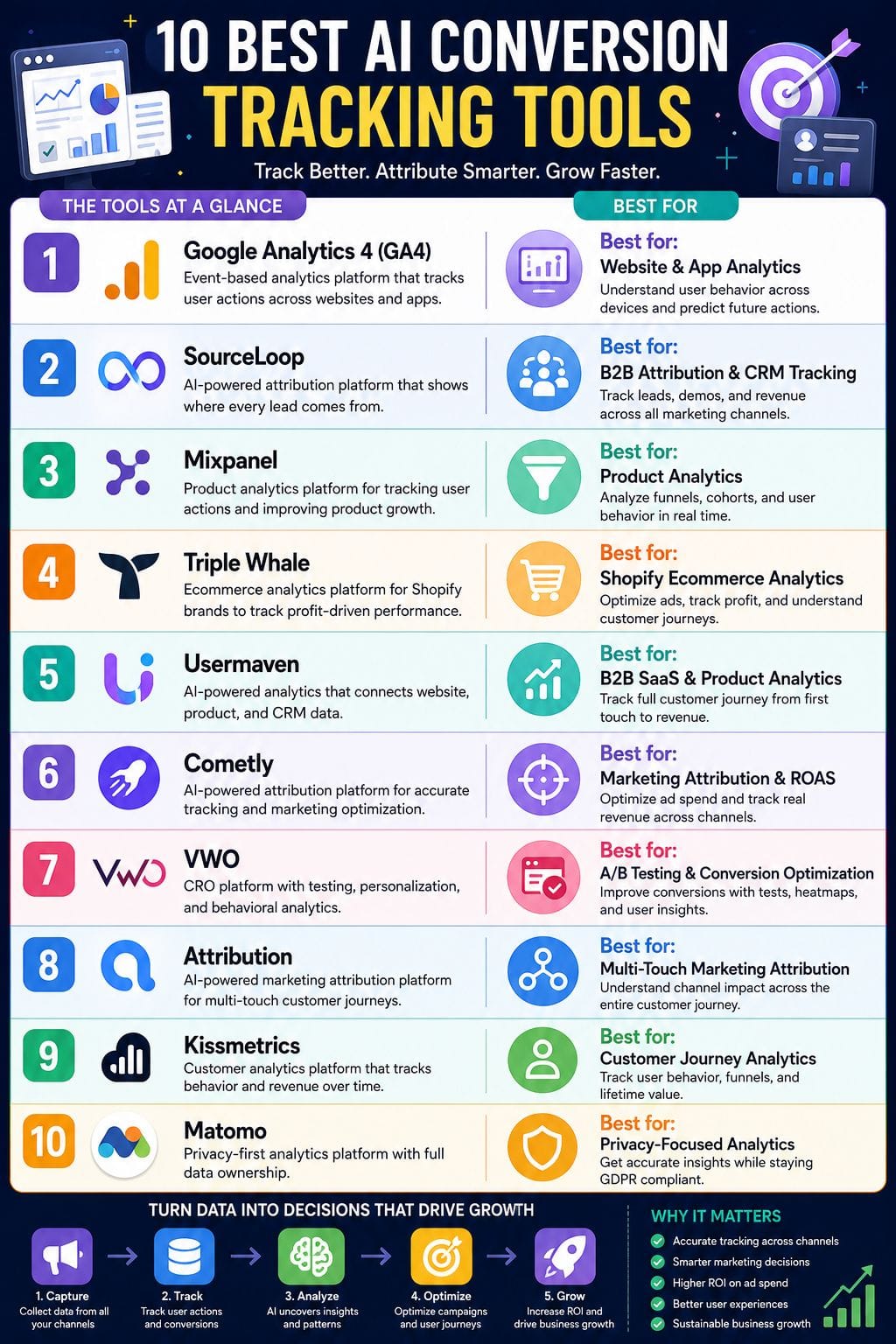
AI Conversion Tracking Tools Comparison
| Tool | Best For | Key Features | Pricing Level | Drawbacks |
|---|---|---|---|---|
| Google Analytics 4 (GA4) | Website & app analytics | Event tracking, AI predictions, cross-device analytics, conversion tracking | Custom (RFP) | Steep learning curve and complex event setup |
| SourceLoop | B2B attribution & CRM tracking | Server-side tracking, CRM attribution, multi-touch journeys, ad integrations | High | Best suited for businesses with established CRM workflows |
| Mixpanel | Product analytics | Funnels, cohorts, real-time events, AI insights, user segmentation | Custom (RFP) | Requires event planning and implementation |
| Triple Whale | Shopify ecommerce analytics | Multi-touch attribution, Triple Pixel, AI assistant, cohort analysis | Premium | Mainly designed for Shopify brands |
| Usermaven | B2B SaaS & product analytics | Auto event capture, AI assistant, funnels, customer journey tracking | Mid | Requires proper event configuration for best results |
| Cometly | Marketing attribution & ROAS tracking | Server-side tracking, CRM integrations, AI optimization, revenue dashboards | Custom (RFP) | Setup can be technical for larger businesses |
| VWO | A/B testing & CRO | Split testing, heatmaps, personalization, AI insights, session recordings | Custom (RFP) | Feature-rich interface may overwhelm beginners |
| Attribution | Multi-touch marketing attribution | Revenue attribution, cross-channel reporting, customer journey analysis | Premium | Requires accurate tagging and tracking setup |
| Kissmetrics | Customer journey analytics | Person-based tracking, funnels, cohorts, revenue attribution | Mid | Reporting interface feels dated |
| Matomo | Privacy-focused analytics | GDPR compliance, AI traffic reports, ecommerce tracking, custom dashboards | Mid | Self-hosted setup requires technical knowledge |
Google Analytics 4 (GA4)
Google Analytics 4 (GA4) is an event-based analytics platform that helps businesses understand how people use their websites and apps. It tracks user actions across devices and uses machine learning to predict future behavior, such as who is likely to make a purchase or stop using a service.
Marketers can set important actions as conversions and use enhanced measurement to automatically track common events. GA4 also offers flexible reports that connect marketing campaigns to revenue instead of just clicks.
Its privacy-first approach and modern data model help businesses maintain reliable tracking as third-party cookies become less common.
Pros
- Event-based model gives granular conversion tracking across every user action
- Built-in AI predictive metrics and audiences support smarter bidding and remarketing
- Strong cross-platform tracking ties web and app journeys into one view
Cons
- Steep learning curve versus Universal Analytics, especially for reports
- Setup for complex custom events often needs technical skills or tag management
Pricing
Request for Pricing (RFP)
SourceLoop
SourceLoop is an AI-powered conversion tracking and attribution platform that shows where every lead comes from. It connects your marketing campaigns, ad spend, and sales pipeline, so you know which channels bring qualified leads, booked demos, and paying customers.
Using server-side tracking and event-level data, it captures conversions that browser limits, missing cookies, and broken UTMs often miss. It also detects tools like Calendly, HubSpot Forms, and popular CRMs to build a complete customer journey.
With clean attribution data and direct integrations with Google, Meta, LinkedIn, and TikTok, SourceLoop helps you optimize campaigns and improve marketing performance.
Pros
- Strong focus on accurate source tracking for B2B leads and pipeline
- Reduces tracking breakage caused by cookies, ad blockers, and redirects
- Makes it easy to connect attribution data directly to CRM lead records
Cons
- Best suited to teams with a clear CRM and lead process; may feel heavy for simple sites
- Value shows most in multi-channel, higher-ticket funnels, not basic one-off purchases
Pricing
| Plan | Pricing |
|---|---|
| Pro | $249/month |
| Enterprise | Custom Pricing |
 Marlene Ann Anthony
Mixpanel
Mixpanel is a product analytics platform that helps businesses understand how people use their websites and mobile apps. It tracks user actions from the first visit to purchase and shows where people stop in the journey.
Teams can build funnels, group users by behavior, and compare the paths that lead to sales or customer loss. AI-powered insights highlight important trends without hours of manual analysis.
Real-time reports help teams improve onboarding, test pricing, refine features, and make better product decisions. This turns user data into clear insights that support growth, higher conversions, and smarter experiments.
Pros
- Strong funnel and cohort analysis for product-led growth
- Real-time event tracking with flexible segmentation
- Built-in experimentation and messaging workflows
Cons
- Event-based setup has a learning curve
- Can be overkill for very small or simple sites
Pricing
Request for Pricing (RFP)
Triple Whale
Triple Whale is an AI-powered ecommerce analytics platform built mainly for Shopify brands. It brings together data from ads, online stores, and marketing tools into one simple dashboard.
The platform tracks customer activity across devices and uses advanced attribution to show which channels, campaigns, and products generate the most profit instead of just clicks. Features like Triple Pixel, multi-touch attribution, cohort analysis, and AI assistants such as Moby and Sonar help businesses understand the full customer journey.
This allows teams to make faster decisions, improve ad performance, spend marketing budgets more wisely, and grow sales with greater confidence.
Pros
- Strong Shopify-native attribution and ecommerce focus
- Real-time, unified view of ad, email, SMS, and store data
- AI assistant (Moby) for insights, alerts, and creative ideas
Cons
- Best suited to Shopify DTC; less ideal for complex, non-Shopify funnels
- Advanced features locked behind higher-priced tiers
Pricing
| Plan | Pricing |
|---|---|
| Foundation | $549/month |
| Automate | $1,349/month |
| Enterprise | Contact Sales |
Usermaven
Usermaven is an AI-powered analytics platform that helps businesses understand what drives real revenue. Instead of only tracking clicks and website visits, it connects website, product, and CRM data to show the full customer journey from the first interaction to a completed sale.
It includes funnel analysis, user journey tracking, and event monitoring to highlight where people drop off and what encourages them to convert. An AI assistant lets you ask questions in plain English and get quick answers.
With privacy-friendly tracking, automatic event capture, and integrations with popular marketing tools, Usermaven makes analytics easier and more useful.
Pros
- Very simple, clean interface compared to complex legacy analytics tools
- Strong focus on B2B SaaS and product-led teams
- AI layer reduces dependence on analysts for day-to-day questions
Cons
- May be more than you need for very small or single-channel sites
- Attribution depth depends on correct event and goal configuration
Pricing
| Plan | Pricing |
|---|---|
| Growth | $84/month |
| Scale | $199/month |
| Enterprise | Contact Sales |
Muskaan Kapoor
Cometly
Cometly is an AI-powered marketing analytics platform that helps businesses understand which ads, campaigns, and channels bring in real revenue. It connects data from ad platforms and your CRM to give a complete view of the customer journey.
Using server-side tracking and multi-touch attribution, it captures conversions that traditional tracking methods often miss. It also sends accurate conversion data back to platforms like Meta and Google, helping their algorithms improve ad performance.
The platform includes AI tools that suggest budget changes and creative improvements. Real-time dashboards and reports make it easy to track ROAS.
Pros
- Multi-touch attribution that maps full customer journeys, not just last click
- Deep integrations with CRMs and ad platforms for closed-loop revenue reporting
- Custom dashboards and reports tuned to ROAS, pipeline, and LTV
Cons
- Setup can feel complex for advanced or multi-system stacks
- Documentation may lag behind feature updates at times
Pricing
Request for Pricing (RFP)
VWO (Visual Website Optimizer)
VWO is a digital experience and conversion optimization platform that helps businesses improve how people use their websites and apps. It combines A/B testing, personalization, behavior analytics, and AI to help teams make better decisions.
You can run A/B, multivariate, split URL, and server-side tests with an easy visual editor. The platform also includes heatmaps, session recordings, scroll maps, form analytics, and funnel tracking to spot user pain points.
Its AI assistant reviews campaign results, highlights issues, suggests new experiments, and summarizes insights. This helps teams optimize faster, improve conversions.
Pros
- All-in-one testing, personalization, and insights stack reduces tool sprawl
- Non-technical teams can launch experiments quickly with visual tools
- AI support speeds up analysis and hypothesis generation
Cons
- Suite depth can feel complex for very small teams or simple sites
- AI features are still evolving, with some in early access phases
Pricing
Request for Pricing (RFP)
Attribution
Attribution is an AI-powered tool that shows which marketing efforts lead to real sales. It connects ad clicks, website visits, and revenue into one simple view. Instead of giving all the credit to the last click, it tracks the full customer journey and shares credit across every key touchpoint.
This helps businesses understand which campaigns, keywords, and creatives bring the most valuable customers, even if they switch devices or return later. It also combines data from ads, search, email, and organic traffic into one dashboard. With real-time, revenue-focused insights, teams can improve bids, budgets, and campaigns with greater confidence.
Pros
- Gives a single source of truth across platforms that often over-report conversions
- Reveals hidden assist channels and touchpoints that last-click models ignore
- Scales in value as traffic, spend, and dataset size increase
Cons
- Needs clean tagging and setup; bad tracking breaks model accuracy
- Advanced, AI-driven models often demand higher volumes and paid tiers
Pricing
| Plan | Pricing |
|---|---|
| Pro Plan | $399/month |
| Enterprise | Contact Sales |
Rinky Moolchandani
Kissmetrics
Kissmetrics is a person-based analytics and conversion tracking platform that helps businesses understand how people move through their products and websites. Instead of tracking only page views, it follows each user across devices and sessions by assigning a unique identity.
This gives teams a clear view of the customer journey from the first visit to a purchase and beyond. It offers event tracking, funnels, cohort analysis, and multi-channel attribution to reveal which campaigns and actions drive signups, sales, and long-term value.
Marketers can also segment users by behavior or traits and launch targeted campaigns based on real customer actions.
Pros
- Strong person-based tracking across visits and devices for clearer customer journeys
- Multi-touch revenue attribution connects marketing spend to MRR, LTV, and retention
- Segmentation and behavioral views help tailor campaigns to precise user groups
Cons
- Interface and reporting UX can feel clunky or unintuitive for some teams
- Built-in visualizations are limited; exports are often needed for deeper analysis
Pricing
| Plan | Pricing |
|---|---|
| Self Serve | $99/month |
| Custom Plan | Contact Sales |
Matomo
Matomo is a privacy-first analytics platform that helps you understand how people find and use your website. It tracks goals, events, ecommerce activity, and conversions across devices and channels.
It also measures traffic from AI assistants and AI agents, making it easier to see how these tools influence signups, sales, and revenue. You can create custom segments, dashboards, and reports to follow users through each stage of the customer journey.
Because Matomo gives you full control of your data and does not rely on sampling, you get accurate insights that support better decisions.
Pros
- Strong goal and ecommerce conversion tracking with flexible custom events.
- Dedicated AI Assistants and AI Agents reports for isolating and attributing AI-driven traffic and conversions.
- 100% data ownership, GDPR compliance, and no data sampling for accurate reporting
Cons
- Setup and self-hosted maintenance can be complex for non-technical teams.
- Some advanced features and cloud hosting sit behind paid tiers
Pricing
| Plan | Pricing |
|---|---|
| Business | INR 1,690/month |
| Enterprise | Contact Sales |
Final Thoughts
AI conversion tracking tools are now the nerve center of smart marketing. They do more than log clicks and page views. They reveal which moments, messages, and paths push people to act.
With machine learning, they find hidden patterns in messy journeys and surface the few levers that truly drive revenue. They help cut waste, sharpen targeting, and prove impact to any skeptic in the room.
In a world of rising costs and shrinking attention, teams that master these tools win more customers, faster, and with far more confidence in every decision they make.
FAQs
What are AI conversion tracking tools?
AI conversion tracking tools use artificial intelligence to monitor customer interactions across websites, apps, ads, and marketing channels. They help businesses identify which campaigns, keywords, and touchpoints generate conversions and revenue.
Why should businesses use AI conversion tracking software?
AI conversion tracking software provides more accurate attribution, uncovers customer behavior patterns, predicts future actions, and helps marketers optimize campaigns for better ROI while reducing wasted ad spend.
How is AI conversion tracking different from traditional analytics?
Traditional analytics mainly reports historical website data such as page views and sessions. AI conversion tracking analyzes the entire customer journey, predicts user behavior, automates insights, and connects marketing efforts directly to revenue.
Which AI conversion tracking tool is best for ecommerce?
For ecommerce businesses, especially Shopify stores, Triple Whale is one of the strongest options because it offers multi-touch attribution, profit tracking, AI insights, and unified marketing dashboards.